
 数据结构
数据结构 网络
网络 关系数据库管理系统 (RDBMS)
 操作系统
操作系统 Java
Java MS Excel
 iOS
iOS HTML
HTML CSS
CSS Android
 Python
 C语言编程
C语言编程 C++
C++ C#
C# MongoDB
 MySQL
MySQL Javascript
 PHP
PHP 物理学
物理学 化学
化学 生物学
生物学 数学
数学 英语
英语 经济学
经济学 心理学
心理学 社会学
社会学 服装学
服装学 法学
法学使用双向链表在任意位置插入节点的C程序
链表使用动态内存分配,是节点的集合。
节点有两个部分:数据和链接。
链表类型
C 编程语言中的链表类型如下:
- 单向链表。
- 双向链表。
- 循环单向链表。
- 循环双向链表。
双向链表
下图显示了双向链表的表示。
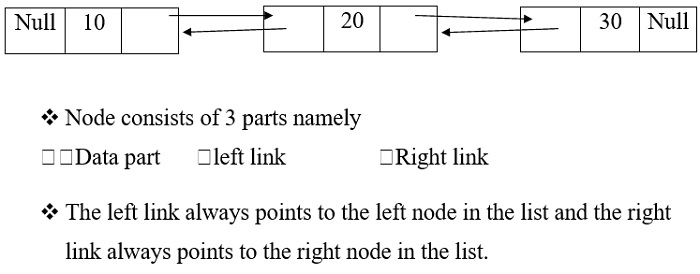
示例
以下是使用双向链表**在任意位置插入节点的 C 程序**:
#include <stdio.h>
#include <stdlib.h>
struct node {
   int num;
   struct node * preptr;
   struct node * nextptr;
}*stnode, *ennode;
void DlListcreation(int n);
void DlLinsertNodeAtBeginning(int num);
void DlLinsertNodeAtEnd(int num);
void DlLinsertNodeAtAny(int num, int pos);
void displayDlList(int a);
int main(){
   int n,num1,a,insPlc;
   stnode = NULL;
   ennode = NULL;
   printf("

 Doubly Linked List : Insert a node at any position :
");
   printf("-----------------------------------------------------------------------------------
");
   printf(" Input the number of nodes : ");
   scanf("%d", &n);
   DlListcreation(n);
   a=1;
   displayDlList(a);
   printf(" Input the position ( 1 to %d ) to insert a new node : ",n+1);
   scanf("%d", &insPlc);
   printf(" Input data for the position %d : ", insPlc);
   scanf("%d", &num1);
   DlLinsertNodeAtAny(num1,insPlc);
   a=2;
   displayDlList(a);
   return 0;
}
void DlListcreation(int n){
   int i, num;
   struct node *fnNode;
   if(n >= 1){
      stnode = (struct node *)malloc(sizeof(struct node));
      if(stnode != NULL){
         printf(" Input data for node 1 : "); // assigning data in the first node
         scanf("%d", &num);
         stnode->num = num;
         stnode->preptr = NULL;
         stnode->nextptr = NULL;
         ennode = stnode;
         for(i=2; i<=n; i++){
            fnNode = (struct node *)malloc(sizeof(struct node));
            if(fnNode != NULL){
               printf(" Input data for node %d : ", i);
               scanf("%d", &num);
               fnNode->num = num;
               fnNode->preptr = ennode;
               fnNode->nextptr = NULL;
               ennode->nextptr = fnNode;
               ennode = fnNode;
            }
            else{
               printf(" Memory can not be allocated.");
               break;
            }
         }
      }
      else{
         printf(" Memory can not be allocated.");
      }
   }
}
void DlLinsertNodeAtAny(int num, int pos){
   int i;
   struct node * newnode, *tmp;
   if(ennode == NULL){
      printf(" No data found in the list!
");
   }
   else{
      tmp = stnode;
      i=1;
      while(i<pos-1 && tmp!=NULL){
         tmp = tmp->nextptr;
         i++;
      }
      if(pos == 1){
         DlLinsertNodeAtBeginning(num);
      }
      else if(tmp == ennode){
         DlLinsertNodeAtEnd(num);
      }
      else if(tmp!=NULL){
         newnode = (struct node *)malloc(sizeof(struct node));
         newnode->num = num;
         newnode->nextptr = tmp->nextptr;
         newnode->preptr = tmp;
         if(tmp->nextptr != NULL){
            tmp->nextptr->preptr = newnode; // n+1th node is linking with new node
         }
         tmp->nextptr = newnode; // n-1th node is linking with new node
      }
      else{
         printf(" The position you entered, is invalid.
");
      }
   }
}
void DlLinsertNodeAtBeginning(int num){
   struct node * newnode;
   if(stnode == NULL){
      printf(" No data found in the list!
");
   }
   else{
      newnode = (struct node *)malloc(sizeof(struct node));
      newnode->num = num;
      newnode->nextptr = stnode;
      newnode->preptr = NULL;
      stnode->preptr = newnode;
      stnode = newnode;
   }
}
void DlLinsertNodeAtEnd(int num){
   struct node * newnode;
   if(ennode == NULL){
      printf(" No data found in the list!
");
   }
   else{
      newnode = (struct node *)malloc(sizeof(struct node));
      newnode->num = num;
      newnode->nextptr = NULL;
      newnode->preptr = ennode;
      ennode->nextptr = newnode;
      ennode = newnode;
   }
}
void displayDlList(int m){
   struct node * tmp;
   int n = 1;
   if(stnode == NULL) {
      printf(" No data found in the List yet.");
   }
   else{
      tmp = stnode;
      if (m==1) {
         printf("
 Data entered in the list are :
");
      }
      else{
         printf("
 After insertion the new list are :
");
      }
      while(tmp != NULL){
         printf(" node %d : %d
", n, tmp->num);
         n++;
         tmp = tmp->nextptr; // current pointer moves to the next node
      }
   }
}
输出
执行上述程序后,会产生以下结果:
Doubly Linked List : Insert node at any position:
-----------------------------------------------------------------------------------
Input the number of nodes : 5
Input data for node 1 : 23
Input data for node 2 : 12
Input data for node 3 : 11
Input data for node 4 : 34
Input data for node 5 : 10

Data entered in the list are :
node 1 : 23
node 2 : 12
node 3 : 11
node 4 : 34
node 5 : 10
Input the position ( 1 to 6 ) to insert a new node : 5
Input data for the position 5 : 78

After insertion the new list are :
node 1 : 23
node 2 : 12
node 3 : 11
node 4 : 34
node 5 : 78
node 6 : 10

更新于:2021年9月3日
2K+ 次浏览

广告