
 数据结构
数据结构 网络
网络 关系数据库管理系统
 操作系统
操作系统 Java
Java MS Excel
 iOS
iOS HTML
HTML CSS
CSS Android
 Python
 C语言编程
C语言编程 C++
C++ C#
C# MongoDB
 MySQL
MySQL Javascript
 PHP
PHP 物理学
物理学 化学
化学 生物学
生物学 数学
数学 英语
英语 经济学
经济学 心理学
心理学 社会学
社会学 时尚研究
时尚研究 法律研究
法律研究Python程序:找出国际象棋棋子到达棋盘上每个位置的最少步数
假设我们有一个棋盘和一个特殊的骑士棋子 K,它在棋盘内以 L 形移动。如果棋子位于 (x1, y1) 位置,并且移动到 (x2, y2) 位置,则移动可以描述为 x2 = x1 ± a ; y2 = y1 ± b 或 x2 = x1 ± b ; y2 = y1 ± a ; 其中 a 和 b 是整数。我们需要找出该棋子从 (0, 0) 位置到达棋盘上 (n-1, n-1) 位置的最少步数。如果某个位置不可到达,则标记为 -1,否则返回步数。我们将打印 n – 1 行输出,其中每行 i 将包含 n − 1 个整数,描述棋子为每个 j 移动所需的最小步数。
因此,如果输入为 n = 6,则输出将为
5  4  3  2  5
4 -1  2 -1 -1
3  2 -1 -1 -1
2 -1 -1 -1 -1
5 -1 -1 -1  1
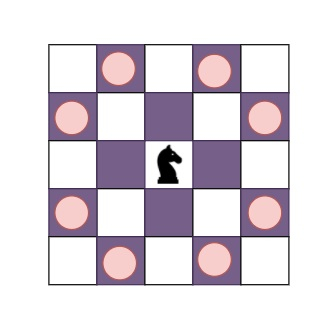
如果棋子位于 5x5 棋盘上的 (3, 3) 位置,则骑士可能的移动。
第一行输出包含棋子到达 (1,1) 到 (1,5) 位置所需的最小步数。后续行类似地描述每个相应 I 和 j 值的最小步数。
为了解决这个问题,我们将遵循以下步骤 -
定义一个函数 path_search() 。它将接收 i、j、n 作为参数。
temp_list := 初始化为 (-1, -1) 对的新映射。
queue_positional := 初始化为 (0, 0) 对的新列表。
ver := [(i, j) ,(-i, j) ,(i, -j) ,(-i, -j) ,(j, i) ,(j, -i) ,(-j, i) ,(-j, -i) ]
当 queue_positional 的大小 > 0 时,执行以下操作:
current_element := 从 queue_positional 中删除第一个元素。
对于 ver 中的每个元素,执行以下操作:
x := element[0] + current_element[0]
y := element[1] + current_element[1]
如果 -1 < x < n 且 -1 < y < n 并且 temp_list[x, y] 与 (-1, -1) 相同,则:
temp_list[x, y] := current_element
在 queue_positional 的末尾插入 (x, y) 对。
如果 x 与 n - 1 相同且 y 与 n - 1 相同,则:
count_var := 1
当 temp_list[x,y] 与 (0, 0) 不相同 时,执行以下操作:
count_var := count_var + 1
x, y := temp_list[x,y]
返回 count_var。
返回 -1。
从主函数/方法中执行以下操作 -
board := 初始化为 -1 的新映射。
对于范围 1 到 n 的 i,执行以下操作:
对于范围 1 到 i 的 j,执行以下操作:
如果 board[i, j] 与 -1 相同,则:
board[i, j] := path_search(i, j, n)
board[j, i] := board[i, j]
如果 (n - 1) mod i 与 0 相同,则:
board[i, i] :=(n - 1) / i
对于范围 1 到 n 的 i,执行以下操作:
对于范围 1 到 n - 1 的 j,执行以下操作:
打印 board[i, j]
打印 board[i, n - 1]
源代码 (Python)
让我们看看以下实现以更好地理解 -
from collections import defaultdict
def path_search(i, j, n):
   temp_list = defaultdict(lambda: (-1,-1))
   queue_positional = [(0, 0)]
   ver = [(i, j), (-i, j), (i, -j), (-i, -j), (j, i), (j, -i), (-j, i), (-j, -i)]
   while len(queue_positional) > 0:
      current_element = queue_positional.pop(0)
      for element in ver:
         x = element[0] + current_element[0]
         y = element[1] + current_element[1]
         if -1 < x < n and -1 < y < n and temp_list[x, y] == (-1,-1):
            temp_list[x, y] = current_element
            queue_positional.append((x, y))
            if x == n - 1 and y == n - 1:
               count_var = 1
               while temp_list[x,y]!=(0,0):
                  count_var += 1
                  x, y = temp_list[x,y]
               return count_var
   return -1

def solve(n):
   board = defaultdict(lambda: -1)
   for i in range(1, n):
      for j in range(1, i):
         if board[i, j] == -1:
            board[i, j] = path_search(i, j, n)
            board[j, i] = board[i, j]
      if (n - 1) % i == 0:
         board[i, i] = (n - 1) / i

   for i in range(1, n):
      for j in range(1, n - 1):
         print(int(board[i, j]), end = ' ')
   print(int(board[i, n - 1]))

solve(6)
输入
6
输出
5  4  3  2  5
4 -1  2 -1 -1
3  2 -1 -1 -1
2 -1 -1 -1 -1
5 -1 -1 -1  1

530 次查看
