
 数据结构
数据结构 网络
网络 RDBMS
RDBMS 操作系统
操作系统 Java
Java Microsoft Excel
 iOS
iOS HTML
HTML CSS
CSS Android
 Python
 C 编程
C 编程 C++
C++ C#
C# MongoDB
 MySQL
MySQL Javascript
 PHP
PHP 物理学
物理学 化学
化学 生物学
生物学 数学
数学 英语
英语 经济学
经济学 心理学
心理学 社会研究
社会研究 时装研究
时装研究 法律研究
法律研究如何在 Android 后台服务中侦听音量按钮?
本示例演示如何使用 Android 后台服务侦听音量按钮。
步骤 1 − 在 Android Studio 中创建一个新项目,转至“文件 ⇒ 新建项目”,并填入所有必需的详细信息以创建一个新项目。
步骤 2 − 将以下代码添加到 res/layout/activity_main.xml。
<?xml version="1.0" encoding="utf-8"?>
<LinearLayout xmlns:android="http://schemas.android.com/apk/res/android"
   xmlns:tools="http://schemas.android.com/tools"
   android:layout_width="match_parent"
   android:layout_height="match_parent"
   android:orientation="vertical"
   android:padding="16sp"
   tools:context=".MainActivity">
<TextView
   android:layout_width="wrap_content"
   android:layout_height="wrap_content"
   android:layout_marginTop="30dp"
   android:text="Increase and decrease Volume"
   android:textSize="24sp"
   android:textStyle="bold" />
</LinearLayout>
步骤 3 − 将以下代码添加到 src/MainActivity.java
import androidx.appcompat.app.AppCompatActivity;
import android.content.Context;
import android.database.ContentObserver;
import android.media.AudioManager;
import android.os.Bundle;
import android.os.Handler;
import android.widget.Toast;
import java.util.Objects;
public class MainActivity extends AppCompatActivity {
   SettingsContentObserver settingsContentObserver;
   @Override
   protected void onCreate(Bundle savedInstanceState) {
      super.onCreate(savedInstanceState);
      setContentView(R.layout.activity_main);
      settingsContentObserver = new SettingsContentObserver(this, new Handler());

                  getApplicationContext().getContentResolver().registerContentObserver(android.provider.Settings.System.
      CONTENT_URI, true, settingsContentObserver);
   }
   public class SettingsContentObserver extends ContentObserver {
      int previousVolume;
      Context context;
      SettingsContentObserver(Context c, Handler handler) {
         super(handler);
         context = c;
         AudioManager audio = (AudioManager) context.getSystemService(Context.AUDIO_SERVICE);
         previousVolume =
         Objects.requireNonNull(audio).getStreamVolume(AudioManager.STREAM_MUSIC);
      }
      @Override
      public boolean deliverSelfNotifications() {
         return super.deliverSelfNotifications();
      }
      @Override
      public void onChange(boolean selfChange) {
         super.onChange(selfChange);
         AudioManager audio = (AudioManager) context.getSystemService(Context.AUDIO_SERVICE);
         int currentVolume =
         Objects.requireNonNull(audio).getStreamVolume(AudioManager.STREAM_MUSIC);
         int delta = previousVolume - currentVolume;
         if (delta > 0) {
            Toast.makeText(MainActivity.this, "Volume Decreased", Toast.LENGTH_SHORT).show();
            previousVolume = currentVolume;
         }
          else if (delta < 0) {
            Toast.makeText(MainActivity.this, "Volume Increased", Toast.LENGTH_SHORT).show();
            previousVolume = currentVolume;
         }
      }
   }
   @Override
   protected void onDestroy() {
         getApplicationContext().getContentResolver().unregisterContentObserver(settingsContentObserver);
super.onDestroy();
   }
}
步骤 4 − 将以下代码添加到 androidManifest.xml
<?xml version="1.0" encoding="utf-8"?>
<manifest xmlns:android="http://schemas.android.com/apk/res/android"
   package="app.com.sample">
   <application
      android:allowBackup="true"
      android:icon="@mipmap/ic_launcher"
      android:label="@string/app_name"
      android:roundIcon="@mipmap/ic_launcher_round"
      android:supportsRtl="true"
      android:theme="@style/AppTheme">
      <activity android:name=".MainActivity">
         <intent-filter>
            <action android:name="android.intent.action.MAIN" />
            <category android:name="android.intent.category.LAUNCHER" />
         </intent-filter>
   </activity>
</application>
</manifest>
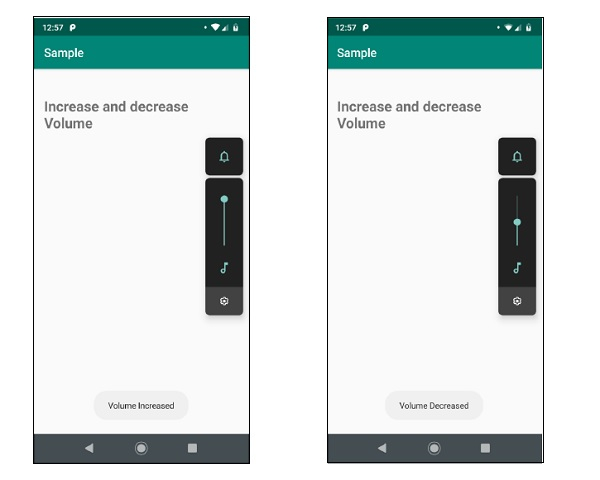
我们来尝试运行你的应用程序。我想你已经将你实际的 Android 移动设备与你的电脑连接起来了。要从 Android Studio 运行该应用,请打开其中一个项目的活动文件并单击工具栏中的运行  图标。选择你的移动设备作为选项,然后检查你的移动设备,它会显示你的默认屏幕 −

更新时间:07-Jul-2020
2K+浏览

广告