
 数据结构
数据结构 网络
网络 关系数据库管理系统 (RDBMS)
 操作系统
操作系统 Java
Java Microsoft Excel
 iOS
iOS HTML
HTML CSS
CSS Android
 Python
 C语言编程
C语言编程 C++
C++ C#
C# MongoDB
 MySQL
MySQL Javascript
 PHP
PHP 物理学
物理学 化学
化学 生物学
生物学 数学
数学 英语
英语 经济学
经济学 心理学
心理学 社会学
社会学 服装设计
服装设计 法学
法学使用链表实现优先队列 (C语言)
给定数据和优先级(整数),任务是根据给定的优先级创建一个链表并显示结果。
队列是一种先进先出 (FIFO) 数据结构,其中最先插入的元素也是最先被删除的元素。优先队列是一种队列,其中元素的插入和删除取决于优先级。它可以使用队列、栈或链表数据结构来实现。优先队列的实现遵循以下规则:
- 具有最高优先级的数 据或元素将优先于具有最低优先级的数 据或元素执行。
- 如果两个元素具有相同的优先级,则它们将按照添加到列表中的顺序执行。
用于实现优先队列的链表节点将包含三个部分:
- 数据 - 它将存储整数值。
- 地址 - 它将存储下一个节点的地址。
- 优先级 - 它将存储优先级,这是一个整数值。它的范围可以是 0-10,其中 0 代表最高优先级,10 代表最低优先级。
示例
输入
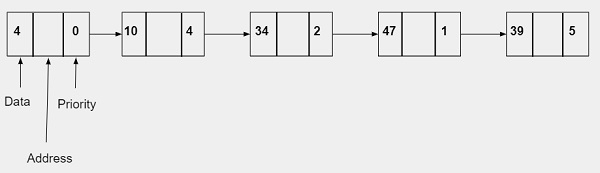
输出

算法
Start
Step 1-> Declare a struct node
   Declare data, priority
   Declare a struct node* next
Step 2-> In function Node* newNode(int d, int p)
   Set Node* temp = (Node*)malloc(sizeof(Node))
   Set temp->data = d
   Set temp->priority = p
   Set temp->next = NULL
   Return temp
Step 3-> In function int peek(Node** head)
   return (*head)->data
Step 4-> In function void pop(Node** head)
   Set Node* temp = *head
   Set (*head) = (*head)->next
   free(temp)
Step 5-> In function push(Node** head, int d, int p)
   Set Node* start = (*head)
   Set Node* temp = newNode(d, p)
   If (*head)->priority > p then,
      Set temp->next = *head
      Set (*head) = temp
   Else
   Loop While start->next != NULL && start->next->priority < p
      Set start = start->next
      Set temp->next = start->next
      Set start->next = temp
Step 6-> In function int isEmpty(Node** head)
   Return (*head) == NULL
Step 7-> In function int main()
   Set Node* pq = newNode(7, 1)
   Call function push(&pq, 1, 2)
   Call function push(&pq, 3, 3)
   Call function push(&pq, 2, 0)
   Loop While (!isEmpty(&pq))
   Print the results obtained from peek(&pq)
   Call function pop(&pq)
Stop
示例
#include <stdio.h>
#include <stdlib.h>
// priority Node
typedef struct node {
   int data;
   int priority;
   struct node* next;
} Node;
Node* newNode(int d, int p) {
   Node* temp = (Node*)malloc(sizeof(Node));
   temp->data = d;
   temp->priority = p;
   temp->next = NULL;
   return temp;
}
int peek(Node** head) {
   return (*head)->data;
}
void pop(Node** head) {
   Node* temp = *head;
   (*head) = (*head)->next;
   free(temp);
}
void push(Node** head, int d, int p) {
   Node* start = (*head);
   Node* temp = newNode(d, p);
   if ((*head)->priority > p) {
      temp->next = *head;
      (*head) = temp;
   } else {
      while (start->next != NULL &&
      start->next->priority < p) {
         start = start->next;
      }
      // Either at the ends of the list
      // or at required position
      temp->next = start->next;
      start->next = temp;
   }
}
// Function to check the queue is empty
int isEmpty(Node** head) {
   return (*head) == NULL;
}
// main function
int main() {
   Node* pq = newNode(7, 1);
   push(&pq, 1, 2);
   push(&pq, 3, 3);
   push(&pq, 2, 0);
   while (!isEmpty(&pq)) {
      printf("%d ", peek(&pq));
      pop(&pq);
   }
   return 0;
}
输出
2 7 1 3

更新于:2019年12月23日
4K+ 浏览量

广告