
 数据结构
数据结构 网络
网络 关系数据库管理系统
 操作系统
操作系统 Java
Java MS Excel
 iOS
iOS HTML
HTML CSS
CSS Android
 Python
 C 语言编程
 C++
C++ C#
C# MongoDB
 MySQL
MySQL Javascript
 PHP
PHP 物理学
物理学 化学
化学 生物学
生物学 数学
数学 英语
英语 经济学
经济学 心理学
心理学 社会学
社会学 时尚学
时尚学 法律学
法律学C 语言实现循环调度算法
给定 n 个进程及其对应的突发时间和时间片,任务是找到平均等待时间和平均周转时间并显示结果。
什么是循环调度算法?
循环调度是一种 CPU 调度算法,专门为分时系统设计。它类似于先来先服务 (FCFS) 调度算法,但有一点不同:在循环调度中,进程会受到时间片大小的限制。一个时间单位称为时间片或时间量子。时间片可以从 10 到 100 毫秒不等。CPU 将就绪队列视为一个循环队列,以给定的时间片执行进程。它遵循抢占式方法,因为会为进程分配固定时间。它的唯一缺点是上下文切换的开销。
我们需要计算什么?
**完成时间**是进程完成执行所需的时间。
**周转时间**是进程提交到完成之间的时间间隔。
周转时间 = 进程完成时间 – 进程提交时间
等待时间是周转时间和突发时间之间的差值。
等待时间 = 周转时间 – 突发时间
示例
给定 3 个进程 P1、P2 和 P3,其对应的突发时间分别为 24、3 和 3。
| 进程 | 突发时间 |
|---|---|
| P1 | 24 |
| P2 | 3 |
| P3 | 3 |
由于时间片为 4 毫秒,进程 P1 获得前 4 毫秒,但它还需要另外 20 毫秒才能完成执行,但 CPU 将在第一个时间片后抢占它,并将 CPU 分配给下一个进程 P2。如表所示,进程 P2 仅需 3 毫秒即可完成执行,因此 CPU 将仅分配 3 毫秒的时间片,而不是 4 毫秒。

使用甘特图,平均等待时间计算如下:
平均等待时间 = 17/3 = 5.66 毫秒
算法
Start
Step 1-> In function int turnarroundtime(int processes[], int n, int bt[], int wt[], int tat[])
   Loop For i = 0 and i < n and i++
      Set tat[i] = bt[i] + wt[i]
   return 1
Step 2-> In function int waitingtime(int processes[], int n, int bt[], int wt[], int quantum)
Declare rem_bt[n]
   Loop For i = 0 and i < n and i++
      Set rem_bt[i] = bt[i]
      Set t = 0
   Loop While (1)
      Set done = true
   Loop For i = 0 and i < n and i++
      If rem_bt[i] > 0 then,
         Set done = false
      If rem_bt[i] > quantum then,
         Set t = t + quantum
         Set rem_bt[i] = rem_bt[i] - quantum
      Else
         Set t = t + rem_bt[i]
         Set wt[i] = t - bt[i]
         Set rem_bt[i] = 0
      If done == true then,
   Break
Step 3->In function int findavgTime(int processes[], int n, int bt[], int quantum)
   Declare and initialize wt[n], tat[n], total_wt = 0, total_tat = 0
   Call function waitingtime(processes, n, bt, wt, quantum)
   Call function turnarroundtime(processes, n, bt, wt, tat)
   Print "Processes Burst Time Waiting Time turnaround time "
   Loop For i=0 and i<n and i++
   Set total_wt = total_wt + wt[i]
   Set total_tat = total_tat + tat[i]
   Print the value i+1, bt[i], wt[i], tat[i]
   Print "Average waiting time = total_wt / n
   Print "Average turnaround time =total_tat / n
Step 4-> In function int main()
   Delcare and initialize processes[] = { 1, 2, 3}
   Declare and initialize n = sizeof processes / sizeof processes[0]
   Declare and initialize burst_time[] = {8, 6, 12}
   Set quantum = 2
   Call function findavgTime(processes, n, burst_time, quantum)
示例
#include <stdio.h>
// Function to calculate turn around time
int turnarroundtime(int processes[], int n,
int bt[], int wt[], int tat[]) {
   // calculating turnaround time by adding
   // bt[i] + wt[i]
   for (int i = 0; i < n ; i++)
   tat[i] = bt[i] + wt[i];
   return 1;
}
// Function to find the waiting time for all
// processes
int waitingtime(int processes[], int n,
int bt[], int wt[], int quantum) {
   // Make a copy of burst times bt[] to store remaining
   // burst times.
   int rem_bt[n];
   for (int i = 0 ; i < n ; i++)
   rem_bt[i] = bt[i];
   int t = 0; // Current time
   // Keep traversing processes in round robin manner
   // until all of them are not done.
   while (1) {
      bool done = true;
      // Traverse all processes one by one repeatedly
      for (int i = 0 ; i < n; i++) {
         // If burst time of a process is greater than 0
         // then only need to process further
         if (rem_bt[i] > 0) {
            done = false; // There is a pending process
            if (rem_bt[i] > quantum) {
               // Increase the value of t i.e. shows
               // how much time a process has been processed
               t += quantum;
               // Decrease the burst_time of current process
               // by quantum
               rem_bt[i] -= quantum;
            }
            // If burst time is smaller than or equal to
            // quantum. Last cycle for this process
            else {
               // Increase the value of t i.e. shows
               // how much time a process has been processed
               t = t + rem_bt[i];
               // Waiting time is current time minus time
               // used by this process
               wt[i] = t - bt[i];
               // As the process gets fully executed
               // make its remaining burst time = 0
               rem_bt[i] = 0;
            }
         }
      }
      // If all processes are done
      if (done == true)
         break;
   }
   return 1;
}
// Function to calculate average time
int findavgTime(int processes[], int n, int bt[],
int quantum) {
   int wt[n], tat[n], total_wt = 0, total_tat = 0;
   // Function to find waiting time of all processes
   waitingtime(processes, n, bt, wt, quantum);
   // Function to find turn around time for all processes
   turnarroundtime(processes, n, bt, wt, tat);
   // Display processes along with all details
   printf("Processes Burst Time Waiting Time turnaround time
");
   // Calculate total waiting time and total turn
   // around time
   for (int i=0; i<n; i++) {
      total_wt = total_wt + wt[i];
      total_tat = total_tat + tat[i];
      printf("\t%d\t\t\t%d\t\t\t%d\t\t\t%d
",i+1, bt[i], wt[i], tat[i]);
   }
   printf("Average waiting time = %f", (float)total_wt / (float)n);
   printf("
Average turnaround time = %f
", (float)total_tat / (float)n);
   return 1;
}
// main function
int main() {
   // process id's
   int processes[] = { 1, 2, 3};
   int n = sizeof processes / sizeof processes[0];
   // Burst time of all processes
   int burst_time[] = {8, 6, 12};
   // Time quantum
   int quantum = 2;
   findavgTime(processes, n, burst_time, quantum);
   return 0;
}
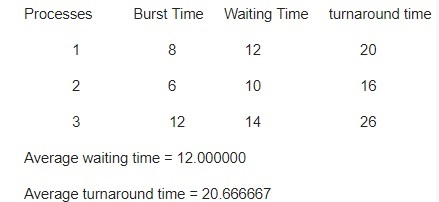
输出

更新于: 2019-12-23
8K+ 浏览量

广告