
 数据结构
数据结构 网络
网络 关系数据库管理系统 (RDBMS)
 操作系统
操作系统 Java
Java MS Excel
 iOS
iOS HTML
HTML CSS
CSS Android
 Python
 C语言编程
C语言编程 C++
C++ C#
C# MongoDB
 MySQL
MySQL Javascript
 PHP
PHP 物理学
物理学 化学
化学 生物学
生物学 数学
数学 英语
英语 经济学
经济学 心理学
心理学 社会学
社会学 服装学
服装学 法学
法学Python中的数据分析和可视化?
Python提供了许多用于数据分析和可视化的库,主要包括numpy、pandas、matplotlib、seaborn等。在本节中,我们将讨论pandas库用于数据分析和可视化,它是一个基于numpy构建的开源库。
它允许我们进行快速分析以及数据清洗和准备。Pandas还提供了许多内置的可视化功能,我们将在下面看到。
安装
要安装pandas,请在终端中运行以下命令:
pipinstall pandas
或者如果您有anaconda,您可以使用
condainstall pandas
Pandas-DataFrame
当我们使用pandas时,DataFrame是主要的工具。
代码:
import numpy as np
import pandas as pd
from numpy.random import randn
np.random.seed(50)
df = pd.DataFrame(randn(6,4), ['a','b','c','d','e','f'],['w','x','y','z'])
df
输出
| w | x | y | z | |
|---|---|---|---|---|
| a | -1.560352 | -0.030978 | -0.620928 | -1.464580 |
| b | 1.411946 | -0.476732 | -0.780469 | 1.070268 |
| c | -1.282293 | -1.327479 | 0.126338 | 0.862194 |
| d | 0.696737 | -0.334565 | -0.997526 | 1.598908 |
| e | 3.314075 | 0.987770 | 0.123866 | 0.742785 |
| f | -0.393956 | 0.148116 | -0.412234 | -0.160715 |
Pandas-缺失数据
我们将看到一些方便的方法来处理pandas中的缺失数据,这些数据会自动填充为零或NaN。
import numpy as np
import pandas as pd
from numpy.random import randn
d = {'A': [1,2,np.nan], 'B': [9, np.nan, np.nan], 'C': [1,4,9]}
df = pd.DataFrame(d)
df
输出
| A | B | C | |
|---|---|---|---|
| 0 | 1.0 | 9.0 | 1 |
| 1 | 2.0 | NaN | 4 |
| 2 | NaN | NaN | 9 |
因此,我们上面有3个缺失值。
df.dropna()
| A | B | C | |
|---|---|---|---|
| 0 | 1.0 | 9.0 | 1 |
df.dropna(axis = 1)
| C | |
|---|---|
| 0 | 1 |
| 1 | 4 |
| 2 | 9 |
df.dropna(thresh = 2)
| A | B | C | |
|---|---|---|---|
| 0 | 1.0 | 9.0 | 1 |
| 1 | 2.0 | NaN | 4 |
df.fillna(value = df.mean())
| A | B | C | |
|---|---|---|---|
| 0 | 1.0 | 9.0 | 1 |
| 1 | 2.0 | 9.0 | 4 |
| 2 | 1.5 | 9.0 | 9 |
Pandas-导入数据
我们将读取csv文件,该文件存储在我的本地机器上(在我的例子中),或者我们可以直接从网上获取。
#import pandas library
import pandas as pd

#Read csv file and assigned it to dataframe variable
df = pd.read_csv("SYB61_T03_Population Growth Rates in Urban areas and Capital cities.csv",encoding = "ISO-8859-1")

#Read first five element from the dataframe
df.head()
输出
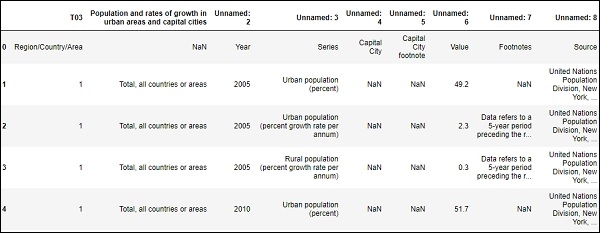
读取DataFrame或csv文件中行数和列数。
#Countthe number of rows and columns in our dataframe.
df.shape
输出
(4166,9)
Pandas-DataFrame数学运算
可以使用pandas的各种统计工具对DataFrame进行运算。
#To computes various summary statistics, excluding NaN values
df.describe()
输出

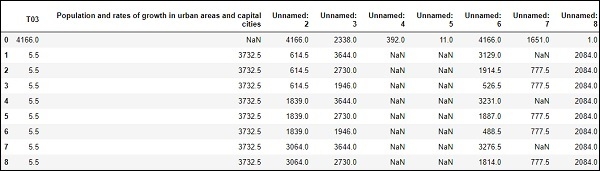
# computes numerical data ranks
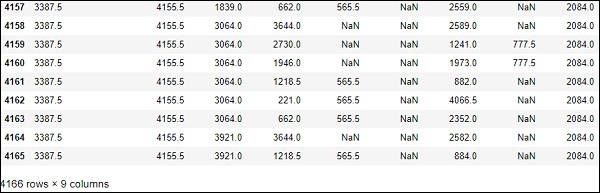
df.rank()
输出
.....
.....
Pandas-绘制图表
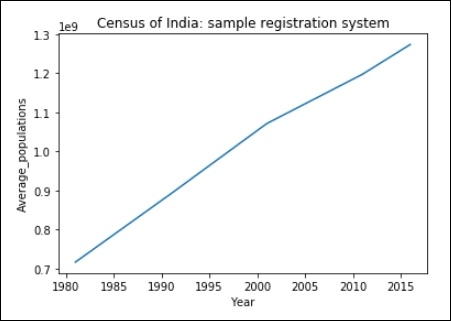
import matplotlib.pyplot as plt
years = [1981, 1991, 2001, 2011, 2016]

Average_populations = [716493000, 891910000, 1071374000, 1197658000, 1273986000]

plt.plot(years, Average_populations)
plt.title("Census of India: sample registration system")
plt.xlabel("Year")
plt.ylabel("Average_populations")
plt.show()
输出
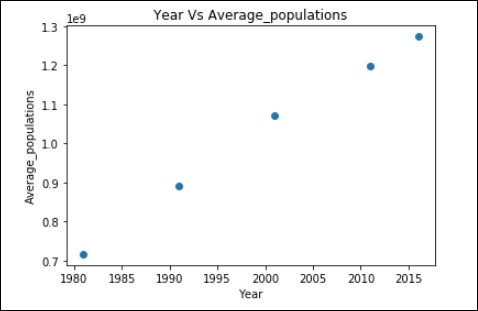
上述数据的散点图
plt.scatter(years,Average_populations)
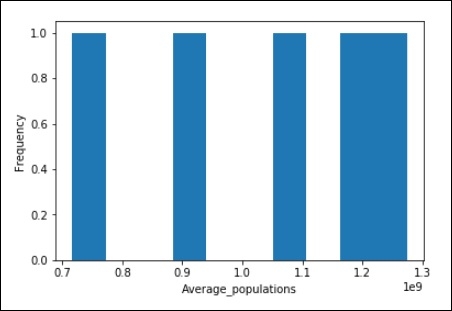
直方图
import matplotlib.pyplot as plt

Average_populations = [716493000, 891910000, 1071374000, 1197658000, 1273986000]

plt.hist(Average_populations, bins = 10)
plt.xlabel("Average_populations")
plt.ylabel("Frequency")

plt.show()
输出

更新于:2019年7月30日
1K+ 浏览量

广告