
 数据结构
数据结构 网络
网络 关系型数据库管理系统
 操作系统
操作系统 Java
Java MS Excel
 iOS
iOS HTML
HTML CSS
CSS Android
 Python
 C语言编程
C语言编程 C++
C++ C#
C# MongoDB
 MySQL
MySQL Javascript
 PHP
PHP 物理学
物理学 化学
化学 生物学
生物学 数学
数学 英语
英语 经济学
经济学 心理学
心理学 社会学
社会学 时尚研究
时尚研究 法律研究
法律研究如何创建一个Dalvik不会杀死的Android服务?
在进入示例之前,我们应该了解Android中的服务是什么。服务将在后台运行而无需与UI交互,即使活动销毁后它也能继续工作。
此示例演示了如何创建一个Dalvik不会杀死的Android服务。
步骤 1 - 在Android Studio中创建一个新项目,转到文件⇒新建项目,并填写所有必要的信息以创建新项目。
步骤 2 - 将以下代码添加到res/layout/activity_main.xml中。
<?xml version = "1.0" encoding = "utf-8"?>
<android.support.constraint.ConstraintLayout xmlns:android = "http://schemas.android.com/apk/res/android"
   xmlns:app = "http://schemas.android.com/apk/res-auto"
   xmlns:tools = "http://schemas.android.com/tools"
   android:layout_width = "match_parent"
   android:layout_height = "match_parent"
   tools:context = ".MainActivity">
   <TextView
      android:id = "@+id/text"
      android:layout_width = "wrap_content"
      android:layout_height = "wrap_content"
      android:text = "Start Service"
      android:textSize = "25sp"
      app:layout_constraintBottom_toBottomOf = "parent"
      app:layout_constraintLeft_toLeftOf = "parent"
      app:layout_constraintRight_toRightOf = "parent"
      app:layout_constraintTop_toTopOf = "parent" />
</android.support.constraint.ConstraintLayout>
在上面的代码中,我们使用了TextView,当用户点击TextView时,它将启动和停止服务。
步骤 3 - 将以下代码添加到src/MainActivity.java中
package com.example.andy.myapplication;
import android.app.ActivityManager;
import android.content.Context;
import android.content.Intent;
import android.support.v7.app.AppCompatActivity;
import android.os.Bundle;
import android.util.Log;
import android.view.View;
import android.widget.TextView;
public class MainActivity extends AppCompatActivity {
   @Override
   protected void onCreate(Bundle savedInstanceState) {
      super.onCreate(savedInstanceState);
      setContentView(R.layout.activity_main);
      final TextView text = findViewById(R.id.text);
      text.setOnClickListener(new View.OnClickListener() {
         @Override
         public void onClick(View v) {
            if (isMyServiceRunning(service.class)) {
               text.setText("Stoped");
               stopService(new Intent(MainActivity.this, service.class));
            } else {
               text.setText("Started");
               startService(new Intent(MainActivity.this, service.class));
            }
         }
      });
   }
   private boolean isMyServiceRunning(Class<?> serviceClass) {
      ActivityManager manager = (ActivityManager) getSystemService(Context.ACTIVITY_SERVICE);
      for (ActivityManager.RunningServiceInfo service : manager.getRunningServices(Integer.MAX_VALUE)) {
         if (serviceClass.getName().equals(service.service.getClassName())) {
            return true;
         }
      }
      return false;
   }
}
在上面的代码中,启动和停止服务。我们使用了Intent并传递了上下文和服务类。现在在包文件夹中创建一个服务类,如service.class,并添加以下代码 -
package com.example.andy.myapplication;
import android.annotation.SuppressLint;
import android.annotation.TargetApi;
import android.app.Notification;
import android.app.NotificationChannel;
import android.app.NotificationManager;
import android.app.PendingIntent;
import android.app.Service;
import android.content.Context;
import android.content.Intent;
import android.graphics.Color;
import android.media.MediaPlayer;
import android.os.Build;
import android.os.IBinder;
import android.os.PowerManager;
import android.support.annotation.RequiresApi;
import android.support.v4.app.NotificationCompat;
import android.util.Log;
import android.widget.Toast;
public class service extends Service {
   PowerManager pm;
   @SuppressLint("InvalidWakeLockTag")
   PowerManager.WakeLock wl;
   @Override
   public IBinder onBind(Intent intent) {
      return null;
   }
   @SuppressLint("InvalidWakeLockTag")
   @Override
   public void onCreate() {
      super.onCreate();
      pm = (PowerManager) getSystemService(Context.POWER_SERVICE);
      wl = pm.newWakeLock(PowerManager.SCREEN_DIM_WAKE_LOCK, "My Tag");
   }
   @TargetApi(Build.VERSION_CODES.O)
   @RequiresApi(api = Build.VERSION_CODES.JELLY_BEAN)
   @Override
   public int onStartCommand(Intent intent, int flags, int startId) {
      wl.acquire();
      //Do some task
      Toast.makeText(this, "Notification Service started by user.", Toast.LENGTH_LONG).show();
      return START_STICKY;
   }
   @RequiresApi(api = Build.VERSION_CODES.N)
   @Override
   public void onDestroy() {
      super.onDestroy();
      wl.release();
      Toast.makeText(this, "Notification Service destroyed by user.", Toast.LENGTH_LONG).show();
   }
}
在上面的代码中,我们调用了电源管理器来停止屏幕锁定,因此Android线程不会停止服务线程,如下所示 -
@SuppressLint("InvalidWakeLockTag")
@Override
public void onCreate() {
   super.onCreate();
   pm = (PowerManager) getSystemService(Context.POWER_SERVICE);
   wl = pm.newWakeLock(PowerManager.SCREEN_DIM_WAKE_LOCK, "My Tag");
}
@TargetApi(Build.VERSION_CODES.O)
@RequiresApi(api = Build.VERSION_CODES.JELLY_BEAN)
@Override
public int onStartCommand(Intent intent, int flags, int startId) {
   wl.acquire();
   //Do some task
   Toast.makeText(this, "Notification Service started by user.", Toast.LENGTH_LONG).show();
   return START_STICKY;
}
@RequiresApi(api = Build.VERSION_CODES.N)
@Override
public void onDestroy() {
   super.onDestroy();
   wl.release();
   Toast.makeText(this, "Notification Service destroyed by user.", Toast.LENGTH_LONG).show();
}
步骤 4 - 将以下代码添加到manifest.xml中
<?xml version = "1.0" encoding = "utf-8"?>
<manifest xmlns:android = "http://schemas.android.com/apk/res/android"
   package = "com.example.andy.myapplication">
   <uses-permission android:name = "android.permission.WAKE_LOCK"/>
   <application
      android:allowBackup = "true"
      android:icon = "@mipmap/ic_launcher"
      android:label = "@string/app_name"
      android:roundIcon = "@mipmap/ic_launcher_round"
      android:supportsRtl = "true"
      android:theme = "@style/AppTheme">
      <activity android:name = ".MainActivity">
         <intent-filter>
            <action android:name = "android.intent.action.MAIN" />
            <category android:name = "android.intent.category.LAUNCHER" />
         </intent-filter>
      </activity>
      <service android:name = ".service"/>
   </application>
</manifest>
让我们尝试运行您的应用程序。我假设您已将您的实际Android移动设备连接到您的计算机。要从Android Studio运行应用程序,请打开项目的其中一个活动文件,然后单击工具栏中的运行 图标。选择您的移动设备作为选项,然后检查您的移动设备,它将显示您的默认屏幕 -
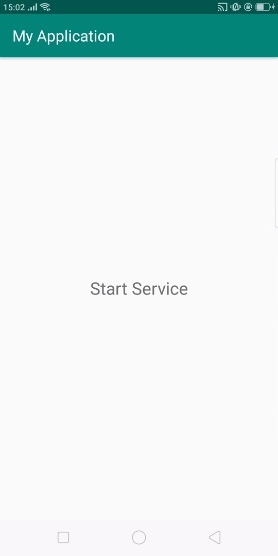
以上结果是初始屏幕,点击TextView,它将启动通知服务,如下所示 -
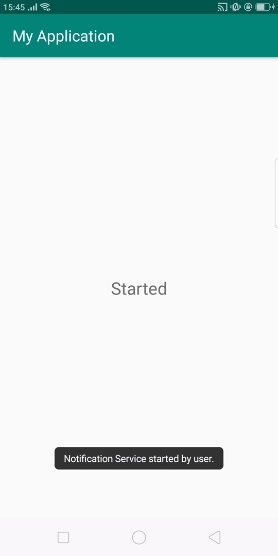
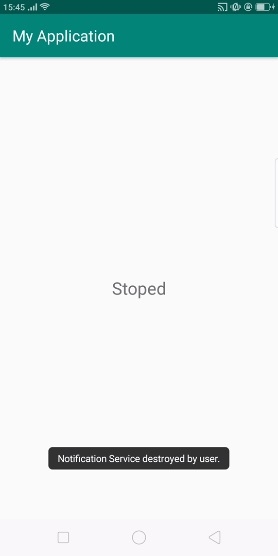
在以上结果中,服务已启动,现在点击TextView,它将停止通知服务,如下所示 -
点击这里下载项目代码

更新于:2019年7月30日
323 次查看

广告