
 数据结构
数据结构 网络
网络 关系型数据库管理系统
 操作系统
操作系统 Java
Java MS Excel
 iOS
iOS HTML
HTML CSS
CSS Android
 Python
 C 编程
C 编程 C++
C++ C#
C# MongoDB
 MySQL
MySQL Javascript
 PHP
PHP 物理学
物理学 化学
化学 生物学
生物学 数学
数学 英语
英语 经济学
经济学 心理学
心理学 社会学
社会学 时尚研究
时尚研究 法律研究
法律研究在 Python 中实现均值漂移算法
机器学习中存在许多类型的聚类算法。这些算法可以在 Python 中实现。在本文中,让我们讨论并使用 Python 实现“均值漂移”算法。它是一种用作无监督学习方法的聚类算法。
在此算法中,没有做出任何假设。这意味着它是一种非参数算法。该算法通过迭代方式将数据点分配到某些集群,这是通过将这些数据点移向数据点密度最高的位置来完成的。
数据点的高密度被称为集群的质心。均值漂移算法和 K 均值聚类之间的区别在于,在前者(K 均值)中,需要提前指定集群的数量。
这是因为集群的数量是根据现有数据使用 K 均值算法找到的。
让我们了解均值漂移算法中的步骤 -
数据点被分配到它自己的集群。
然后,确定这些集群的质心。
这些质心的位置被迭代更新。
接下来,该过程移动到更高密度的区域。
一旦质心到达无法进一步移动的位置,该过程就会停止。
让我们了解如何使用 scikit-learn 在 Python 中实现它 -
示例
import numpy as np
from sklearn.cluster import MeanShift
import matplotlib.pyplot as plt
from matplotlib import style
style.use("ggplot")
from sklearn.datasets.samples_generator import make_blobs
centers = [[3,3,1],[4,5,5],[11,10,10]]
X, _ = make_blobs(n_samples = 950, centers = centers, cluster_std = 0.89)
plt.title("Implementation of Mean-Shift algorithm")
plt.xlabel("X-axis")
plt.ylabel("Y-axis")
plt.scatter(X[:,0],X[:,1])
plt.show()

ms = MeanShift()
ms.fit(X)
labels = ms.labels_
clusterCent = ms.cluster_centers_
print(clusterCent)
numCluster = len(np.unique(labels))
print("Estimated clusters:", numCluster)
colors = 10*['r.','g.','b.','c.','k.','y.','m.']
for i in range(len(X)):
   plt.plot(X[i][0], X[i][1], colors[labels[i]], markersize = 3)
plt.scatter(clusterCent[:,0],clusterCent[:,1],
   marker=".",color='k', s=20, linewidths = 5, zorder=10)
plt.show()
输出

[[ 3.05250924 3.03734994 1.06159541]
[ 3.92913017 4.99956874 4.86668482]
[10.99127523 10.02361122 10.00084718]]
Estimated clusters: 3
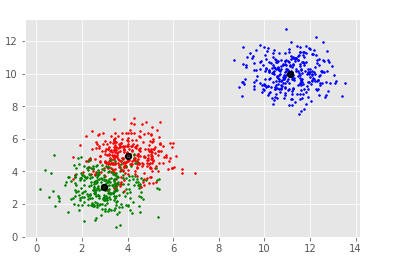
解释
导入所需的包并为其定义别名以方便使用。
将“ggplot”指定给“style”类中存在的“use”函数。
使用“make_blobs”函数创建数据集群。
使用 set_xlabel、set_ylabel 和 set_title 函数为“X”轴、“Y”轴和标题提供标签。
调用“MeanShift”函数,并将其分配给一个变量。
将数据拟合到模型。
定义标签和集群数量。
绘制此数据,并显示拟合到模型的数据的散点图。
使用“show”函数在控制台上显示。

更新于: 2021年1月18日
388 次查看

广告