
 数据结构
数据结构 网络
网络 关系数据库管理系统 (RDBMS)
 操作系统
操作系统 Java
Java MS Excel
 iOS
iOS HTML
HTML CSS
CSS Android
 Python
 C语言编程
C语言编程 C++
C++ C#
C# MongoDB
 MySQL
MySQL Javascript
 PHP
PHP 物理学
物理学 化学
化学 生物学
生物学 数学
数学 英语
英语 经济学
经济学 心理学
心理学 社会学
社会学 服装设计
服装设计 法学
法学C++二叉树中节点的后序遍历后续节点
在这个问题中,我们给定一个二叉树和一个节点。我们的任务是打印该二叉树中节点的后序遍历后续节点。
二叉树是一种特殊的树,其中每个节点最多可以有两个子节点。
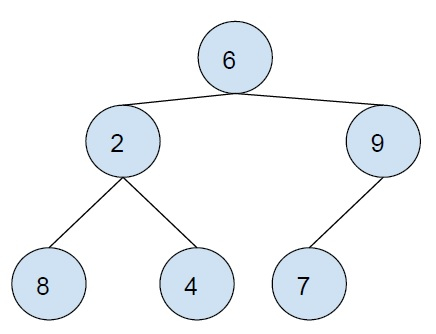
后序遍历是一种树遍历技术,其中首先遍历左子树,然后遍历右子树,最后遍历根节点。
上述树的后序遍历:8 4 2 7 9 6
让我们来看一个例子来理解这个问题。
输入 - 上例中的二叉树,节点 = 7
输出 - 9
解释 - 我们可以在二叉树的后序遍历中看到它。
为了解决这个问题,一个简单、容易且适合初学者的解决方案是简单地找到后序遍历,然后打印遍历中下一个数字。
但是我们需要学习更有效的解决方案,
有效的解决方案将涉及对后序遍历进行一些一般的观察。
由于根节点是后序遍历中的最后一个节点,因此它的后续节点是 NULL。
如果当前节点是右子节点,则父节点是后续节点。
如果当前节点是左子节点,则
如果缺少右兄弟节点,则后续节点是父节点
如果存在右兄弟节点,则该节点或其最左边的子节点是后续节点。
这种方法是有效的,时间复杂度为 O(h),h 是树的高度。
示例
程序演示了我们解决方案的实现,
#include <iostream>
using namespace std;
struct Node {
   struct Node *left, *right, *parent;
   int value;
};
struct Node* insertNode(int value) {
   Node* temp = new Node;
   temp->left = temp->right = temp->parent = NULL;
   temp->value = value;
   return temp;
}
Node* findPostorderSuccessor(Node* root, Node* n) {
   if (n == root)
      return NULL;
   Node* parent = n->parent;
   if (parent->right == NULL || parent->right == n)
      return parent;
   Node* curr = parent->right;
   while (curr->left != NULL)
      curr = curr->left;
   return curr;
}
int main(){
   struct Node* root = insertNode(6);
   root->parent = NULL;
   root->left = insertNode(2);
   root->left->parent = root;
   root->left->left = insertNode(8);
   root->left->left->parent = root->left;
   root->left->right = insertNode(4);
   root->left->right->parent = root->left;
   root->right = insertNode(9);
   root->right->parent = root;
   root->right->left = insertNode(7);
   root->right->left->parent = root->right;
   root->left->right->left = insertNode(14);
   struct Node* successorNode = findPostorderSuccessor(root, root->left->right);
   if (successorNode)
      cout<<"Postorder successor of "<<root->left->right->value<<" is "<<successorNode->value;
   else
      cout<<"Postorder successor of "<<root->left->right->value<<" is NULL";
   return 0;
}
输出
Postorder successor of 4 is 2

更新于:2020年4月17日
595 次浏览

广告