
 数据结构
数据结构 网络
网络 关系型数据库管理系统
 操作系统
操作系统 Java
Java MS Excel
 iOS
iOS HTML
HTML CSS
CSS Android
 Python
 C 语言
C 语言 C++
C++ C#
C# MongoDB
 MySQL
MySQL Javascript
 PHP
PHP 物理学
物理学 化学
化学 生物学
生物学 数学
数学 英语
英语 经济学
经济学 心理学
心理学 社会学
社会学 服装设计
服装设计 法律研究
法律研究用 C++ 统计节点权重与 X 相加为斐波那契数的节点数量
给定一棵二叉树,其节点权重为数字。目标是找到权重为斐波那契数的节点数量。斐波那契数列中的数字为:0、1、1、2、3、5、8、13……第 n 个数是第 (n−1) 个数和第 (n−2) 个数的和。如果权重为 13,则它是一个斐波那契数,因此该节点将被计数。
例如
输入
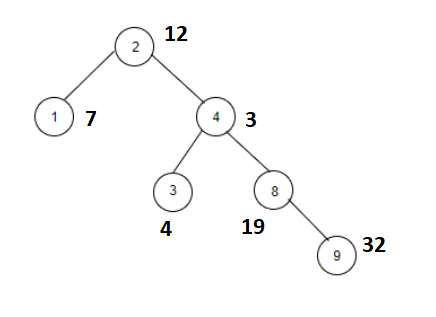
temp = 1。输入值后创建的树如下所示:
输出
Count the nodes whose sum with X is a Fibonacci number are: 3
解释
we are given with the tree nodes and the weights associated with each
node. Now we check whether the temp+weight is a Fibonacci number or not.
| 节点 | 权重 | 权重 + temp = 斐波那契数 | 是/否 |
|---|---|---|---|
| 2 | 12 | 12+1=13 | 是 |
| 1 | 7 | 7+1=8 | 是 |
| 4 | 3 | 3+1=4 | 否 |
| 3 | 4 | 4+1=5 | 是 |
| 8 | 19 | 19+1=20 | 否 |
| 9 | 32 | 32+1=33 | 否 |
输入
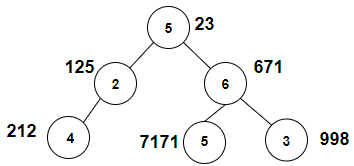
temp = 3。输入值后创建的树如下所示:
输出
Count the nodes whose sum with X is a Fibonacci number are: 3
解释
we are given with the tree nodes and the weights associated with each
node. Now we check whether the temp+weight is a Fibonacci number or not.
| 节点 | 权重 | 权重 + temp = 斐波那契数 | 是/否 |
|---|---|---|---|
| 5 | 23 | 23+3=26 | 否 |
| 2 | 125 | 125+3=128 | 否 |
| 6 | 671 | 671+3=674 | 否 |
| 4 | 212 | 212+3=215 | 否 |
| 5 | 7171 | 7171+3=7174 | 否 |
| 3 | 998 | 998+3=1001 | 否 |
下面程序中使用的方案如下:
在此方案中,我们将对树的图形应用深度优先搜索 (DFS) 来遍历它并检查节点的权重和 temp 是否加起来为斐波那契数。为此,请使用两个向量 Node_Weight(100) 和 edge_graph[100]。
用节点的权重初始化 Node_Weight[]。
使用向量 edge_graph 创建树。
取一个全局变量 Fibonacci 并将其初始化为 0。取另一个全局变量 temp。
函数 check_square(long double val) 获取一个整数,如果 val 是一个完全平方数,则返回 true。
取 val_1 = sqrt(val)
现在,如果 (val_1 − floor(val_1) == 0) 返回 true,则 total 是一个完全平方数,返回 true。
否则返回 false。
函数 check_Fibonacci(int num) 获取一个数字,如果它是斐波那契数,则返回 true。
用 5*num*num 初始化 fib。
如果 check_square((fib + 4)) || check_square((fib − 4)) 结果为 true,则返回 true。
否则返回 false。
函数 Fibonacci_number(int node, int root) 返回权重与 X 相加为斐波那契数的节点数量。
如果 if(check_Fibonacci(Node_Weight[node] + temp)) 返回 true,则递增 Fibonacci。
使用 for 循环遍历向量 edge_graph[node] 中的树。
对向量中的下一个节点调用 Fibonacci_number(it, node)。
在所有函数结束时,我们将拥有一个 Fibonacci 作为权重与 temp 相加为斐波那契数的节点数。
示例
#include <bits/stdc++.h>
using namespace std;
vector<int> Node_Weight(100);
vector<int> edge_graph[100];
int Fibonacci = 0, temp;
bool check_square(long double val){
   long double val_1 = sqrt(val);
   if(val_1 − floor(val_1) == 0){
      return true;
   }
   return false;
}
bool check_Fibonacci(int num){
   int fib = 5 * num * num;
   if(check_square((fib + 4)) || check_square((fib − 4))){
      return true;
   }
   return false;
}
void Fibonacci_number(int node, int root){
   if(check_Fibonacci(Node_Weight[node] + temp)){
      Fibonacci++;
   }
   for (int it : edge_graph[node]){
      if(it == root){
         continue;
      }
      Fibonacci_number(it, node);
   }
}
int main(){
   //weight of the nodes
   Node_Weight[2] = 6;
   Node_Weight[1] = 4;
   Node_Weight[4] = 23;
   Node_Weight[3] = 5;
   Node_Weight[8] = 161;
   Node_Weight[9] = 434;
   //create graph edge
   edge_graph[2].push_back(1);
   edge_graph[2].push_back(4);
   edge_graph[4].push_back(3);
   edge_graph[4].push_back(8);
   edge_graph[8].push_back(9);
   temp = 3;
   Fibonacci_number(2, 2);
   cout<<"Count the nodes whose sum with X is a Fibonacci number are: "<<Fibonacci;
   return 0;
}
输出
如果我们运行上述代码,它将生成以下输出:
Count the nodes whose sum with X is a Fibonacci number are: 1

104 次查看
