
 数据结构
数据结构 网络
网络 关系数据库管理系统 (RDBMS)
 操作系统
操作系统 Java
Java MS Excel
 iOS
iOS HTML
HTML CSS
CSS Android
 Python
 C语言编程
C语言编程 C++
C++ C#
C# MongoDB
 MySQL
MySQL Javascript
 PHP
PHP 物理学
物理学 化学
化学 生物学
生物学 数学
数学 英语
英语 经济学
经济学 心理学
心理学 社会学
社会学 服装设计
服装设计 法学
法学如何在Android中使用RecyclerView实现无限列表?
此示例演示了如何在Android中使用RecyclerView实现无限列表。
步骤1 - 在Android Studio中创建一个新项目,转到文件⇒新建项目,并填写所有必要信息以创建新项目。
在build.gradle (Module: app)中添加以下依赖项:
implementation 'com.android.support:cardview-v7:28.0.0'
implementation 'com.android.support:recyclerview-v7:28.0.0'
步骤2 - 将以下代码添加到res/layout/activity_main.xml。
<?xml version="1.0" encoding="utf-8"?>
<LinearLayout xmlns:android="http://schemas.android.com/apk/res/android"
   xmlns:tools="http://schemas.android.com/tools"
   android:layout_width="match_parent"
   android:layout_height="match_parent"
   android:orientation="vertical"
   tools:context=".MainActivity">
   <androidx.recyclerview.widget.RecyclerView
      android:id="@+id/recyclerView"
      android:layout_width="match_parent"
      android:layout_height="wrap_content" />
</LinearLayout>
步骤3 - 将以下代码添加到src/MainActivity.java。
import androidx.annotation.NonNull;
import androidx.appcompat.app.AppCompatActivity;
import androidx.recyclerview.widget.LinearLayoutManager;
import androidx.recyclerview.widget.RecyclerView;
import android.os.Bundle;
import android.os.Handler;
import java.util.ArrayList;
public class MainActivity extends AppCompatActivity {
   RecyclerView recyclerView;
   RecyclerViewAdapter recyclerViewAdapter;
   ArrayList<String>rowsArrayList = new ArrayList<>();
   boolean isLoading = false;
   @Override
   protected void onCreate(Bundle savedInstanceState) {
      super.onCreate(savedInstanceState);
      setContentView(R.layout.activity_main);
      recyclerView = findViewById(R.id.recyclerView);
      populateData();
      initAdapter();
      initScrollListener();
   }
   private void populateData() {
      for (int i = 0; i < 10; i++) {
         rowsArrayList.add("Number " + i);
      }
   }
   private void initAdapter() {
      recyclerViewAdapter = new RecyclerViewAdapter(rowsArrayList);
      recyclerView.setLayoutManager(new LinearLayoutManager(getApplicationContext()));
      recyclerView.setAdapter(recyclerViewAdapter);
   }
   private void initScrollListener() {
      recyclerView.addOnScrollListener(new RecyclerView.OnScrollListener() {
         @Override
         public void onScrollStateChanged(@NonNull RecyclerView recyclerView, int newState) {
            super.onScrollStateChanged(recyclerView, newState);
         }
         @Override
         public void onScrolled(@NonNull RecyclerView recyclerView, int dx, int dy) {
            super.onScrolled(recyclerView, dx, dy);
            LinearLayoutManager linearLayoutManager = (LinearLayoutManager) recyclerView.getLayoutManager();
            if (!isLoading) {
               if (linearLayoutManager != null && linearLayoutManager.findLastCompletelyVisibleItemPosition() == rowsArrayList.size() - 1) {
                  //bottom of list!
                  loadMore();
                  isLoading = true;
               }
            }
         }
      });
   }
   private void loadMore() {
      rowsArrayList.add(null);
      recyclerViewAdapter.notifyItemInserted(rowsArrayList.size() - 1);
      Handler handler = new Handler();
      handler.postDelayed(new Runnable() {
         @Override
         public void run() {
            rowsArrayList.remove(rowsArrayList.size() - 1);
            int scrollPosition = rowsArrayList.size();
            recyclerViewAdapter.notifyItemRemoved(scrollPosition);
            int currentSize = scrollPosition;
            int nextLimit = currentSize + 10;
            while (currentSize - 1 < nextLimit) {
               rowsArrayList.add("Number " + currentSize);
               currentSize++;
            }
            recyclerViewAdapter.notifyDataSetChanged();
            isLoading = false;
         }
      }, 2000);
   }
}
步骤4 - 创建一个新的Java类(RecyclerViewAdapter.java)并添加以下代码:
package app.com.sample;
import android.view.LayoutInflater;
import android.view.View;
import android.view.ViewGroup;
import android.widget.ProgressBar;
import android.widget.TextView;
import java.util.List;
import androidx.annotation.NonNull;
import androidx.recyclerview.widget.RecyclerView;
public class RecyclerViewAdapter extends
RecyclerView.Adapter<RecyclerView.ViewHolder> {
   private final int VIEW_TYPE_ITEM = 0;
   private List<String> mItemList;
   RecyclerViewAdapter(List<String> itemList) {
      mItemList = itemList;
   }
   @NonNull
   @Override
   public RecyclerView.ViewHolder onCreateViewHolder(@NonNull ViewGroup parent, int viewType) {
      if (viewType == VIEW_TYPE_ITEM) {
         View view = LayoutInflater.from(parent.getContext()).inflate(R.layout.item_row, parent, false);
         return new ItemViewHolder(view);
      } else {
         View view = LayoutInflater.from(parent.getContext()).inflate(R.layout.item_loading, parent, false);
         return new LoadingViewHolder(view);
      }
   }
   @Override
   public void onBindViewHolder(@NonNull RecyclerView.ViewHolder viewHolder, int position) {
      if (viewHolder instanceof ItemViewHolder) {
         populateItemRows((ItemViewHolder) viewHolder, position);
      }
       else if (viewHolder instanceof LoadingViewHolder) {
         showLoadingView((LoadingViewHolder) viewHolder, position);
      }
   }
   @Override
   public int getItemCount() {
      return mItemList == null ? 0 : mItemList.size();
   }
   @Override
   public int getItemViewType(int position) {
      int VIEW_TYPE_LOADING = 1;
      return mItemList.get(position) == null ? VIEW_TYPE_LOADING :
      VIEW_TYPE_ITEM;
   }
   private class ItemViewHolder extends RecyclerView.ViewHolder {
      TextView tvItem;
      ItemViewHolder(@NonNull View itemView) {
         super(itemView);
         tvItem = itemView.findViewById(R.id.textViewItem);
      }
   }
   private class LoadingViewHolder extends RecyclerView.ViewHolder {
      ProgressBar progressBar;
      LoadingViewHolder(@NonNull View itemView) {
         super(itemView);
         progressBar = itemView.findViewById(R.id.progressBar);
      }
   }
   private void showLoadingView(LoadingViewHolder viewHolder, int position) {
   }
   private void populateItemRows(ItemViewHolder viewHolder, int position) {
      String item = mItemList.get(position);
      viewHolder.tvItem.setText(item);
   }
}
步骤5 - 创建一个新的布局资源文件(item_row.xml)并添加以下代码:
<?xml version="1.0" encoding="utf-8"?>
<androidx.cardview.widget.CardView
xmlns:android="http://schemas.android.com/apk/res/android"
   xmlns:app="http://schemas.android.com/apk/res-auto"
   android:layout_width="match_parent"
   android:layout_height="wrap_content"
   app:cardElevation="2dp"
   app:cardUseCompatPadding="true">
   <TextView
      android:id="@+id/textViewItem"
      android:layout_width="match_parent"
      android:layout_height="wrap_content"
      android:padding="16dp" />
</androidx.cardview.widget.CardView>
步骤6 - 创建一个新的布局资源文件(item_loading.xml)并添加以下代码:
<?xml version="1.0" encoding="utf-8"?>
<LinearLayout xmlns:android="http://schemas.android.com/apk/res/android"
   android:layout_width="match_parent"
   android:layout_height="match_parent"
   android:orientation="vertical">
   <ProgressBar
      android:id="@+id/progressBar"
      android:layout_width="wrap_content"
      android:layout_height="wrap_content"
      android:layout_gravity="center_horizontal"
      android:indeterminate="true"
      android:paddingLeft="8dp"
      android:paddingRight="8dp" />
</LinearLayout>
步骤7 - 将以下代码添加到AndroidManifest.xml。
<?xml version="1.0" encoding="utf-8"?>
<manifest xmlns:android="http://schemas.android.com/apk/res/android" package="app.com.sample">
   <application
      android:allowBackup="true"
      android:icon="@mipmap/ic_launcher"
      android:label="@string/app_name"
      android:roundIcon="@mipmap/ic_launcher_round"
      android:supportsRtl="true"
      android:theme="@style/AppTheme">
      <activity android:name=".MainActivity">
         <intent-filter>
            <action android:name="android.intent.action.MAIN" />
            <category android:name="android.intent.category.LAUNCHER" />
         </intent-filter>
      </activity>
   </application>
</manifest>
让我们尝试运行您的应用程序。我假设您已将您的Android移动设备连接到您的计算机。要从Android Studio运行应用程序,请打开您的项目活动文件之一,然后单击工具栏中的运行 图标。选择您的移动设备作为选项,然后检查您的移动设备,它将显示您的默认屏幕:
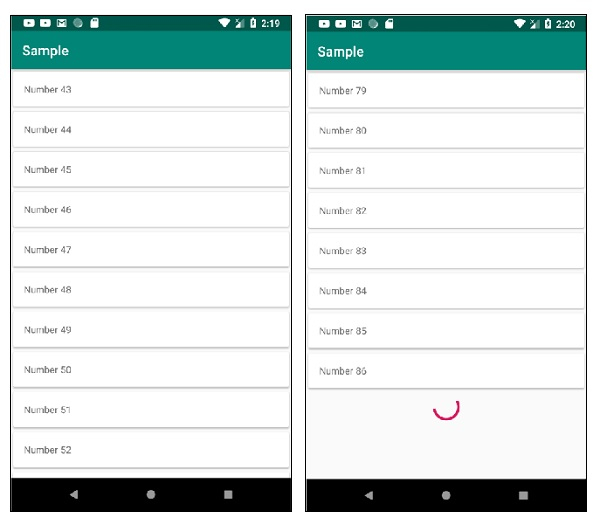
点击这里下载项目代码。

更新于:2019年11月26日
284 次浏览

广告