- JSF 教程
- JSF - 首页
- JSF - 概述
- JSF - 环境设置
- JSF - 架构
- JSF - 生命周期
- JSF - 第一个应用程序
- JSF - 托管Bean
- JSF - 页面导航
- JSF - 基本标签
- JSF - Facelet 标签
- JSF - 转换器标签
- JSF - 验证器标签
- JSF - DataTable
- JSF - 复合组件
- JSF - Ajax
- JSF - 事件处理
- JSF - JDBC 集成
- JSF - Spring 集成
- JSF - 表达式语言
- JSF - 国际化
- JSF 有用资源
- JSF - 快速指南
- JSF - 有用资源
- JSF - 讨论
JSF - 页面导航
导航规则是由 JSF 框架提供的规则,描述了单击按钮或链接时要显示哪个视图。
导航规则可以在名为 faces-config.xml 的 JSF 配置文件中定义。它们也可以在托管 Bean 中定义。
导航规则可以包含基于其显示结果视图的条件。JSF 2.0 还提供了隐式导航,在这种情况下,无需定义导航规则。
隐式导航
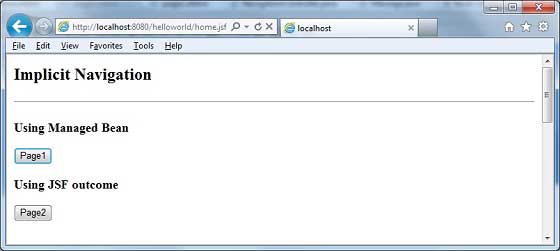
JSF 2.0 提供了名为隐式导航的自动视图页面解析器机制。在这种情况下,您只需要在 action 属性中放置视图名称,JSF 将自动在已部署的应用程序中搜索正确的视图页面。
JSF 页面中的自动导航
在任何 JSF UI 组件的 action 属性中设置视图名称。
<h:form>
   <h3>Using JSF outcome</h3>
   <h:commandButton action = "page2" value = "Page2" />
</h:form>
在这里,单击Page2按钮时,JSF 将解析视图名称page2为 page2.xhtml 扩展名,并在当前目录中找到相应的视图文件page2.xhtml。
托管 Bean 中的自动导航
在托管 Bean 中定义一个方法以返回视图名称。
@ManagedBean(name = "navigationController", eager = true)
@RequestScoped

public class NavigationController implements Serializable {
   public String moveToPage1() {
      return "page1";
   }
}
使用托管 Bean 在任何 JSF UI 组件的 action 属性中获取视图名称。
<h:form>
   <h3> Using Managed Bean</h3>
   <h:commandButton action = "#{navigationController.moveToPage1}"
   value = "Page1" /glt;
</h:form>
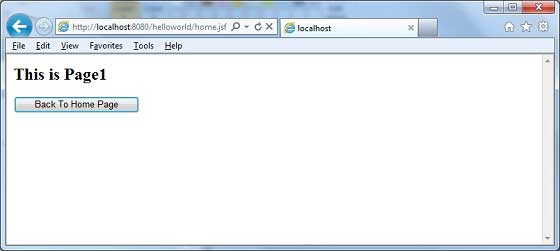
在这里,单击Page1按钮时,JSF 将解析视图名称page1为 page1.xhtml 扩展名,并在当前目录中找到相应的视图文件page1.xhtml。
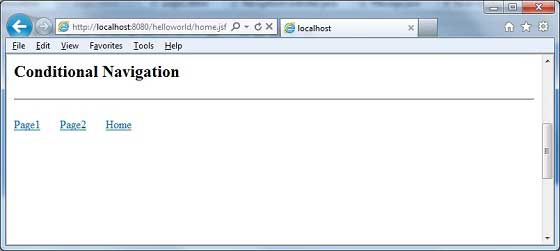
条件导航
使用托管 Bean,我们可以很容易地控制导航。查看托管 Bean 中的以下代码。
@ManagedBean(name = "navigationController", eager = true)
@RequestScoped

public class NavigationController implements Serializable {
   //this managed property will read value from request parameter pageId
   @ManagedProperty(value = "#{param.pageId}")
   private String pageId;

   //condional navigation based on pageId
   //if pageId is 1 show page1.xhtml,
   //if pageId is 2 show page2.xhtml
   //else show home.xhtml

   public String showPage() {
      if(pageId == null) {
         return "home";
      }

      if(pageId.equals("1")) {
         return "page1";
      }else if(pageId.equals("2")) {
         return "page2";
      }else {
         return "home";
      }
   }
}
在 JSF UI 组件中将 pageId 作为请求参数传递。
<h:form>
   <h:commandLink action = "#{navigationController.showPage}" value = "Page1">
      <f:param name = "pageId" value = "1" />
   </h:commandLink>
   <h:commandLink action = "#{navigationController.showPage}" value = "Page2">
      <f:param name = "pageId" value = "2" />
   </h:commandLink>
   <h:commandLink action = "#{navigationController.showPage}" value = "Home">
      <f:param name = "pageId" value = "3" />
   </h:commandLink>
</h:form>
在这里,单击“Page1”按钮时。
JSF 将创建一个带有参数 pageId = 1 的请求
然后 JSF 将此参数传递给 navigationController 的托管属性 pageId
现在调用 navigationController.showPage(),它将在检查 pageId 后返回 page1 作为视图
JSF 将解析视图名称 page1 为 page1.xhtml 扩展名
在当前目录中找到相应的视图文件 page1.xhtml
基于 from-action 解析导航
即使托管 Bean 的不同方法返回相同的视图名称,JSF 也提供导航解析选项。
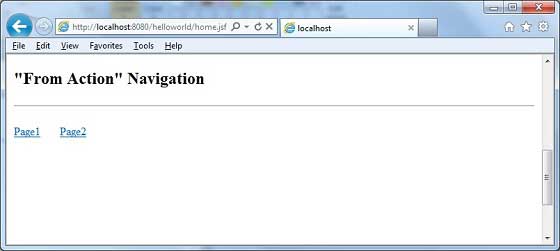
查看托管 Bean 中的以下代码。
public String processPage1() {
   return "page";
}
public String processPage2() {
   return "page";
}
要解析视图,请在faces-config.xml中定义以下导航规则。
<navigation-rule>
   <from-view-id>home.xhtml</from-view-id>

   <navigation-case>
      <from-action>#{navigationController.processPage1}</from-action>
      <from-outcome>page</from-outcome>
      <to-view-id>page1.jsf</to-view-id>
   </navigation-case>

   <navigation-case>
      <from-action>#{navigationController.processPage2}</from-action>
      <from-outcome>page</from-outcome>
      <to-view-id>page2.jsf</to-view-id>
   </navigation-case>

</navigation-rule>
在这里,单击 Page1 按钮时:
navigationController.processPage1() 将被调用,它将返回视图 page
JSF 将解析视图名称page1,因为视图名称为page,而faces-config中的from-action为navigationController.processPage1
在当前目录中找到相应的视图文件page1.xhtml
转发与重定向
JSF 默认情况下在导航到另一个页面时执行服务器页面转发,并且应用程序的 URL 不会更改。
要启用页面重定向,请在视图名称末尾附加faces-redirect=true。
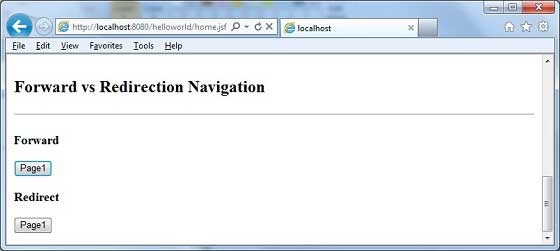
<h:form>
   <h3>Forward</h3>
   <h:commandButton action = "page1" value = "Page1" />
   <h3>Redirect</h3>
   <h:commandButton action = "page1?faces-redirect = true" value = "Page1" />
</h:form>
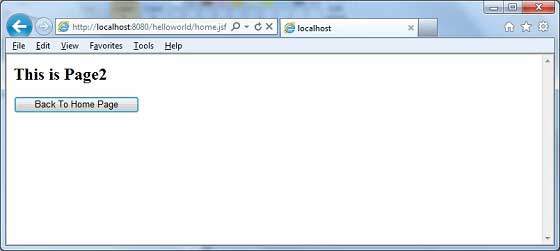
在这里,单击转发下的Page1按钮时,您将获得以下结果。
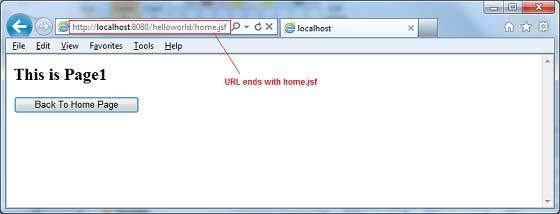
在这里,单击重定向下的Page1按钮时,您将获得以下结果。
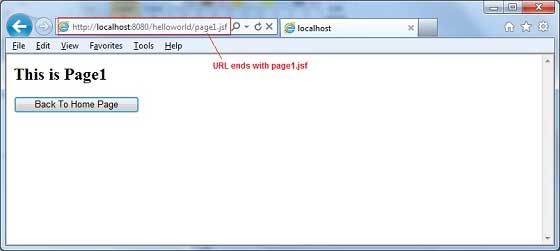
示例应用程序
让我们创建一个测试 JSF 应用程序来测试上述所有导航示例。
| 步骤 | 描述 |
|---|---|
| 1 | 如JSF - 创建应用程序章节所述,在包 com.tutorialspoint.test下创建一个名为helloworld的项目。 |
| 2 | 如以下所述,在包com.tutorialspoint.test下创建NavigationController.java。 |
| 3 | 如以下所述,在WEB-INF文件夹下创建faces-config.xml并更新其内容。 |
| 4 | 如以下所述,更新WEB-INF文件夹下的web.xml。 |
| 5 | 如以下所述,创建page1.xhtml和page2.xhtml,并修改webapp文件夹下的home.xhtml。 |
| 6 | 编译并运行应用程序以确保业务逻辑按要求工作。 |
| 7 | 最后,将应用程序构建为 war 文件,并将其部署到 Apache Tomcat Web 服务器。 |
| 8 | 使用最后一步中说明的适当 URL 启动您的 Web 应用程序。 |
NavigationController.java
package com.tutorialspoint.test;

import java.io.Serializable;

import javax.faces.bean.ManagedBean;
import javax.faces.bean.ManagedProperty;
import javax.faces.bean.RequestScoped;

@ManagedBean(name = "navigationController", eager = true)
@RequestScoped
public class NavigationController implements Serializable {
   private static final long serialVersionUID = 1L;
   @ManagedProperty(value = "#{param.pageId}")
   private String pageId;

   public String moveToPage1() {
      return "page1";
   }

   public String moveToPage2() {
      return "page2";
   }

   public String moveToHomePage() {
      return "home";
   }

   public String processPage1() {
      return "page";
   }

   public String processPage2() {
      return "page";
   }

   public String showPage() {
      if(pageId == null) {
         return "home";
      }

      if(pageId.equals("1")) {
         return "page1";
      }else if(pageId.equals("2")) {
         return "page2";
      }else {
         return "home";
      }
   }

   public String getPageId() {
      return pageId;
   }

   public void setPageId(String pageId) {
      this.pageId = pageId;
   }
}
faces-config.xml
<?xml version = "1.0" encoding = "UTF-8"?>

<faces-config
   xmlns = "http://java.sun.com/xml/ns/javaee"
   xmlns:xsi = "http://www.w3.org/2001/XMLSchema-instance"
   xsi:schemaLocation = "http://java.sun.com/xml/ns/javaee
   http://java.sun.com/xml/ns/javaee/web-facesconfig_2_0.xsd"
   version = "2.0">

   <navigation-rule>
      <from-view-id>home.xhtml</from-view-id>
      <navigation-case>
         <from-action>#{navigationController.processPage1}</from-action>
         <from-outcome>page</from-outcome>
         <to-view-id>page1.jsf</to-view-id>
      </navigation-case>
      <navigation-case>
         <from-action>#{navigationController.processPage2}</from-action>
         <from-outcome>page</from-outcome>
         <to-view-id>page2.jsf</to-view-id>
      </navigation-case>
   </navigation-rule>

</faces-config>
web.xml
<!DOCTYPE web-app PUBLIC
   "-//Sun Microsystems, Inc.//DTD Web Application 2.3//EN"
   "http://java.sun.com/dtd/web-app_2_3.dtd" >

<web-app>
   <display-name>Archetype Created Web Application</display-name>

   <context-param>
      <param-name>javax.faces.PROJECT_STAGE</param-name>
      <param-value>Development</param-value>
   </context-param>
   <context-param>
      <param-name>javax.faces.CONFIG_FILES</param-name>
      <param-value>/WEB-INF/faces-config.xml</param-value>
   </context-param>

   <servlet>
      <servlet-name>Faces Servlet</servlet-name>
      <servlet-class>javax.faces.webapp.FacesServlet</servlet-class>
   </servlet>
   <servlet-mapping>
      <servlet-name>Faces Servlet</servlet-name>
      <url-pattern>*.jsf</url-pattern>
   </servlet-mapping>

</web-app>
page1.xhtml
<?xml version = "1.0" encoding = "UTF-8"?>
<!DOCTYPE html PUBLIC "-//W3C//DTD XHTML 1.0 Transitional//EN"
   "http://www.w3.org/TR/xhtml1/DTD/xhtml1-transitional.dtd">
<html xmlns = "http://www.w3.org/1999/xhtml"
   xmlns:h = "http://java.sun.com/jsf/html">

   <h:body>
      <h2>This is Page1</h2>
      <h:form>
         <h:commandButton action = "home?faces-redirect = true"
            value = "Back To Home Page" />
      </h:form>
   </h:body>
</html>
page2.xhtml
<?xml version = "1.0" encoding = "UTF-8"?>
<!DOCTYPE html PUBLIC "-//W3C//DTD XHTML 1.0 Transitional//EN"
   "http://www.w3.org/TR/xhtml1/DTD/xhtml1-transitional.dtd">
<html xmlns = "http://www.w3.org/1999/xhtml"
   xmlns:h = "http://java.sun.com/jsf/html">

   <h:body>
      <h2>This is Page2</h2>
      <h:form>
         <h:commandButton action = "home?faces-redirect = true"
            value = "Back To Home Page" />
      </h:form>
   </h:body>
</html>
home.xhtml
<?xml version = "1.0" encoding = "UTF-8"?>
<!DOCTYPE html PUBLIC "-//W3C//DTD XHTML 1.0 Transitional//EN"
"http://www.w3.org/TR/xhtml1/DTD/xhtml1-transitional.dtd">

<html xmlns = "http://www.w3.org/1999/xhtml"
   xmlns:f = "http://java.sun.com/jsf/core"
   xmlns:h = "http://java.sun.com/jsf/html">

   <h:body>
      <h2>Implicit Navigation</h2>
      <hr />

      <h:form>
         <h3>Using Managed Bean</h3>
         <h:commandButton action = "#{navigationController.moveToPage1}"
            value = "Page1" />
         <h3>Using JSF outcome</h3>
         <h:commandButton action = "page2" value = "Page2" />
      </h:form>
      <br/>

      <h2>Conditional Navigation</h2>
      <hr />
      <h:form>
         <h:commandLink action = "#{navigationController.showPage}"
            value="Page1">
            <f:param name = "pageId" value = "1" />
         </h:commandLink>


         <h:commandLink action = "#{navigationController.showPage}"
            value="Page2">
            <f:param name = "pageId" value = "2" />
         </h:commandLink>


         <h:commandLink action = "#{navigationController.showPage}"
            value = "Home">
            <f:param name = "pageId" value = "3" />
         </h:commandLink>
      </h:form>
      <br/>

      <h2>"From Action" Navigation</h2>
      <hr />

      <h:form>
         <h:commandLink action = "#{navigationController.processPage1}"
         value = "Page1" />

         <h:commandLink action = "#{navigationController.processPage2}"
         value = "Page2" />

      </h:form>
      <br/>

      <h2>Forward vs Redirection Navigation</h2>
      <hr />
      <h:form>
         <h3>Forward</h3>
         <h:commandButton action = "page1" value = "Page1" />
         <h3>Redirect</h3>
         <h:commandButton action = "page1?faces-redirect = true"
         value = "Page1" />
      </h:form>
   </h:body>
</html>
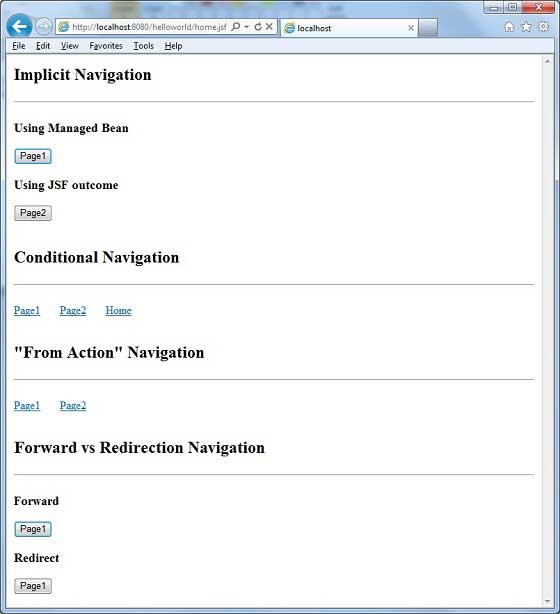
完成所有更改后,让我们像在 JSF - 创建应用程序章节中所做的那样编译并运行应用程序。如果您的应用程序一切正常,这将产生以下结果。