
 数据结构
数据结构 网络
网络 关系数据库管理系统
 操作系统
操作系统 Java
Java MS Excel
 iOS
iOS HTML
HTML CSS
CSS Android
 Python
 C 编程
C 编程 C++
C++ C#
C# MongoDB
 MySQL
MySQL Javascript
 PHP
PHP 物理学
物理学 化学
化学 生物学
生物学 数学
数学 英语
英语 经济学
经济学 心理学
心理学 社会学
社会学 服装设计
服装设计 法律研究
法律研究打印从给定字符串列表构建的 Trie 的所有可能的连接节点
在 C++ 中,Trie 是一种高级数据结构,用于存储树的集合。Trie 这个词来源于检索(retrieval),它也被称为数字树或前缀树。
让我们以一个给定字符串列表的所有可能的连接节点为例。
我们将字符串输入定义为 {“tutor”, “true”, “tuo”}
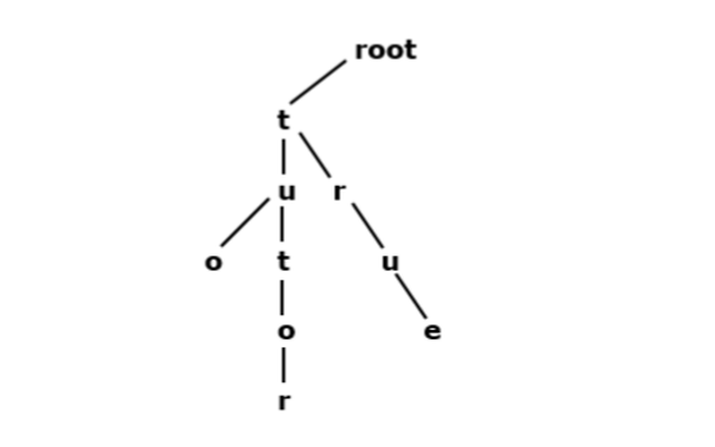
我们可以观察到,不同的字符字符串连接到单个字符字符串。因此,这里t 和u 是字符串中连接所有可能字符串的字符列表。
在本文中,我们将使用 Trie 数据结构来解决包含所有可能的连接节点的字符串列表。
语法
struct name_of_structure{
   data_type var_name;   // data member or field of the structure.
}
参数
struct - 此关键字用于表示结构数据类型。
name_of_structure - 我们为结构提供任何名称。
结构是在一个地方收集各种相关变量。
treetrie* alpha[alphabet]
alpha 是指向名为 treetrie 的结构指针/数据成员的变量的名称。alphabet 是将总字符数以整数形式设置值的宏。
算法
我们从一个名为‘bits/stdc++.h’的头文件开始,它包含了 C++ 的所有标准模板库。
我们定义了两个宏,即‘alphabet’ 和‘max’,它们分别定义了字母表中的总字符数和最大字符数。
我们创建了一个名为‘tree node’ 的结构,并定义了一个指向‘tree_node’ 的指针来存储字母的地址。使用布尔数据类型定义变量 ‘end_word’,它将用于字符串的结束字符。
我们定义了一个名为‘buildNode’ 的函数,使用指针连接一个新的节点,该节点表示构建的 Trie 树。
为了插入字符串,我们创建了一个名为‘ins_recursive_of_string’ 的递归函数,它接受三个参数 - itm、str(要插入的字符串)和 i(指示当前正在处理的字符)。
函数ins() 在代码中定义为ins_recursive_of_str() 的包装函数。它接受两个参数:tree_trie* itm(一个 tree_trie 对象)和string str(要插入的字符串)。它使用当前节点、要插入的字符串和起始索引 0 来调用递归函数。
接下来,我们创建一个名为is LeafNode() 的函数,它将 tree_trie 对象作为参数,并检查它是否为叶子节点,即它是否没有子节点。
函数display_joint() 在代码中定义,并接受四个参数:tree_trie* root, tree_trie*itm(正在处理的当前节点),char str[](一个字符数组 str,存储从根节点到当前节点的路径形成的字符串)和一个整数 level(表示当前节点深度的整数 level)。
代码定义了displayJ() 函数,它是display_joint() 的包装函数。它将 tree_trie 对象作为参数,并使用根节点、一个空字符数组和一个起始级别 0 作为参数调用display_joint() 函数。
代码定义了 main() 函数,它生成一个新的tree_trie 对象作为 Trie 根节点。它生成一个包含要插入 Trie 的字符串列表的向量 s。然后,它调用ins() 函数将每个字符串插入 Trie。
最后,它打印一条消息来指示输出的开始,并调用displayJ() 函数来显示 Trie 的所有连接节点。
示例
在这个程序中,我们将打印从给定字符串列表构建的 Trie 的所有可能的连接节点。
#include <bits/stdc++.h>
using namespace std;
#define alphabet 26
#define max 200

// creating a structure for trie node
struct tree_trie {
   tree_trie* alpha[alphabet];
   bool end_word;
};
tree_trie* buildNode(){
   tree_trie* temp = new tree_trie();
   temp->end_word = false;
   for (int i = 0; i < alphabet; i++) {
      temp->alpha[i] = NULL;
   }
   return temp;
}

// We will insert the string using trie recursively
void ins_recursive_of_str(tree_trie* itm,
string str, int i){
   if (i < str.length()) {
      int idx = str[i] - 'a';
      if (itm->alpha[idx] == NULL) {
         // We are creating a new node
         itm->alpha[idx] = buildNode();
      }
      // calling recursion function for inserting a string
      ins_recursive_of_str(itm->alpha[idx],
      str, i + 1);
   }
   else {
      // We make the end_word true which represents the end of string
      itm->end_word = true;
   }
}

// By using function call we are inserting a tree
void ins(tree_trie* itm, string str){

   // The necessary argument required for function call
   ins_recursive_of_str(itm, str, 0);
}

// Using function we check whether the node is a leaf or not
bool isLeafNode(tree_trie* root){
   return root->end_word != false;
}

// This function is an important part of the program to display the joints of trie
void display_joint(tree_trie* root, tree_trie* itm,
char str[], int level){

   //Using this variable we are counting the current child
   int current_alpha = 0;
   for (int i = 0; i < alphabet; i++){
      if (itm->alpha[i]) {
         str[level] = i + 'a';
         display_joint(root, itm->alpha[i],
         str, level + 1);
         current_alpha++;
      }
   }

   // We are printing the character if it has more than 1 character
   if (current_alpha > 1 && itm != root) {
      cout << str[level - 1] << endl;
   }
}

// By using this function call we are diplaying the joint of trie.
void displayJ(tree_trie* root){
   int level = 0;
   char str[max];
   display_joint(root, root, str, level);
}

// main function
int main(){
   tree_trie* root = buildNode();
   vector<string> s = { "tutor", "true", "tuo"};

   for (string str : s) {
      ins(root, str);
   }
   cout<<"All possible joint of trie using the given list of string"<<endl;
   displayJ(root);
   return 0;
}
输出
All possible joint of trie using the given list of string
u
t
结论
我们探讨了 Trie 数据结构的概念,其中我们从给定的字符串列表构建了 Trie 的所有可能的连接节点。我们在输出中看到了字符 u 和 t 如何通过获取诸如 tutor、true 和 tuo 之类的字符串来连接 Trie 的所有可能的连接节点。因此,通过提供可能的连接节点,树可以减少其节点数量。

205 次查看
