
- Three.js 教程
- Three.js - 首页
- Three.js - 简介
- Three.js - 安装
- Three.js - Hello Cube 应用
- Three.js - 渲染器和响应性
- Three.js - 响应式设计
- Three.js - 调试和统计
- Three.js - 相机
- Three.js - 控制器
- Three.js - 光照与阴影
- Three.js - 几何体
- Three.js - 材质
- Three.js - 纹理
- Three.js - 绘制线条
- Three.js - 动画
- Three.js - 创建文本
- Three.js - 加载 3D 模型
- Three.js - 库和插件
- Three.js 有用资源
- Three.js - 快速指南
- Three.js - 有用资源
- Three.js - 讨论
Three.js - 光照与阴影
光照使物体可见,类似地,在 Three.js 中,THREE.Light 照亮场景并使某些东西可见。并非所有材质都会受到光照的影响。MeshBasicMaterial 和 MeshNormalMaterial 是自发光的,因此它们不需要光照就能在场景中可见。但是,大多数其他材质都需要,例如 MeshLambertMaterial、MeshPhongMaterial、MeshStandardMaterial、MeshPhysicalMaterial 和 MeshToonMaterial。我们将在后面的章节中讨论更多材质。在本章中,我们将重点介绍 Three.js 中不同类型的灯光。
每个灯光都有颜色和强度属性。
color − (可选)灯光的十六进制颜色。默认为 0xffffff(白色)。
intensity − (可选)灯光的强度/亮度的数值。默认为 1。
投射阴影
来自特定方向的光可以投射阴影。首先,我们应该使场景准备好投射阴影。
步骤 - 1
我们应该首先告诉渲染器我们想要启用阴影。投射阴影是一个代价高昂的操作。WebGLRenderer 仅支持此功能。它使用阴影贴图,这是一种特定于 WebGL 的技术,直接在 GPU 上执行。
renderer.shadowMapEnabled = true
以上代码行告诉渲染器在场景中投射阴影。
注意 - Three.js 默认使用阴影贴图。阴影贴图适用于投射阴影的光。场景从光源的视角渲染所有标记为投射阴影的物体。
如果您的阴影边缘看起来有点块状,则表示阴影贴图太小。要增加阴影贴图的大小,您可以为灯光定义 shadowMapHeight 和 shadowMapWidht 属性。或者,您也可以尝试更改 WebGLRenderer 的 shadowMapType 属性。您可以将其设置为 THREE.BasicShadowMap、THREE.PCFShadowMap 或 THREE.PCFSoftShadowMap。
// to antialias the shadow
renderer.shadowMapType = THREE.PCFSoftShadowMap
// or
directionalLight.shadowMapWidth = 2048
directionalLight.shadowMapHeight = 2048
步骤 - 2
您应该配置对象以投射阴影。您可以告知 Three.js 哪些对象可以投射阴影,哪些对象可以接收阴影。
object.castShadow = true
object.recieveShadow = true
步骤 - 3
以上所有步骤对于每种灯光都相同。下一步是设置与阴影相关的属性。
light.castShadow = true
light.shadow.camera.near = 10
light.shadow.camera.far = 100
light.shadow.camera.left = -50
light.shadow.camera.right = 50
light.shadow.camera.top = 50
light.shadow.camera.bottom = -50
第一个属性 castShadow 告诉 Three.js 此灯光投射阴影。由于投射阴影是一个代价高昂的操作,我们需要定义阴影可以出现的区域。您可以使用 shadow.camera.near、shadow.camera.far 和 shadow.camera.left 等属性来实现。使用上述属性,我们创建了一个类似盒子的区域,Three.js 在其中渲染阴影。
示例
在此示例中了解更多信息。
directional.html
<!DOCTYPE html>
<html lang="en">
   <head>
      <meta charset="UTF-8" />
      <meta http-equiv="X-UA-Compatible" content="ie=edge" />
      <meta name="viewport" content="width=device-width, initial-scale=1.0" />
      <title>Three.js - Directional Light</title>
      <style>
         * {
            margin: 0;
            padding: 0;
            box-sizing: border-box;
            font-family: -applesystem, BlinkMacSystemFont, 'Segoe UI', Roboto, Oxygen, Ubuntu,
            Cantarell, 'Open Sans', 'Helvetica Neue', sans-serif;
         }
         html,
         body {
            height: 100vh;
            width: 100vw;
         }
         #threejs-container {
            position: block;
            width: 100%;
            height: 100%;
         }
      </style>
      <script src="https://cdnjs.cloudflare.com/ajax/libs/three.js/r128/three.min.js"></script>
      <script src="https://cdnjs.cloudflare.com/ajax/libs/dat-gui/0.7.7/dat.gui.js"></script>
   </head>
   <body>
   <div id="container"></div>
      <script type="module">
         // Adding directional light to the scene
         // The lights falls from the light only in one direction.
         // You can see the position of light using helpers provided in Three.j
         s for debugging purposes

         // GUI
         const gui = new dat.GUI()
         // sizes
         let width = window.innerWidth
         let height = window.innerHeight
         // scene
         const scene = new THREE.Scene()
         scene.background = new THREE.Color(0x262626)
         // camera
         const camera = new THREE.PerspectiveCamera(45, width / height, 0.1, 1000)
         camera.position.set(0, 0, 10)
         const camFolder = gui.addFolder('Camera')
         camFolder.add(camera.position, 'z', 10, 80, 1)
         camFolder.open()
         // lights
         const ambientLight = new THREE.AmbientLight(0xffffff, 0.5)
         scene.add(ambientLight)
         const light = new THREE.DirectionalLight()
         light.position.set(2.5, 2, 2)
         light.castShadow = true
         light.shadow.mapSize.width = 512
         light.shadow.mapSize.height = 512
         light.shadow.camera.near = 0.5
         light.shadow.camera.far = 100
         scene.add(light)
         const helper = new THREE.DirectionalLightHelper(light)
         scene.add(helper)
         // light controls
         const lightColor = {
            color: light.color.getHex()
         }
         const lightFolder = gui.addFolder('Directional Light')
         lightFolder.addColor(lightColor, 'color').onChange(() => {
         light.color.set(lightColor.color)
         })
         lightFolder.add(light, 'intensity', 0, 1, 0.01)
         lightFolder.open()
         const directionalLightFolder = gui.addFolder('Position of Light')
         directionalLightFolder.add(light.position, 'x', -10, 10, 0.1)
         directionalLightFolder.add(light.position, 'y', -10, 10, 0.1)
         directionalLightFolder.add(light.position, 'z', -10, 10, 0.1)
         directionalLightFolder.open()
         // plane
         const planeGeometry = new THREE.PlaneGeometry(100, 20)
         const plane = new THREE.Mesh(planeGeometry, new THREE.MeshPhongMateria
         l({ color: 0xffffff }))
         plane.rotateX(-Math.PI / 2)
         plane.position.y = -1.75
         plane.receiveShadow = true
         scene.add(plane)
         // cube
         const geometry = new THREE.BoxGeometry(2, 2, 2)
         const material = new THREE.MeshStandardMaterial({
            color: 0x87ceeb
         })
         const materialFolder = gui.addFolder('Material')
         materialFolder.add(material, 'wireframe')
         materialFolder.open()
         const cube = new THREE.Mesh(geometry, material)
         cube.position.set(0, 0.5, 0)
         cube.castShadow = true
         cube.receiveShadow = true
         scene.add(cube)
         // responsiveness
         window.addEventListener('resize', () => {
            width = window.innerWidth
            height = window.innerHeight
            camera.aspect = width / height
            camera.updateProjectionMatrix()
            renderer.setSize(window.innerWidth, window.innerHeight)
            renderer.render(scene, camera)
         })
         // renderer
         const renderer = new THREE.WebGL1Renderer()
         renderer.setSize(window.innerWidth, window.innerHeight)
         renderer.shadowMap.enabled = true
         renderer.shadowMap.type = THREE.PCFSoftShadowMap
         renderer.setPixelRatio(Math.min(window.devicePixelRatio, 2))
         // animation
         function animate() {
            requestAnimationFrame(animate)
            cube.rotation.x += 0.005
            cube.rotation.y += 0.01
            renderer.render(scene, camera)
         }
         // rendering the scene
         const container = document.querySelector('#container')
         container.append(renderer.domElement)
         renderer.render(scene, camera)
         animate()
      </script>
   </body>
</html>
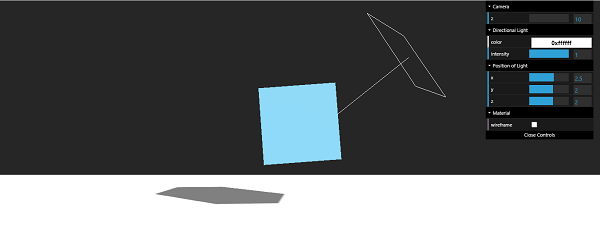
输出
| 序号 | 灯光与描述 |
|---|---|
| 1 |
它是最基本的灯光,它均匀地照亮整个场景。 |
| 2 |
方向光来自特定点,并从远处直接发出到目标。 |
| 3 |
它是另一种灯光,它来自锥形形状的特定方向。 |
| 4 |
点光源是一种从单个点向所有方向发射光的光源。 |
| 5 |
它是一种用于创建自然光照的特殊灯光。 |