
 数据结构
数据结构 网络
网络 关系数据库管理系统
 操作系统
操作系统 Java
Java MS Excel
 iOS
iOS HTML
HTML CSS
CSS Android
 Python
 C语言编程
C语言编程 C++
C++ C#
C# MongoDB
 MySQL
MySQL Javascript
 PHP
PHP 物理学
物理学 化学
化学 生物学
生物学 数学
数学 英语
英语 经济学
经济学 心理学
心理学 社会学
社会学 时尚研究
时尚研究 法律研究
法律研究C++程序检查有向图是否包含欧拉路径
欧拉路径是一条路径,通过它我们可以精确地访问每条边一次。我们可以多次使用相同的顶点。包含欧拉回路的图在这种情况下也被考虑在内,因为它也具有欧拉路径。
要检查有向图是否具有欧拉路径,我们必须检查以下条件:
- 必须存在一个唯一的顶点an,其中(入度 + 1 = 出度)
- 必须存在一个唯一的顶点bn,其中(入度 = 出度 + 1)
- 如果任何这些情况失败,则图中没有欧拉路径,其余所有顶点都有(入度 = 出度)。
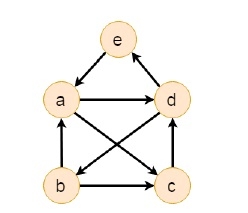
顶点b具有(入度1,出度2),顶点c具有(入度2,出度1)。对于其余顶点a、d,具有(入度2,出度2),e具有(入度1,出度1)。
输入
图的邻接矩阵。
| 0 | 0 | 1 | 1 | 0 |
| 1 | 0 | 1 | 0 | 0 |
| 0 | 0 | 0 | 1 | 0 |
| 0 | 1 | 0 | 0 | 1 |
| 1 | 0 | 0 | 0 | 0 |
输出
找到欧拉路径。
算法
traverse(u, visited)
输入:起始节点u和已访问节点,以标记哪些节点已被访问。
输出:遍历所有连接的顶点。
Begin
   mark u as visited
   for all vertex v, if it is adjacent with u, do
      if v is not visited, then
      traverse(v, visited)
   done
End
isConnected(graph)
输入:图。
输出:如果图是连通的,则返回True。
Begin
   define visited array
   for all vertices u in the graph, do
      make all nodes unvisited
      traverse(u, visited)
      if any unvisited node is still remaining, then
         return false
      done
   return true
End
hasEulerPath(Graph)
输入:给定的图。
输出:找到一个欧拉回路时返回True。
Begin
   an := 0
   bn := 0
   if isConnected() is false, then
      return false
   define list for inward and outward edge count for each node
   for all vertex i in the graph, do
      sum := 0
      for all vertex j which are connected with i, do
         inward edges for vertex i increased
         increase sum
      done
      number of outward of vertex i is sum
   done
   if inward list and outward list are same, then
      return true
   for all vertex i in the vertex set V, do
      if inward[i] ≠ outward[i], then
         if inward[i] + 1 = outward[i], then
            an := an + 1
         else if inward[i] = outward[i] + 1, then
            bn := bn + 1
      done
      if an and bn both are 1, then
          return true
      otherwise return false
End
示例代码
#include<iostream>
#include<vector>
#define NODE 5
using namespace std;
int graph[NODE][NODE] = {{0, 0, 1, 1, 0},
   {1, 0, 1, 0, 0},
   {0, 0, 0, 1, 0},
   {0, 1, 0, 0, 1},
   {1, 0, 0, 0, 0}};
void traverse(int u, bool visited[]) {
   visited[u] = true; //mark v as visited
   for(int v = 0; v<NODE; v++) {
      if(graph[u][v]) {
         if(!visited[v])
            traverse(v, visited);
      }
   }
}
bool isConnected() {
   bool *vis = new bool[NODE];
   //for all vertex u as start point, check whether all nodes are visible or not
   for(int u; u < NODE; u++) {
      for(int i = 0; i<NODE; i++)
         vis[i] = false; //initialize as no node is visited
         traverse(u, vis);
      for(int i = 0; i<NODE; i++) {
         if(!vis[i]) //if there is a node, not visited by traversal, graph is not connected
            return false;
      }
   }
   return true;
}
bool hasEulerPath() {
   int an = 0, bn = 0;
   if(isConnected() == false){ //when graph is not connected
      return false;
   }
   vector<int> inward(NODE, 0), outward(NODE, 0);
   for(int i = 0; i<NODE; i++) {
      int sum = 0;
      for(int j = 0; j<NODE; j++) {
         if(graph[i][j]) {
            inward[j]++; //increase inward edge for destination vertex
            sum++; //how many outward edge
         }
      }
      outward[i] = sum;
   }
   //check the condition for Euler paths
   if(inward == outward) //when number inward edges and outward edges for each node is same
      return true; //Euler Circuit, it has Euler path
   for(int i = 0; i<NODE; i++) {
      if(inward[i] != outward[i]) {
         if((inward[i] + 1 == outward[i])) {
            an++;
         } else if((inward[i] == outward[i] + 1)) {
            bn++;
         }
      }
   }
   if(an == 1 && bn == 1) { //if there is only an, and bn, then this has euler path
      return true;
   }
   return false;
}
int main() {
   if(hasEulerPath())
      cout << "Euler Path Found.";
   else
   cout << "There is no Euler Circuit.";
}
输出
Euler Path Found.

更新于:2019年7月30日
412次浏览

广告