
- Flask 教程
- Flask - 首页
- Flask - 概述
- Flask - 环境
- Flask - 应用程序
- Flask - 路由
- Flask - 变量规则
- Flask - URL 构建
- Flask - HTTP 方法
- Flask - 模板
- Flask - 静态文件
- Flask - 请求对象
- 将表单数据发送到模板
- Flask - Cookie
- Flask - 会话
- Flask - 重定向和错误
- Flask - 消息闪现
- Flask - 文件上传
- Flask - 扩展
- Flask - 邮件
- Flask - WTF
- Flask - SQLite
- Flask - SQLAlchemy
- Flask - Sijax
- Flask - 部署
- Flask - FastCGI
- Flask 有用资源
- Flask - 快速指南
- Flask - 有用资源
- Flask - 讨论
Flask – SQLite
Python 内置支持 **SQLite**。SQLite3 模块随 Python 发行版一起提供。有关在 Python 中使用 SQLite 数据库的详细教程,请参阅 此链接。在本节中,我们将了解 Flask 应用程序如何与 SQLite 交互。
创建一个 SQLite 数据库 **‘database.db’** 并在其内部创建一个学生表。
import sqlite3

conn = sqlite3.connect('database.db')
print "Opened database successfully";

conn.execute('CREATE TABLE students (name TEXT, addr TEXT, city TEXT, pin TEXT)')
print "Table created successfully";
conn.close()
我们的 Flask 应用程序有三个 **视图** 函数。
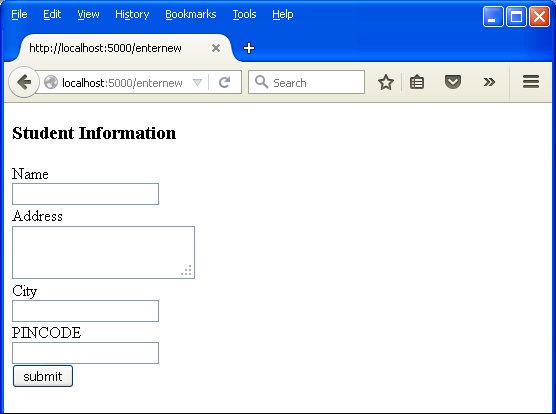
第一个 **new_student()** 函数绑定到 URL 规则 **(‘/addnew’)**。它呈现一个包含学生信息表单的 HTML 文件。
@app.route('/enternew')
def new_student():
   return render_template('student.html')
**‘student.html’** 的 HTML 脚本如下所示:
<html>
   <body>
      <form action = "{{ url_for('addrec') }}" method = "POST">
         <h3>Student Information</h3>
         Name<br>
         <input type = "text" name = "nm" /></br>

         Address<br>
         <textarea name = "add" ></textarea><br>

         City<br>
         <input type = "text" name = "city" /><br>

         PINCODE<br>
         <input type = "text" name = "pin" /><br>
         <input type = "submit" value = "submit" /><br>
      </form>
   </body>
</html>
可以看出,表单数据被发布到绑定 **addrec()** 函数的 **‘/addrec’** URL。
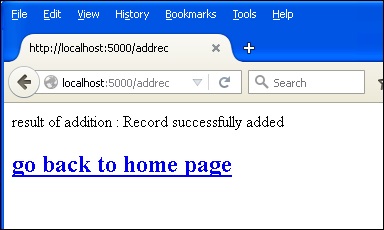
此 **addrec()** 函数通过 **POST** 方法检索表单数据并将其插入学生表中。插入操作成功或失败的消息将呈现到 **‘result.html’** 中。
@app.route('/addrec',methods = ['POST', 'GET'])
def addrec():
   if request.method == 'POST':
      try:
         nm = request.form['nm']
         addr = request.form['add']
         city = request.form['city']
         pin = request.form['pin']

         with sql.connect("database.db") as con:
            cur = con.cursor()
            cur.execute("INSERT INTO students (name,addr,city,pin)
               VALUES (?,?,?,?)",(nm,addr,city,pin) )

            con.commit()
            msg = "Record successfully added"
      except:
         con.rollback()
         msg = "error in insert operation"

      finally:
         return render_template("result.html",msg = msg)
         con.close()
**result.html** 的 HTML 脚本包含一个转义语句 **{{msg}}**,该语句显示 **插入** 操作的结果。
<!doctype html>
<html>
   <body>
      result of addition : {{ msg }}
      <h2><a href = "\">go back to home page</a></h2>
   </body>
</html>
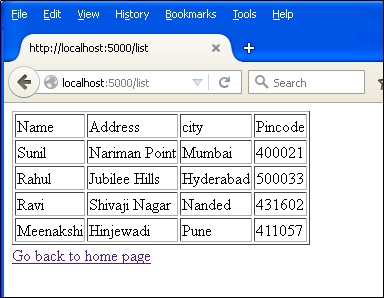
该应用程序包含另一个由 **‘/list’** URL 表示的 **list()** 函数。它将 **rows** 填充为包含学生表中所有记录的 **MultiDict** 对象。此对象传递给 **list.html** 模板。
@app.route('/list')
def list():
   con = sql.connect("database.db")
   con.row_factory = sql.Row

   cur = con.cursor()
   cur.execute("select * from students")

   rows = cur.fetchall();
   return render_template("list.html",rows = rows)
此 **list.html** 是一个模板,它迭代行集并在 HTML 表格中呈现数据。
<!doctype html>
<html>
   <body>
      <table border = 1>
         <thead>
            <td>Name</td>
            <td>Address>/td<
            <td>city</td>
            <td>Pincode</td>
         </thead>

         {% for row in rows %}
            <tr>
               <td>{{row["name"]}}</td>
               <td>{{row["addr"]}}</td>
               <td> {{ row["city"]}}</td>
               <td>{{row['pin']}}</td>
            </tr>
         {% endfor %}
      </table>

      <a href = "/">Go back to home page</a>
   </body>
</html>
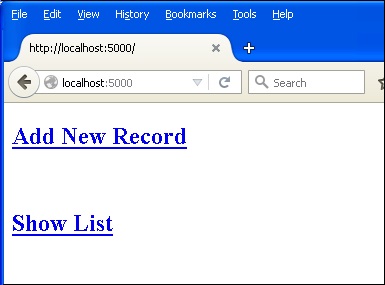
最后,**‘/’** URL 规则呈现一个 **‘home.html’**,它充当应用程序的入口点。
@app.route('/')
def home():
   return render_template('home.html')
以下是 **Flask-SQLite** 应用程序的完整代码。
from flask import Flask, render_template, request
import sqlite3 as sql
app = Flask(__name__)

@app.route('/')
def home():
   return render_template('home.html')

@app.route('/enternew')
def new_student():
   return render_template('student.html')

@app.route('/addrec',methods = ['POST', 'GET'])
def addrec():
   if request.method == 'POST':
      try:
         nm = request.form['nm']
         addr = request.form['add']
         city = request.form['city']
         pin = request.form['pin']

         with sql.connect("database.db") as con:
            cur = con.cursor()

            cur.execute("INSERT INTO students (name,addr,city,pin)
               VALUES (?,?,?,?)",(nm,addr,city,pin) )

            con.commit()
            msg = "Record successfully added"
      except:
         con.rollback()
         msg = "error in insert operation"

      finally:
         return render_template("result.html",msg = msg)
         con.close()

@app.route('/list')
def list():
   con = sql.connect("database.db")
   con.row_factory = sql.Row

   cur = con.cursor()
   cur.execute("select * from students")

   rows = cur.fetchall();
   return render_template("list.html",rows = rows)

if __name__ == '__main__':
   app.run(debug = True)
从 Python shell 运行此脚本,并启动开发服务器。在浏览器中访问 **https://:5000/**,它将显示一个简单的菜单,如下所示:
单击 **‘添加新记录’** 链接以打开 **学生信息** 表单。
填写表单字段并提交。底层函数将记录插入学生表中。
返回主页并单击 **‘显示列表’** 链接。将显示显示示例数据的表格。