
- Gensim教程
- Gensim - 首页
- Gensim - 简介
- Gensim - 入门
- Gensim - 文档与语料库
- Gensim - 向量与模型
- Gensim - 创建词典
- 创建词袋 (BoW) 语料库
- Gensim - 变换
- Gensim - 创建TF-IDF矩阵
- Gensim - 主题建模
- Gensim - 创建LDA主题模型
- Gensim - 使用LDA主题模型
- Gensim - 创建LDA Mallet模型
- Gensim - 文档与LDA模型
- Gensim - 创建LSI和HDP主题模型
- Gensim - 开发词嵌入
- Gensim - Doc2Vec模型
- Gensim有用资源
- Gensim - 快速指南
- Gensim - 有用资源
- Gensim - 讨论
Gensim - 文档与LDA模型
本章讨论Gensim中的文档和LDA模型。
查找LDA的最佳主题数量
我们可以通过创建许多具有不同主题值的LDA模型来找到LDA的最佳主题数量。在这些LDA中,我们可以选择一个具有最高一致性值的一个。
以下名为coherence_values_computation()的函数将训练多个LDA模型。它还将提供模型及其对应的一致性分数:
def coherence_values_computation(dictionary, corpus, texts, limit, start=2, step=3):
   coherence_values = []
   model_list = []
   for num_topics in range(start, limit, step):
      model = gensim.models.wrappers.LdaMallet(
         mallet_path, corpus=corpus, num_topics=num_topics, id2word=id2word
      )
      model_list.append(model)
   coherencemodel = CoherenceModel(
      model=model, texts=texts, dictionary=dictionary, coherence='c_v'
   )
   coherence_values.append(coherencemodel.get_coherence())
return model_list, coherence_values
现在,借助以下代码,我们可以获得最佳主题数量,我们也可以通过图表来显示:
model_list, coherence_values = coherence_values_computation (
   dictionary=id2word, corpus=corpus, texts=data_lemmatized,
   start=1, limit=50, step=8
)
limit=50; start=1; step=8;
x = range(start, limit, step)
plt.plot(x, coherence_values)
plt.xlabel("Num Topics")
plt.ylabel("Coherence score")
plt.legend(("coherence_values"), loc='best')
plt.show()
输出
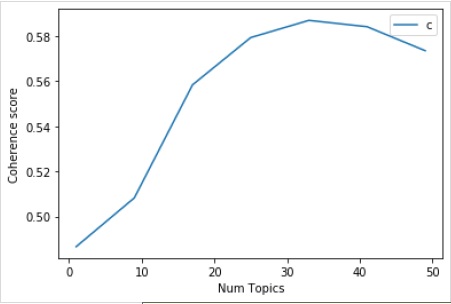
接下来,我们还可以打印不同主题的一致性值,如下所示:
for m, cv in zip(x, coherence_values):
   print("Num Topics =", m, " is having Coherence Value of", round(cv, 4))
输出
Num Topics = 1 is having Coherence Value of 0.4866
Num Topics = 9 is having Coherence Value of 0.5083
Num Topics = 17 is having Coherence Value of 0.5584
Num Topics = 25 is having Coherence Value of 0.5793
Num Topics = 33 is having Coherence Value of 0.587
Num Topics = 41 is having Coherence Value of 0.5842
Num Topics = 49 is having Coherence Value of 0.5735
现在,问题出现了,我们现在应该选择哪个模型?一个好的做法是选择在变平之前给出最高一致性值的模型。因此,我们将选择上面列表中编号为4的具有25个主题的模型。
optimal_model = model_list[3]
model_topics = optimal_model.show_topics(formatted=False)
pprint(optimal_model.print_topics(num_words=10))

[
   (0,
   '0.018*"power" + 0.011*"high" + 0.010*"ground" + 0.009*"current" + '
   '0.008*"low" + 0.008*"wire" + 0.007*"water" + 0.007*"work" + 0.007*"design" '
   '+ 0.007*"light"'),
   (1,
   '0.036*"game" + 0.029*"team" + 0.029*"year" + 0.028*"play" + 0.020*"player" '
   '+ 0.019*"win" + 0.018*"good" + 0.013*"season" + 0.012*"run" + 0.011*"hit"'),
   (2,
   '0.020*"image" + 0.019*"information" + 0.017*"include" + 0.017*"mail" + '
   '0.016*"send" + 0.015*"list" + 0.013*"post" + 0.012*"address" + '
   '0.012*"internet" + 0.012*"system"'),
   (3,
   '0.986*"ax" + 0.002*"_" + 0.001*"tm" + 0.000*"part" + 0.000*"biz" + '
   '0.000*"mb" + 0.000*"mbs" + 0.000*"pne" + 0.000*"end" + 0.000*"di"'),
   (4,
   '0.020*"make" + 0.014*"work" + 0.013*"money" + 0.013*"year" + 0.012*"people" '
   '+ 0.011*"job" + 0.010*"group" + 0.009*"government" + 0.008*"support" + '
   '0.008*"question"'),
   (5,
   '0.011*"study" + 0.011*"drug" + 0.009*"science" + 0.008*"food" + '
   '0.008*"problem" + 0.008*"result" + 0.008*"effect" + 0.007*"doctor" + '
   '0.007*"research" + 0.007*"patient"'),
   (6,
   '0.024*"gun" + 0.024*"law" + 0.019*"state" + 0.015*"case" + 0.013*"people" + '
   '0.010*"crime" + 0.010*"weapon" + 0.010*"person" + 0.008*"firearm" + '
   '0.008*"police"'),
   (7,
   '0.012*"word" + 0.011*"question" + 0.011*"exist" + 0.011*"true" + '
   '0.010*"religion" + 0.010*"claim" + 0.008*"argument" + 0.008*"truth" + '
   '0.008*"life" + 0.008*"faith"'),
   (8,
   '0.077*"time" + 0.029*"day" + 0.029*"call" + 0.025*"back" + 0.021*"work" + '
   '0.019*"long" + 0.015*"end" + 0.015*"give" + 0.014*"year" + 0.014*"week"'),
   (9,
   '0.048*"thing" + 0.041*"make" + 0.038*"good" + 0.037*"people" + '
   '0.028*"write" + 0.019*"bad" + 0.019*"point" + 0.018*"read" + 0.018*"post" + '
   '0.016*"idea"'),
   (10,
   '0.022*"book" + 0.020*"_" + 0.013*"man" + 0.012*"people" + 0.011*"write" + '
   '0.011*"find" + 0.010*"history" + 0.010*"armenian" + 0.009*"turkish" + '
   '0.009*"number"'),
   (11,
   '0.064*"line" + 0.030*"buy" + 0.028*"organization" + 0.025*"price" + '
   '0.025*"sell" + 0.023*"good" + 0.021*"host" + 0.018*"sale" + 0.017*"mail" + '
   '0.016*"cost"'),
   (12,
   '0.041*"car" + 0.015*"bike" + 0.011*"ride" + 0.010*"engine" + 0.009*"drive" '
   '+ 0.008*"side" + 0.008*"article" + 0.007*"turn" + 0.007*"front" + '
   '0.007*"speed"'),
   (13,
   '0.018*"people" + 0.011*"attack" + 0.011*"state" + 0.011*"israeli" + '
   '0.010*"war" + 0.010*"country" + 0.010*"government" + 0.009*"live" + '
   '0.009*"give" + 0.009*"land"'),
   (14,
   '0.037*"file" + 0.026*"line" + 0.021*"read" + 0.019*"follow" + '
   '0.018*"number" + 0.015*"program" + 0.014*"write" + 0.012*"entry" + '
   '0.012*"give" + 0.011*"check"'),
   (15,
   '0.196*"write" + 0.172*"line" + 0.165*"article" + 0.117*"organization" + '
   '0.086*"host" + 0.030*"reply" + 0.010*"university" + 0.008*"hear" + '
   '0.007*"post" + 0.007*"news"'),
   (16,
   '0.021*"people" + 0.014*"happen" + 0.014*"child" + 0.012*"kill" + '
   '0.011*"start" + 0.011*"live" + 0.010*"fire" + 0.010*"leave" + 0.009*"hear" '
   '+ 0.009*"home"'),
   (17,
   '0.038*"key" + 0.018*"system" + 0.015*"space" + 0.015*"technology" + '
   '0.014*"encryption" + 0.010*"chip" + 0.010*"bit" + 0.009*"launch" + '
   '0.009*"public" + 0.009*"government"'),
   (18,
   '0.035*"drive" + 0.031*"system" + 0.027*"problem" + 0.027*"card" + '
   '0.020*"driver" + 0.017*"bit" + 0.017*"work" + 0.016*"disk" + '
   '0.014*"monitor" + 0.014*"machine"'),
   (19,
   '0.031*"window" + 0.020*"run" + 0.018*"color" + 0.018*"program" + '
   '0.017*"application" + 0.016*"display" + 0.015*"set" + 0.015*"version" + '
   '0.012*"screen" + 0.012*"problem"')
]
查找句子中的主要主题
查找句子中的主要主题是主题建模最常用的实际应用之一。它确定给定文档的主题。在这里,我们将找到在该特定文档中贡献百分比最高的主题编号。为了汇总表中的信息,我们将创建一个名为dominant_topics()的函数:
def dominant_topics(ldamodel=lda_model, corpus=corpus, texts=data):
   sent_topics_df = pd.DataFrame()
接下来,我们将获得每个文档中的主要主题:
for i, row in enumerate(ldamodel[corpus]):
   row = sorted(row, key=lambda x: (x[1]), reverse=True)
接下来,我们将获得每个文档的主要主题、百分比贡献和关键词:
for j, (topic_num, prop_topic) in enumerate(row):
   if j == 0: # => dominant topic
      wp = ldamodel.show_topic(topic_num)
      topic_keywords = ", ".join([word for word, prop in wp])
sent_topics_df = sent_topics_df.append(
   pd.Series([int(topic_num), round(prop_topic,4), topic_keywords]), ignore_index=True
)
   else:
      break
sent_topics_df.columns = ['Dominant_Topic', 'Perc_Contribution', 'Topic_Keywords']
借助以下代码,我们将原始文本添加到输出的末尾:
contents = pd.Series(texts)
   sent_topics_df = pd.concat([sent_topics_df, contents], axis=1)
   return(sent_topics_df)
df_topic_sents_keywords = dominant_topics(
   ldamodel=optimal_model, corpus=corpus, texts=data
)
现在,对句子中的主题进行格式化,如下所示:
df_dominant_topic = df_topic_sents_keywords.reset_index()
df_dominant_topic.columns = [
   'Document_No', 'Dominant_Topic', 'Topic_Perc_Contrib', 'Keywords', 'Text'
]
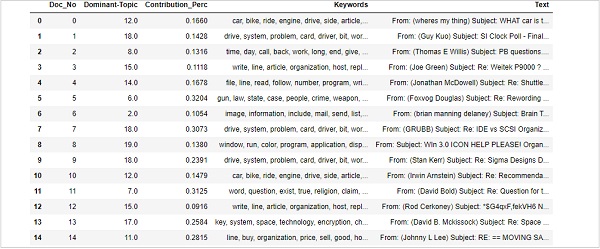
最后,我们可以显示主要主题,如下所示:
df_dominant_topic.head(15)
查找最具代表性的文档
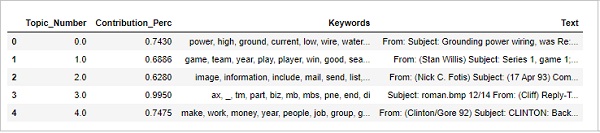
为了更好地理解主题,我们还可以找到给定主题对贡献最大的文档。我们可以通过阅读特定文档来推断该主题。
sent_topics_sorteddf_mallet = pd.DataFrame()
sent_topics_outdf_grpd = df_topic_sents_keywords.groupby('Dominant_Topic')
for i, grp in sent_topics_outdf_grpd:
   sent_topics_sorteddf_mallet = pd.concat([sent_topics_sorteddf_mallet,
grp.sort_values(['Perc_Contribution'], ascending=[0]).head(1)], axis=0)
sent_topics_sorteddf_mallet.reset_index(drop=True, inplace=True)
sent_topics_sorteddf_mallet.columns = [
   'Topic_Number', "Contribution_Perc", "Keywords", "Text"
]
sent_topics_sorteddf_mallet.head()
输出
主题的体积和分布
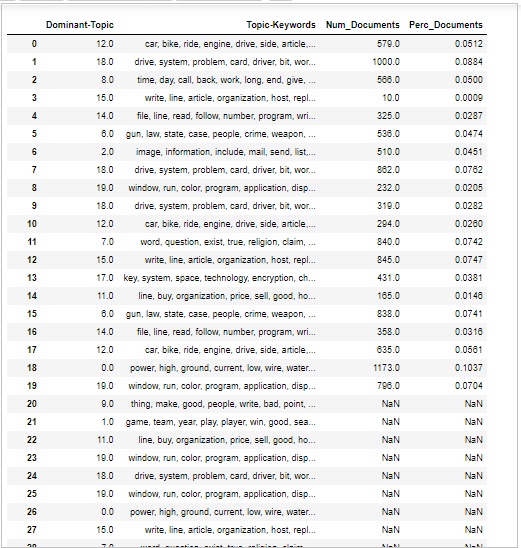
有时我们也想知道主题在文档中的讨论范围。为此,我们需要了解主题在文档中的体积和分布。
首先计算每个主题的文档数量,如下所示:
topic_counts = df_topic_sents_keywords['Dominant_Topic'].value_counts()
接下来,计算每个主题的文档百分比,如下所示:
topic_contribution = round(topic_counts/topic_counts.sum(), 4)
现在找到主题编号和关键词,如下所示:
topic_num_keywords = df_topic_sents_keywords[['Dominant_Topic', 'Topic_Keywords']]
现在,按列连接它们,如下所示:
df_dominant_topics = pd.concat(
   [topic_num_keywords, topic_counts, topic_contribution], axis=1
)
接下来,我们将更改列名,如下所示:
df_dominant_topics.columns = [
   'Dominant-Topic', 'Topic-Keywords', 'Num_Documents', 'Perc_Documents'
]
df_dominant_topics
输出
广告