
 数据结构
数据结构 网络
网络 关系型数据库管理系统
 操作系统
操作系统 Java
Java MS Excel
 iOS
iOS HTML
HTML CSS
CSS Android
 Python
 C 编程
C 编程 C++
C++ C#
C# MongoDB
 MySQL
MySQL Javascript
 PHP
PHP 物理学
物理学 化学
化学 生物学
生物学 数学
数学 英语
英语 经济学
经济学 心理学
心理学 社会学
社会学 时尚研究
时尚研究 法律研究
法律研究如何在没有 Google API 的情况下用 Kotlin 在 Android 中开发语音识别器?
本示例展示了如何在没有 Google API 的情况下用 Kotlin 在 Android 中开发语音识别器。
步骤 1 − 在 Android Studio 中创建一个新项目,转到文件 ? 新项目,并填写所有必需的详细信息以创建一个新项目。
步骤 2 − 将以下代码添加到 res/layout/activity_main.xml。
示例
<?xml version="1.0" encoding="utf-8"?>
<RelativeLayout xmlns:android="http://schemas.android.com/apk/res/android"
   android:layout_width="match_parent"
   android:layout_height="match_parent"
   android:orientation="vertical">
   <ImageView
      android:id="@+id/imageView"
      android:layout_width="200dp"
      android:layout_height="200dp"
      android:layout_centerInParent="true"
      android:src="@drawable/ic_mic" />
   <ProgressBar
      android:id="@+id/progressBar"
      style="?android:attr/progressBarStyleHorizontal"
      android:layout_width="match_parent"
      android:layout_height="wrap_content"
      android:layout_below="@+id/toggleButton"
      android:layout_alignParentStart="true"
      android:layout_marginTop="28dp"
      android:paddingLeft="10dp"
      android:paddingRight="10dp" />
   <TextView
      android:id="@+id/textView"
      android:layout_width="wrap_content"
      android:layout_height="wrap_content"
      android:layout_below="@+id/progressBar"
      android:layout_centerHorizontal="true"
      android:layout_marginTop="47dp" />
   <ToggleButton
      android:id="@+id/toggleButton"
      android:layout_width="wrap_content"
      android:layout_height="wrap_content"
      android:layout_alignParentTop="true"
      android:layout_centerHorizontal="true"
      android:layout_marginTop="26dp"
      android:text="ToggleButton" />
</RelativeLayout>
步骤 3 − 将以下代码添加到 src/MainActivity.kt
示例
import android.Manifest
import android.content.Intent
import android.content.pm.PackageManager
import android.os.Bundle
import android.speech.RecognitionListener
import android.speech.RecognizerIntent
import android.speech.SpeechRecognizer
import android.util.Log
import android.view.View
import android.widget.ProgressBar
import android.widget.TextView
import android.widget.Toast
import android.widget.ToggleButton
import androidx.appcompat.app.AppCompatActivity
import androidx.core.app.ActivityCompat
class MainActivity : AppCompatActivity(), RecognitionListener {
   private val permission = 100
   private lateinit var returnedText: TextView
   private lateinit var toggleButton: ToggleButton
   private lateinit var progressBar: ProgressBar
   private lateinit var speech: SpeechRecognizer
   private lateinit var recognizerIntent: Intent
   private var logTag = "VoiceRecognitionActivity"
   override fun onCreate(savedInstanceState: Bundle?) {
      super.onCreate(savedInstanceState)
      setContentView(R.layout.activity_main)
      title = "KotlinApp"
      returnedText = findViewById(R.id.textView)
      progressBar = findViewById(R.id.progressBar)
      toggleButton = findViewById(R.id.toggleButton)
      progressBar.visibility = View.VISIBLE
      speech = SpeechRecognizer.createSpeechRecognizer(this)
      Log.i(logTag, "isRecognitionAvailable: " + SpeechRecognizer.isRecognitionAvailable(this))
      speech.setRecognitionListener(this)
      recognizerIntent = Intent(RecognizerIntent.ACTION_RECOGNIZE_SPEECH)
      recognizerIntent.putExtra(RecognizerIntent.EXTRA_LANGUAGE_PREFERENCE, "US-en")
      recognizerIntent.putExtra(RecognizerIntent.EXTRA_LANGUAGE_MODEL,
      RecognizerIntent.LANGUAGE_MODEL_FREE_FORM)
      recognizerIntent.putExtra(RecognizerIntent.EXTRA_MAX_RESULTS, 3)
      toggleButton.setOnCheckedChangeListener { _, isChecked ->
         if (isChecked) {
            progressBar.visibility = View.VISIBLE
            progressBar.isIndeterminate = true
            ActivityCompat.requestPermissions(this@MainActivity,
            arrayOf(Manifest.permission.RECORD_AUDIO),
            permission)
         } else {
            progressBar.isIndeterminate = false
            progressBar.visibility = View.VISIBLE
            speech.stopListening()
         }
      }
   }
   override fun onRequestPermissionsResult(requestCode: Int, permissions: Array<String?>,
   grantResults: IntArray) {
      super.onRequestPermissionsResult(requestCode, permissions, grantResults)
      when (requestCode) {
         permission -> if (grantResults.isNotEmpty() && grantResults[0] == PackageManager
         .PERMISSION_GRANTED) {
            speech.startListening(recognizerIntent)
         } else {
            Toast.makeText(this@MainActivity, "Permission Denied!",
            Toast.LENGTH_SHORT).show()
         }
      }
   }
   override fun onStop() {
      super.onStop()
      speech.destroy()
      Log.i(logTag, "destroy")
   }
   override fun onReadyForSpeech(params: Bundle?) {
      TODO("Not yet implemented")
   }
   override fun onRmsChanged(rmsdB: Float) {
      progressBar.progress = rmsdB.toInt()
   }
   override fun onBufferReceived(buffer: ByteArray?) {
      TODO("Not yet implemented")
   }
   override fun onPartialResults(partialResults: Bundle?) {
      TODO("Not yet implemented")
   }
   override fun onEvent(eventType: Int, params: Bundle?) {
      TODO("Not yet implemented")
   }
   override fun onBeginningOfSpeech() {
      Log.i(logTag, "onBeginningOfSpeech")
      progressBar.isIndeterminate = false
      progressBar.max = 10
   }
   override fun onEndOfSpeech() {
      progressBar.isIndeterminate = true
      toggleButton.isChecked = false
   }
   override fun onError(error: Int) {
      val errorMessage: String = getErrorText(error)
      Log.d(logTag, "FAILED $errorMessage")
      returnedText.text = errorMessage
      toggleButton.isChecked = false
   }
   private fun getErrorText(error: Int): String {
      var message = ""
      message = when (error) {
         SpeechRecognizer.ERROR_AUDIO -> "Audio recording error"
         SpeechRecognizer.ERROR_CLIENT -> "Client side error"
         SpeechRecognizer.ERROR_INSUFFICIENT_PERMISSIONS -> "Insufficient permissions"
         SpeechRecognizer.ERROR_NETWORK -> "Network error"
         SpeechRecognizer.ERROR_NETWORK_TIMEOUT -> "Network timeout"
         SpeechRecognizer.ERROR_NO_MATCH -> "No match"
         SpeechRecognizer.ERROR_RECOGNIZER_BUSY -> "RecognitionService busy"
         SpeechRecognizer.ERROR_SERVER -> "error from server"
         SpeechRecognizer.ERROR_SPEECH_TIMEOUT -> "No speech input"
         else -> "Didn't understand, please try again."
      }
      return message
   }
   override fun onResults(results: Bundle?) {
      Log.i(logTag, "onResults")
      val matches = results!!.getStringArrayList(SpeechRecognizer.RESULTS_RECOGNITION)
      var text = ""
      for (result in matches) text = """
      $result
      """.trimIndent()
      returnedText.text = text
   }
}
步骤 4 − 将以下代码添加到 androidManifest.xml
示例
<?xml version="1.0" encoding="utf-8"?>
<manifest xmlns:android="http://schemas.android.com/apk/res/android" package="app.com.myapplication">
   <uses-permission android:name="android.permission.RECORD_AUDIO" />
   <uses-permission android:name="android.permission.INTERNET" />
   <application
      android:allowBackup="true"
      android:icon="@mipmap/ic_launcher"
      android:label="@string/app_name"
      android:roundIcon="@mipmap/ic_launcher_round"
      android:supportsRtl="true"
      android:theme="@style/AppTheme">
      <activity android:name=".MainActivity">
         <intent-filter>
            <action android:name="android.intent.action.MAIN" />
            <category android:name="android.intent.category.LAUNCHER" />
         </intent-filter>
      </activity>
   </application>
</manifest>
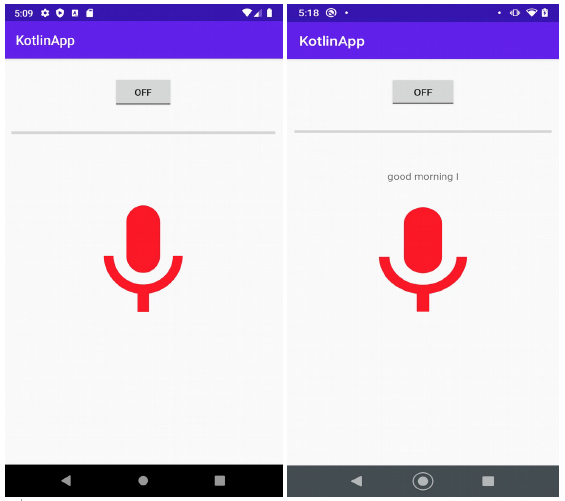
让我们尝试运行你的应用程序。我假设你已将你的实际 Android 移动设备连接到了你的计算机。要从 android studio 中运行该应用程序,请打开一个项目活动文件并单击工具栏中的运行图标 。选择你的移动设备作为选项,然后检查将显示默认界面的移动设备 −

更新于: 2020 年 5 月 23 日
2K+ 浏览量

广告