
 数据结构
数据结构 网络
网络 关系数据库管理系统 (RDBMS)
 操作系统
操作系统 Java
Java MS Excel
 iOS
iOS HTML
HTML CSS
CSS Android
 Python
 C语言编程
C语言编程 C++
C++ C#
C# MongoDB
 MySQL
MySQL Javascript
 PHP
PHP 物理学
物理学 化学
化学 生物学
生物学 数学
数学 英语
英语 经济学
经济学 心理学
心理学 社会学
社会学 服装学
服装学 法学
法学包含元音的最长公共子序列长度
在这个问题中,我们的任务是找到两个字符串中存在的最长公共子序列的长度,条件是子序列的每个字母都必须是元音。借助递归算法和迭代算法,可以解决给定的问题陈述。在英文字母表中,存在五个元音字母:“A”、“E”、“I”、“O”、“U”。子序列与子串:在子序列中,我们可以以非连续的方式取字符,但在子串中,我们只能取连续的字符。
例如:在字符串“TutorialsPoint”中:“tri”是子序列,但不是子串。而“tor”既是子序列又是子串。
举几个例子
示例1
字符串1:“point”
字符串2:“tutorials”
包含元音的公共子序列长度:2
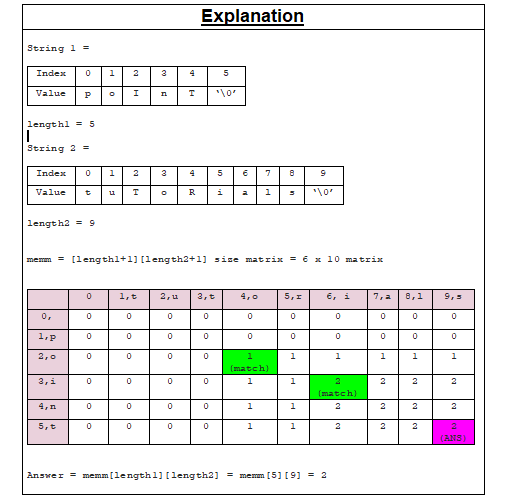
示例2
字符串1:“longestsub”
字符串2:“ohbekhfuo”
包含元音的公共子序列长度:3
递归子结构
If idx_1 = 0 or idx_2 = 0, Then
	LCSVowels(idx1, idx2) = 0
Else If str1[idx_1-1] = str2[idx_2-1] and str1[idx_1-1] = Vowel, Then
	LCSVowels(idx_1, idx_2) = 1 + LCSVowels(idx_1-1, idx_2-1)
Else
	LCSVowels(idx_1, idx_2) = max(LCSVowels(idx_1, idx_2-1), LCSVowels(idx_1-1, idx_2))
多种方法
我们提供了多种方法的解决方案。
迭代算法。
递归算法。
方法1:迭代算法
这是一种基于迭代算法的动态规划方法。
算法:LCSVowels(string1, string2)
步骤1:length1 = LENGTH(string1)
步骤2:length2 = LENGTH(string2)
步骤3:创建一个大小为(length1+1) X (length2+1)的二维整数数组“memm”。
步骤4:将第一行的所有列设置为0。
步骤5:将第一列的所有行设置为0。
步骤6:使用for循环LOOP (idx_1 = 1 到 length1)
步骤7:使用内循环LOOP(idx_2 = 1 到 length2)
步骤8:检查条件IF (string1[idx_1-1] == string2[idx_2-1] AND string1[idx_1-1] == 元音), THEN
步骤9:memm[idx_1][idx_2] = 1 + memm[idx_1-1][idx_2-1];
步骤10:否则 memm[idx_1][idx_2]=MAX(memm[idx_1][idx_2-1],memm[idx_1-1][idx_2])
步骤11:RETURN memm[length1][length2]
示例
#include <iostream>
using namespace std;

/**
* @param ch: character parameter
*
* @return true: if ch == vowel
* @return false: if ch == consonent
*/
bool checkVowel(char chr) {
   switch(chr) {
       case 'A':
       case 'E':
       case 'I':
       case 'O':
       case 'U':
       case 'a':
       case 'e':
       case 'i':
       case 'o':
       case 'u':
           return true;
           break;
       default:
           return false;
           break;
   }
}

/**
* @param num1: first number
* @param num2: second number
*
* @return maximum number
*/
int maxx(int first, int second) {
   if (first >= second)
       return first;
   else
       return second;
}

/**
* @param string1: First String
* @param string2: Second String
*
* @return Length of maximum common subsequence containing vowels
*/
int LCSVowels(string string1, string string2) {
   int length1 = string1.length();
   int length2 = string2.length();
   // create memory array for using Dynamic Programming
   int memm[length1+1][length2+2];
   // make first column zero
   for (int idx_ = 0; idx_ <= length1; ++idx_) {
       memm[idx_][0] = 0;
   }
   // make first row zero
   for (int idx_=0; idx_ <= length2; ++idx_) {
       memm[0][idx_] = 0;
   }

   // traverse the DP matrix
   for (int idx_1=1; idx_1<=length1; ++idx_1) {
       for (int idx_2=1; idx_2<=length2; ++idx_2) {
           // if characters are equal and also they are vowels
           if (string1[idx_1-1] == string2[idx_2-1] && checkVowel(string1[idx_1-1])) {
               memm[idx_1][idx_2] = 1 + memm[idx_1-1][idx_2-1];
           } else {
               memm[idx_1][idx_2] = maxx(memm[idx_1][idx_2-1], memm[idx_1-1][idx_2]);
           }
       }
   }

   return memm[length1][length2];
}
int main() {
   string string1, string2;
     // Ask string 1
   cout << "Enter String 1: ";
   cin >> string1;
   // Ask String 2
   cout << "Enter String 2: ";
   cin >> string2;
   // call the function
   int lcs = LCSVowels(string1, string2);
   // display the result
   cout << "Length of Longest Common Subsequence containing vowels: " << lcs << endl;

   return 0;
}
输出
Enter String 1: point
Enter String 2: tutorials
Length of Longest Common Subsequence containing vowels: 2
程序时间复杂度 = O(length1 x length2)
程序空间复杂度 = O(length1 x length2)
方法2:递归算法
这是一种基于递归算法的动态规划方法。
算法:LCS_Vowels(string1, string2, idx1, idx2, memm)
步骤1:IF (idx1 == -1 OR idx2 == -1), THEN RETURN 0
步骤2:IF (memm[idx1][idx2] != -1), THEN RETURN memm[idx1][idx2]
步骤3:IF (string1[idx_1] == string2[idx_2] AND string1[idx_1] == 元音), THEN
步骤4:memm[idx1][idx2] = 1 + LCS_Vowels(string1, string2, idx1-1, idx2-1, memm)
步骤5:否则,设置memm[idx1][idx2]=MAX(LCS_Vowels(string1, string2, idx1-1, idx2, memm)
, LCS_Vowels(string1, string2, idx1, idx2-1, memm))
步骤7:END IF
步骤8:RETURN memm[idx1][idx2]
示例
#include <iostream>
using namespace std;

/**
* @param ch: character parameter
*
* @return true: if ch == vowel
* @return false: if ch == consonent
*/
bool check_Vowel(char _chr) {
   switch(_chr) {
       case 'A':
       case 'E':
       case 'I':
       case 'O':
       case 'U':
       case 'a':
       case 'e':
       case 'i':
       case 'o':
       case 'u':
           return true;
           break;
       default:
           return false;
           break;
   }
}

/**
* @param num1: first number
* @param num2: second number
*
* @return maximum number
*/
int maxx(int first, int second) {
   if (first >= second)
       return first;
   else
       return second;
}

/**
* @param ABC: First String
* @param XYZ: Second String
* @param ABC_IDX: index for string-A
* @param XYZ_IDX: index for string-B
* @param memm: DP matrix
*/
int LCS_Vowels(string ABC, string XYZ, int ABC_IDX, int XYZ_IDX, int memm[1000][1000]) {
   if (ABC_IDX == -1 || XYZ_IDX == -1)
       return 0;

   if (memm[ABC_IDX][XYZ_IDX] != -1)
       return memm[ABC_IDX][XYZ_IDX];

   if (ABC[ABC_IDX] == XYZ[XYZ_IDX] && check_Vowel(ABC[ABC_IDX])) {
       memm[ABC_IDX][XYZ_IDX] = LCS_Vowels(ABC, XYZ, ABC_IDX-1, XYZ_IDX-1, memm) + 1;
   } else {
       memm[ABC_IDX][XYZ_IDX] = maxx(
           LCS_Vowels(ABC, XYZ, ABC_IDX-1, XYZ_IDX, memm),
           LCS_Vowels(ABC, XYZ, ABC_IDX, XYZ_IDX-1, memm)
       );
   }

   return memm[ABC_IDX][XYZ_IDX];
}

int main() {
   string ABC, XYZ;

   // Ask string 1
   cout << "Enter String 1: ";
   cin >> ABC;

   // Ask String 2
   cout << "Enter String 2: ";
   cin >> XYZ;

   int LENGTH_1 = ABC.length();
   int LENGTH_2 = XYZ.length();

   int memm[1000][1000];
   for (int p=0; p<1000; ++p) {
       for (int q=0; q<1000; ++q) {
           memm[p][q] = -1;
       }
   }

   // call the function
   int lcs = LCS_Vowels(ABC, XYZ, LENGTH_1-1, LENGTH_2-1, memm);

   // display the result
   cout << "Length of Longest Common Subsequence containing vowels: " << lcs << endl;

   return 0;
}
输出
Enter String 1: longestsub
Enter String 2: ohbekhfuo
Length of Longest Common Subsequence containing vowels: 3
程序时间复杂度 = O(length1 x length2)
程序空间复杂度 = O(length1 x length2)
最后,本文描述了一个C++代码,它成功地利用动态规划解决了给定的问题。这些算法使用O(length1 x length2)的时间复杂度和空间复杂度来解决问题。

222 次浏览
