
 数据结构
数据结构 网络
网络 关系数据库管理系统
 操作系统
操作系统 Java
Java MS Excel
 iOS
iOS HTML
HTML CSS
CSS Android
 Python
 C 编程
C 编程 C++
C++ C#
C# MongoDB
 MySQL
MySQL Javascript
 PHP
PHP 物理学
物理学 化学
化学 生物学
生物学 数学
数学 英语
英语 经济学
经济学 心理学
心理学 社会学
社会学 服装设计
服装设计 法律研究
法律研究使用 C++ 打印从给定源到目标的所有路径
在这个问题中,我们给定了一个有向图,我们需要打印从图的源到目标的所有路径。
有向图是指边从顶点 a 指向顶点 b 的图。
让我们举个例子来理解这个问题
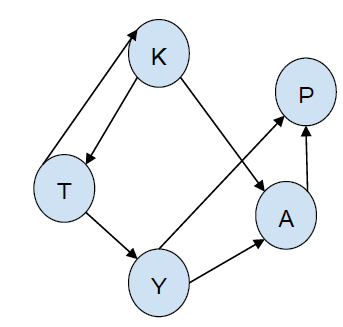
源 = K 目标 = P
输出
K -> T -> Y -> A -> P
K -> T -> Y -> P
K -> A -> P
在这里,我们找到了从 K 到 P 的路径。我们遍历了路径并打印了从 K 到 P 的所有路径。
为了解决这个问题,我们将使用深度优先搜索遍历技术遍历图。从源开始,我们将遍历存储在我们路径数组中的每个顶点,并将其标记为已访问(以避免多次访问同一个顶点)。当到达目标顶点时,打印此路径。
让我们看看实现该逻辑的程序 -
示例
#include<iostream>
#include <list>
using namespace std;
class Graph {
   int V;
   list<int> *adj;
   void findNewPath(int , int , bool [], int [], int &);
   public:
   Graph(int V);
   void addEdge(int u, int v);
   void printPaths(int s, int d);
};
Graph::Graph(int V) {
   this->V = V;
   adj = new list<int>[V];
}
void Graph::addEdge(int u, int v) {
   adj[u].push_back(v);
}
void Graph::printPaths(int s, int d) {
   bool *visited = new bool[V];
   int *path = new int[V];
   int path_index = 0;
   for (int i = 0; i < V; i++)
   visited[i] = false;
   findNewPath(s, d, visited, path, path_index);
}
void Graph::findNewPath(int u, int d, bool visited[],
int path[], int &path_index) {
   visited[u] = true;
   path[path_index] = u;
   path_index++;
   if (u == d) {
      for (int i = 0; i<path_index; i++)
      cout<<path[i]<<" ";
      cout << endl;
   } else {
      list<int>::iterator i;
      for (i = adj[u].begin(); i != adj[u].end(); ++i)
         if (!visited[*i])
            findNewPath(*i, d, visited, path, path_index);
   }
   path_index--;
   visited[u] = false;
}
int main() {
   Graph g(4);
   g.addEdge(0, 1);
   g.addEdge(0, 2);
   g.addEdge(0, 3);
   g.addEdge(2, 0);
   g.addEdge(2, 1);
   g.addEdge(1, 3);
   int s = 2, d = 3;
   cout<<"Following are all different paths from source to destination : \n";
   g.printPaths(s, d);
   return 0;
}
输出
Following are all different paths from source to destination :
2 0 1 3
2 0 3
2 1 3

更新于: 2020年1月16日
285 次浏览

广告