
- FastAPI 教程
- FastAPI - 首页
- FastAPI - 简介
- FastAPI - Hello World
- FastAPI - OpenAPI
- FastAPI - Uvicorn
- FastAPI - 类型提示
- FastAPI - IDE 支持
- FastAPI - REST 架构
- FastAPI - 路径参数
- FastAPI - 查询参数
- FastAPI - 参数验证
- FastAPI - Pydantic
- FastAPI - 请求体
- FastAPI - 模板
- FastAPI - 静态文件
- FastAPI - HTML 表单模板
- FastAPI - 访问表单数据
- FastAPI - 上传文件
- FastAPI - Cookie 参数
- FastAPI - 头部参数
- FastAPI - 响应模型
- FastAPI - 嵌套模型
- FastAPI - 依赖项
- FastAPI - CORS
- FastAPI - CRUD 操作
- FastAPI - SQL 数据库
- FastAPI - 使用 MongoDB
- FastAPI - 使用 GraphQL
- FastAPI - Websockets
- FastAPI - FastAPI 事件处理器
- FastAPI - 挂载子应用
- FastAPI - 中间件
- FastAPI - 挂载 Flask 应用
- FastAPI - 部署
- FastAPI 有用资源
- FastAPI - 快速指南
- FastAPI - 有用资源
- FastAPI - 讨论
FastAPI - 静态文件
通常需要在模板响应中包含一些即使存在某些动态数据也不会更改的资源。此类资源称为静态资产。媒体文件(.png、.jpg 等)、用于执行某些前端代码的 JavaScript 文件或用于格式化 HTML 的样式表(.CSS 文件)都是静态文件的示例。
为了处理静态文件,您需要一个名为aiofiles的库。
pip3 install aiofiles
接下来,从fastapi.staticfiles模块导入StaticFiles类。它的对象是 FastAPI 应用程序对象的mount()方法的参数之一,用于将当前应用程序文件夹中的"static"子文件夹分配给存储和服务应用程序的所有静态资产。
app.mount(app.mount("/static", StaticFiles(directory="static"), name="static")
示例
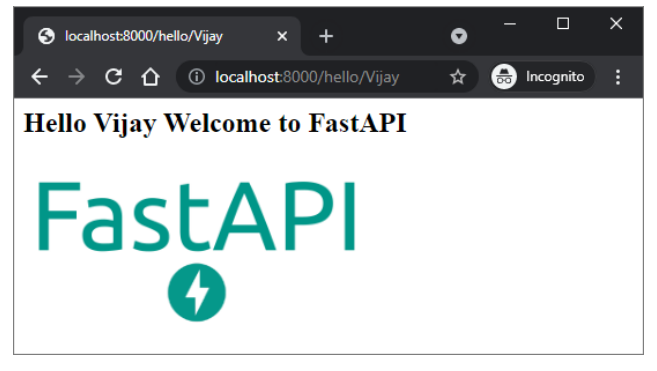
在以下示例中,需要在 hello.html 模板中呈现 FastAPI 徽标。因此,首先将“fa-logo.png”文件放置在 static 文件夹中。现在可以使用 HTML 代码中<img>标签的src属性来使用它。
from fastapi import FastAPI, Request
from fastapi.responses import HTMLResponse
from fastapi.templating import Jinja2Templates
from fastapi.staticfiles import StaticFiles
app = FastAPI()
templates = Jinja2Templates(directory="templates")
app.mount("/static", StaticFiles(directory="static"), name="static")
@app.get("/hello/{name}", response_class=HTMLResponse)
async def hello(request: Request, name:str):
   return templates.TemplateResponse("hello.html", {"request": request, "name":name})
\templates\hello.html的 HTML 代码如下所示:
<html>
   <body>
      <h2>Hello {{name}} Welcome to FastAPI</h2>
      <img src="{{ url_for('static', path='fa-logo.png') }}" alt="" width="300">
   </body>
</html>
</pre>
运行 Uvicorn 服务器并访问 URL https:///hello/Vijay。徽标将显示在浏览器窗口中,如下所示。
示例
这是另一个静态文件的示例。JavaScript 代码 hello.js 包含myfunction()的定义,该函数在以下 HTML 脚本(\templates\hello.html)中的onload事件上执行。
<html>
   <head>
      <title>My Website</title>
      <script src="{{ url_for('static', path='hello.js') }}"></script>
   </head>
   <body onload="myFunction()">
      <div id="time" style="text-align:right; width="100%"></div>
      <h1><div id="ttl">{{ name }}</div></h1>
   </body>
</html>
hello.js代码如下所示:(\static\hello.js)
function myFunction() {
   var today = new Date();
   var h = today.getHours();
   var m = today.getMinutes();
   var s = today.getSeconds();
   var msg="";
   if (h<12) {
      msg="Good Morning, ";
   }
   if (h>=12 && h<18) {
      msg="Good Afternoon, ";
   }
   if (h>=18) {
      msg="Good Evening, ";
   }
   var x=document.getElementById('ttl').innerHTML;
   document.getElementById('ttl').innerHTML = msg+x;
   document.getElementById('time').innerHTML = h + ":" + m + ":" + s;
}
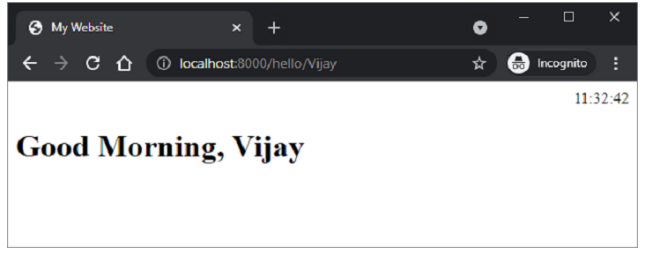
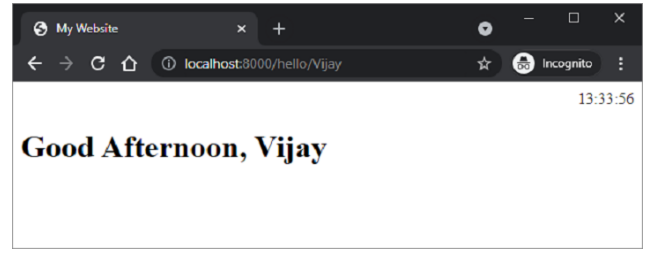
该函数检测当前时间的值,并根据一天中的时间为msg变量分配适当的值(早上好、下午好或晚上好)。
保存/static/hello.js,修改\templates\hello.html并重新启动服务器。浏览器应显示当前时间及其下方的相应消息。
广告