
 数据结构
数据结构 网络
网络 关系数据库管理系统 (RDBMS)
 操作系统
操作系统 Java
Java MS Excel
 iOS
iOS HTML
HTML CSS
CSS Android
 Python
 C语言编程
C语言编程 C++
C++ C#
C# MongoDB
 MySQL
MySQL Javascript
 PHP
PHP 物理
物理 化学
化学 生物
生物 数学
数学 英语
英语 经济学
经济学 心理学
心理学 社会研究
社会研究 服装研究
服装研究 法律研究
法律研究如何在Android应用中创建多级ListView?
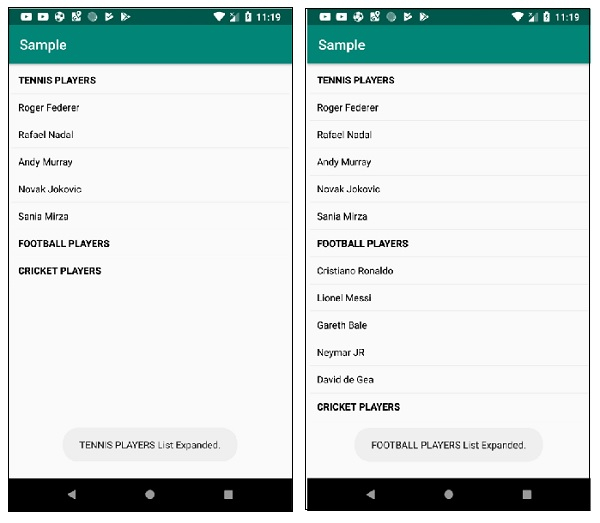
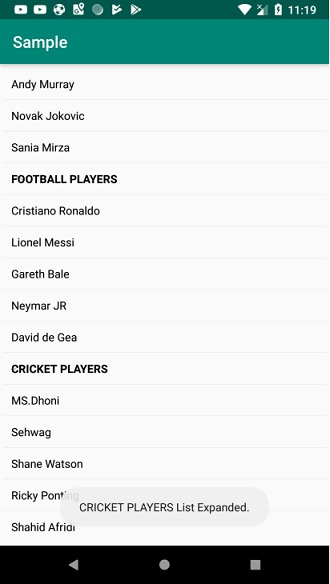
本例演示了如何在Android中创建多级ListView。
步骤1 - 在Android Studio中创建一个新项目,转到文件 ⇒ 新建项目,并填写所有必需的详细信息以创建新项目。
步骤2 - 将以下代码添加到res/layout/activity_main.xml。
<?xml version="1.0" encoding="utf-8"?>
<RelativeLayout xmlns:android="http://schemas.android.com/apk/res/android"
   xmlns:tools="http://schemas.android.com/tools"
   android:layout_width="match_parent"
   android:padding="4dp"
   android:layout_height="match_parent"
   tools:context=".MainActivity">
   <ExpandableListView
      android:id="@+id/expendableList"
      android:layout_width="match_parent"
      android:layout_height="match_parent"
      android:divider="@android:color/background_light"
      android:dividerHeight="0.5dp"/>
</RelativeLayout>
步骤3 - 将以下代码添加到src/MainActivity.java
import androidx.appcompat.app.AppCompatActivity;
import android.os.Bundle;
import android.view.View;
import android.widget.ExpandableListAdapter;
import android.widget.ExpandableListView;
import android.widget.Toast;
import java.util.ArrayList;
import java.util.HashMap;
import java.util.List;
public class MainActivity extends AppCompatActivity {
   ExpandableListView expandableListView;
   ExpandableListAdapter expandableListAdapter;
   List<String>expandableListTitle;
   HashMap<String, List<String>> expandableListDetail;
   @Override
   protected void onCreate(Bundle savedInstanceState) {
      super.onCreate(savedInstanceState);
      setContentView(R.layout.activity_main);
      expandableListView = findViewById(R.id.expendableList);
      expandableListDetail = ExpandableListData.getData();
      expandableListTitle = new ArrayList<>(expandableListDetail.keySet());
      expandableListAdapter = new CustomExpandableListAdapter(this, expandableListTitle, expandableListDetail);
      expandableListView.setAdapter(expandableListAdapter);
      expandableListView.setOnGroupExpandListener(new ExpandableListView.OnGroupExpandListener() {
         @Override
         public void onGroupExpand(int groupPosition) {
         Toast.makeText(getApplicationContext(), expandableListTitle.get(groupPosition)
            + " List Expanded.", Toast.LENGTH_SHORT).show();
      }
   });
   expandableListView.setOnGroupCollapseListener(new ExpandableListView.OnGroupCollapseListener() {
      @Override
      public void onGroupCollapse(int groupPosition) {
         Toast.makeText(getApplicationContext(), expandableListTitle.get(groupPosition) + " List Collapsed.",
            Toast.LENGTH_SHORT).show();
      }
   });
   expandableListView.setOnChildClickListener(new ExpandableListView.OnChildClickListener() {
      @Override
      public boolean onChildClick(ExpandableListView parent, View v, int groupPosition, int childPosition, long id) {
            Toast.makeText( getApplicationContext(), expandableListTitle.get(groupPosition) + "
               -> " + expandableListDetail.get( expandableListTitle.get(groupPosition)).get( childPosition), Toast.LENGTH_SHORT ).show();
            return false;
         }
      });
   }
}
步骤4 - 创建一个java类(ExpandableListData.java)和以下代码
import java.util.ArrayList;
import java.util.HashMap;
import java.util.List;
class ExpandableListData {
   static HashMap<String, List<String>> getData() {
      HashMap<String, List<String>> expandableListDetail = new HashMap<>();
      List<String> myFavCricketPlayers = new ArrayList<>();
      myFavCricketPlayers.add("MS.Dhoni");
      myFavCricketPlayers.add("Sehwag");
      myFavCricketPlayers.add("Shane Watson");
      myFavCricketPlayers.add("Ricky Ponting");
      myFavCricketPlayers.add("Shahid Afridi");
      List<String> myFavFootballPlayers = new ArrayList<String>();
      myFavFootballPlayers.add("Cristiano Ronaldo");
      myFavFootballPlayers.add("Lionel Messi");
      myFavFootballPlayers.add("Gareth Bale");
      myFavFootballPlayers.add("Neymar JR");
      myFavFootballPlayers.add("David de Gea");
      List<String> myFavTennisPlayers = new ArrayList<String>();
      myFavTennisPlayers.add("Roger Federer");
      myFavTennisPlayers.add("Rafael Nadal");
      myFavTennisPlayers.add("Andy Murray");
      myFavTennisPlayers.add("Novak Jokovic");
      myFavTennisPlayers.add("Sania Mirza");
      expandableListDetail.put("CRICKET PLAYERS", myFavCricketPlayers);
      expandableListDetail.put("FOOTBALL PLAYERS", myFavFootballPlayers);
      expandableListDetail.put("TENNIS PLAYERS", myFavTennisPlayers);
      return expandableListDetail;
   }
}
步骤5 - 创建一个java类(CustomExpandableListAdapter.java)和以下代码
package app.com.sample;
import android.content.Context;
import android.graphics.Typeface;
import android.view.LayoutInflater;
import android.view.View;
import android.view.ViewGroup;
import android.widget.BaseExpandableListAdapter;
import android.widget.TextView;
import java.util.HashMap;
import java.util.List;
import java.util.Objects;
class CustomExpandableListAdapter extends BaseExpandableListAdapter {
   private Context context;
   private List<String> expandableListTitle;
   private HashMap<String, List<String>> expandableListDetail;
   CustomExpandableListAdapter(Context context, List<String> expandableListTitle, HashMap<String, List<String>> expandableListDetail) {
      this.context = context;
      this.expandableListTitle = expandableListTitle;
      this.expandableListDetail = expandableListDetail;
   }
   @Override
   public Object getChild(int listPosition, int expandedListPosition) {
      return
      Objects.requireNonNull(this.expandableListDetail.get(this.expandableListTitle.get(list Position))).get(expandedListPosition);
   }
   @Override
   public long getChildId(int listPosition, int expandedListPosition) {
      return expandedListPosition;
   }
   @Override
   public View getChildView(int listPosition, final int expandedListPosition, boolean isLastChild, View convertView, ViewGroup parent) {
      final String expandedListText = (String) getChild(listPosition, expandedListPosition);
      if (convertView == null) {
         LayoutInflater layoutInflater = (LayoutInflater) this.context.getSystemService(Context.LAYOUT_INFLATER_SERVICE);
         convertView = Objects.requireNonNull(layoutInflater).inflate(R.layout.list_row, null);
      }
      TextView textView = convertView.findViewById(R.id.listTitle);
      textView.setText(expandedListText);
      return convertView;
   }
   @Override
   public int getChildrenCount(int listPosition) {
      return
      this.expandableListDetail.get(this.expandableListTitle.get(listPosition)).size();
   }
   @Override
   public Object getGroup(int listPosition) {
      return this.expandableListTitle.get(listPosition);
   }
   @Override
   public int getGroupCount() {
      return this.expandableListTitle.size();
   }
   @Override
   public long getGroupId(int listPosition) {
      return listPosition;
   }
   @Override
   public View getGroupView(int listPosition, boolean isExpanded, View convertView, ViewGroup parent) {
      String listTitle = (String) getGroup(listPosition);
      if (convertView == null) {
         LayoutInflater layoutInflater = (LayoutInflater) this.context. getSystemService(Context.LAYOUT_INFLATER_SERVICE);
         convertView = Objects.requireNonNull(layoutInflater).inflate(R.layout.list_row, null);
      }
      TextView listTitleTextView = convertView.findViewById(R.id.listTitle);
      listTitleTextView.setTypeface(null, Typeface.BOLD);
      listTitleTextView.setText(listTitle);
      return convertView;
   }
   @Override
   public boolean hasStableIds() {
      return false;
   }
   @Override
   public boolean isChildSelectable(int listPosition, int expandedListPosition) {
      return true;
   }
}
步骤6 - 创建一个布局资源文件(list_row.xml)并添加以下代码 -
<?xml version="1.0" encoding="utf-8"?>
<LinearLayout xmlns:android="http://schemas.android.com/apk/res/android"
   android:orientation="vertical" android:layout_width="match_parent"
   android:layout_height="match_parent">
   <TextView
      android:id="@+id/listTitle"
      android:layout_width="fill_parent"
      android:layout_height="wrap_content"
      android:padding="10dp"
      android:textColor="@android:color/black" />
</LinearLayout>
步骤7 - 将以下代码添加到androidManifest.xml
<?xml version="1.0" encoding="utf-8"?>
<manifest xmlns:android="http://schemas.android.com/apk/res/android" package="app.com.sample">
   <application
      android:allowBackup="true"
      android:icon="@mipmap/ic_launcher"
      android:label="@string/app_name"
      android:roundIcon="@mipmap/ic_launcher_round"
      android:supportsRtl="true"
      android:theme="@style/AppTheme">
         <activity android:name=".MainActivity">
            <intent-filter>
               <action android:name="android.intent.action.MAIN" />
               <category android:name="android.intent.category.LAUNCHER" />
            </intent-filter>
      </activity>
   </application>
</manifest>
让我们尝试运行您的应用程序。我假设您已将您的实际Android移动设备连接到您的计算机。要从Android Studio运行应用程序,请打开您的一个项目活动文件,然后单击运行 工具栏中的图标。选择您的移动设备作为选项,然后检查您的移动设备,它将显示您的默认屏幕 -
点击这里下载项目代码。

更新于:2019年11月26日
508 次浏览

广告