
 数据结构
数据结构 网络
网络 关系数据库管理系统 (RDBMS)
 操作系统
操作系统 Java
Java MS Excel
 iOS
iOS HTML
HTML CSS
CSS Android
 Python
 C语言编程
C语言编程 C++
C++ C#
C# MongoDB
 MySQL
MySQL Javascript
 PHP
PHP 物理学
物理学 化学
化学 生物学
生物学 数学
数学 英语
英语 经济学
经济学 心理学
心理学 社会学
社会学 服装设计
服装设计 法学
法学如何在Go语言中求梯形的面积?
在本教程中,我们将学习Go语言程序如何计算梯形的面积。面积是任何封闭图形所覆盖的总空间。
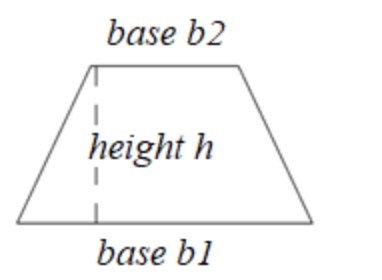
公式
Area of Trapezium - ½ * (b1 + b2) * h
b1 - length of one parallel side of a Trapezium
b2 - length of another parallel side of a Trapezium
h - the distance between the parallel sides of a Trapezium.
例如,梯形的一条平行边的长度为10厘米,另一条平行边的长度为8厘米,它们之间的距离为4厘米,则梯形的面积为:
b1 = 10 cm
b2 = 8 cm
h = 4 cm
Area = ½ * (a + b) * h
   = ½ *( 10 + 8) * 4
   = ½ * 18 * 4
   = 9 * 4
   = 32 cm^2
在函数中计算梯形的面积
算法
步骤1 - 声明用于存储平行边长度、平行边之间距离和面积的float64类型变量。
步骤2 - 初始化变量。
步骤3 - 使用上述公式在函数中计算面积。
步骤4 - 打印结果。
Time Complexity:
O(1)

Space Complexity:
O(1)
示例1
在这个例子中,我们将学习如何在函数中计算梯形的面积。
package main
// fmt package provides the function to print anything
import (
   "fmt"
)
func main() {
   // declaring the floating variables using the var keyword for
   // storing the length of the parallel sides of the Trapezium,
   // distance between the parallel sides and also a variable area
   // to store Area
   var a, b, d, Area float64
   fmt.Println("Program to find the Area of a Trapezium.")

   // initializing the length of one of the parallel side of a Trapezium
   a = 10

   // initializing the length of another parallel side of a Trapezium
   b = 8

   // initializing the length of distance between parallel sides of a Trapezium
   d = 4

   // finding the Area of a Trapezium
   Area = (1.0 / 2) * ((a + b) * d)

   // printing the result
   fmt.Println("The Area of a Trapezium whose length of the parallel sides and distance between the sides are", a,",", b,",", d, "is", Area, "cm * cm.")
   fmt.Println("(Finding the Area of a Trapezium within the function)")
}
输出
% go run tutorialpoint.go
Program to find the Area of a Trapezium.
The Area of a Trapezium whose length of the parallel sides and distance between the sides are 10 8 4 is 36 cm * cm.
(Finding the Area of a Trapezium within the function)
在单独的函数中计算梯形的面积
算法
步骤1 - 声明用于存储平行边长度、平行边之间距离和面积的float64类型变量。
步骤2 - 初始化变量。
步骤3 - 调用函数,将梯形的平行边长度和距离作为参数传入,并将函数返回的面积存储起来。
步骤4 - 打印结果。
示例2
在这个例子中,我们将通过定义一个单独的函数来计算梯形的面积。
package main

// fmt package provides the function to print anything
import (
   "fmt"
)

// in this line we have declared the function that have float64
// type parameter and float64 type returntype
func areaOfTrapezium(a, b, d float64) float64 {
   // returning the area by applying the formula
   return (1.0 / 2) * ((a + b) * d)
}
func main() {
   // declaring the floating variables using the var keyword for
   // storing the length of the parallel sides of the Trapezium,
   // distance between the parallel sides and also a variable area
   // to store Area
   var a, b, d, Area float64
   fmt.Println("Program to find the Area of a Trapezium.")

   // initializing the length of one of the parallel side of a Trapezium
   a = 10

   // initializing the length of another parallel side of a Trapezium
   b = 8

   // initializing the length of distance between parallel sides of a Trapezium
   d = 4

   // finding the Area of a Trapezium by calling the function with the respective parameter
   Area = areaOfTrapezium(a, b, d)

   // printing the result
   fmt.Println("The Area of a Trapezium whose length of the parallel sides and distance between the sides are", a,",", b,",", d, "is", Area, "cm * cm.")
   fmt.Println("(Finding the Area of a Trapezium in the separate function)")
}
输出
Program to find the Area of a Trapezium.
The Area of a Trapezium whose length of the parallel sides and distance between the sides are 10 , 8 , 4 is 36 cm * cm.
(Finding the Area of a Trapezium in the separate function)
结论
以上是两种在Go语言中计算梯形面积的方法。第二种方法在模块化和代码可重用性方面更好,因为我们可以在项目的任何地方调用该函数。要了解更多关于Go语言的知识,您可以浏览这些教程。

更新于:2022年9月2日
149 次浏览

广告