
 Data Structure
 Networking
 RDBMS
RDBMS Operating System
 Java
Java MS Excel
 iOS
iOS HTML
HTML CSS
CSS Android
 Python
 C Programming
 C++
C++ C#
C# MongoDB
 MySQL
MySQL Javascript
 PHP
PHP Physics
 Chemistry
 Biology
 Mathematics
 English
 Economics
 Psychology
 Social Studies
 Fashion Studies
 Legal Studies
如何在 Android 中使用 Kotlin 解析 HTML?
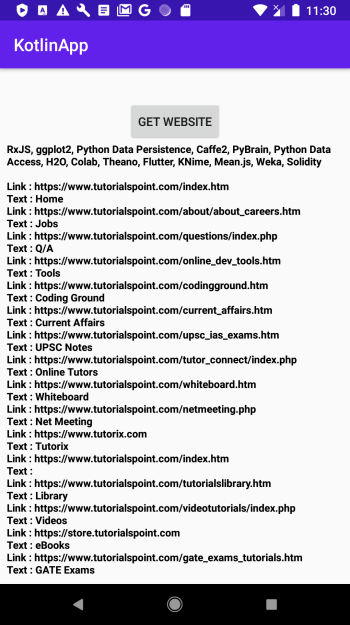
本示例演示了如何在 Android 中使用 Kotlin 解析 HTML。
步骤 1 − 在 Android Studio 中创建一个新项目,转至文件 ⇒ 新项目,并填写所有必需的详细信息以创建一个新项目。
步骤 2 − 向 res/layout/activity_main.xml 添加以下代码。
<?xml version="1.0" encoding="utf-8"?>
<RelativeLayout xmlns:android="http://schemas.android.com/apk/res/android"
   xmlns:tools="http://schemas.android.com/tools"
   android:layout_width="match_parent"
   android:layout_height="match_parent"
   android:padding="8dp"
   tools:context=".MainActivity">
   <Button
      android:id="@+id/btnParseHTML"
      android:layout_width="wrap_content"
      android:layout_height="wrap_content"
      android:layout_centerHorizontal="true"
      android:layout_marginTop="30dp"
      android:text="Get website" />
   <TextView
      android:textColor="@android:color/background_dark"
      android:id="@+id/textView"
      android:layout_width="wrap_content"
      android:layout_height="wrap_content"
      android:layout_below="@id/btnParseHTML"
      android:layout_centerHorizontal="true"
      android:text="Result"
      android:textSize="12sp"
      android:textStyle="bold" />
</RelativeLayout>
步骤 3 − 向 build.gradle(模块:应用)添加给定的依赖关系
implementation 'org.jsoup:jsoup:1.11.2'
步骤 4 − 向 src/MainActivity.kt 添加以下代码
import android.os.Bundle
import android.widget.Button
import android.widget.TextView
import androidx.appcompat.app.AppCompatActivity
import org.jsoup.Jsoup
import org.jsoup.nodes.Document
import org.jsoup.select.Elements
import java.io.IOException
class MainActivity : AppCompatActivity() {
   lateinit var button: Button
   lateinit var textView: TextView
   override fun onCreate(savedInstanceState: Bundle?) {
      super.onCreate(savedInstanceState)
      setContentView(R.layout.activity_main)
      title = "KotlinApp"
      textView = findViewById(R.id.textView)
      button = findViewById(R.id.btnParseHTML)
      button.setOnClickListener {
         getHtmlFromWeb()
      }
   }
   private fun getHtmlFromWeb() {
      Thread(Runnable {
         val stringBuilder = StringBuilder()
         try {
            val doc: Document = Jsoup.connect("https://tutorialspoint.com/").get()
            val title: String = doc.title()
            val links: Elements = doc.select("a[href]")
            stringBuilder.append(title).append("
")
            for (link in links) {
               stringBuilder.append("
").append("Link :
               ").append(link.attr("href")).append("
").append("Text : ").append(link.text())
            }
         } catch (e: IOException) {
            stringBuilder.append("Error : ").append(e.message).append("
")
         }
         runOnUiThread { textView.text = stringBuilder.toString() }
      }).start()
   }
}
步骤 5 − 向 androidManifest.xml 添加以下代码
<?xml version="1.0" encoding="utf-8"?>
<manifest xmlns:android="http://schemas.android.com/apk/res/android" package="app.com.q11">
   <uses-permission android:name="android.permission.INTERNET"/>
   <application
      android:allowBackup="true"
      android:icon="@mipmap/ic_launcher"
      android:label="@string/app_name"
      android:roundIcon="@mipmap/ic_launcher_round"
      android:supportsRtl="true"
      android:theme="@style/AppTheme">
      <activity android:name=".MainActivity">
         <intent-filter>
            <action android:name="android.intent.action.MAIN" />
            <category android:name="android.intent.category.LAUNCHER" />
         </intent-filter>
      </activity>
   </application>
</manifest>
让我们试着运行你的应用程序。我假设你已经将实际的 Android 移动设备与电脑相连。要从 Android Studio 运行应用程序,请打开项目的一个活动文件,然后从工具栏中单击运行图标 。选择你的移动设备作为选项,然后检查你的移动设备,它将显示你的默认屏幕


更新于: 2020 年 11 月 5 日
3 千次+ 浏览

广告