
 数据结构
数据结构 网络
网络 关系数据库管理系统 (RDBMS)
 操作系统
操作系统 Java
Java Microsoft Excel
 iOS
iOS HTML
HTML CSS
CSS Android
 Python
 C语言编程
C语言编程 C++
C++ C#
C# MongoDB
 MySQL
MySQL Javascript
 PHP
PHP 物理学
物理学 化学
化学 生物学
生物学 数学
数学 英语
英语 经济学
经济学 心理学
心理学 社会学
社会学 服装设计
服装设计 法学
法学C++二叉树的简洁编码
假设我们有一个二叉树。众所周知,二叉树的简洁编码接近最低可能的存储空间。第n个卡塔兰数由具有n个不同节点的结构不同的二叉树的数量决定。如果n很大,则约为4n;因此,我们需要至少约log2(4)n = 2n位来对其进行编码。因此,简洁的二叉树将消耗2n + O(n)位。
所以,如果输入是这样的:
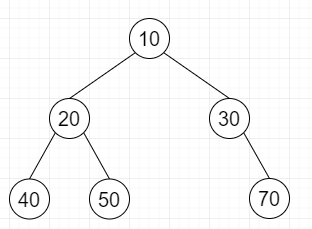
那么输出将是:
编码:
结构列表:1 1 1 0 0 1 0 0 1 0 1 0 0
数据列表:10 20 40 50 30 70
解码:如上所示的树。
为了解决这个问题,我们将遵循以下步骤:
- 定义一个函数Encode(),它将接收根节点、名为struc的列表和名为data的列表作为参数。
- 如果根节点等于NULL,则:
- 在struc的末尾插入0
- 返回
- 在struc的末尾插入1
- 在data的末尾插入根节点的值
- Encode(根节点的左子节点, struc, data)
- Encode(根节点的右子节点, struc, data)
- 定义一个函数Decode(),它将接收名为struc的列表和名为data的列表作为参数。
- 如果struc的大小小于等于0,则:
- 返回NULL
- vb := struc的第一个元素
- 从struc中删除第一个元素
- 如果b等于1,则:
- key := data的第一个元素
- 从data中删除第一个元素
- root = 创建一个具有key值的新节点
- root的左子节点 := Decode(struc, data)
- root的右子节点 := Decode(struc, data)
- 返回root
- 返回NULL
示例 (C++)
让我们看看下面的实现来更好地理解:
#include<bits/stdc++.h>
using namespace std;
class TreeNode {
   public:
      int val;
      TreeNode *left, *right;
      TreeNode(int data) {
         val = data;
         left = NULL;
         right = NULL;
      }
};
void Encode(TreeNode *root, list<bool>&struc, list<int>&data){
   if(root == NULL){
      struc.push_back(0);
      return;
   }
   struc.push_back(1);
   data.push_back(root->val);
   Encode(root->left, struc, data);
   Encode(root->right, struc, data);
}
TreeNode *Decode(list<bool>&struc, list<int>&data){
   if(struc.size() <= 0)
   return NULL;
   bool b = struc.front();
   struc.pop_front();
   if(b == 1){
      int key = data.front();
      data.pop_front();
      TreeNode *root = new TreeNode(key);
      root->left = Decode(struc, data);
      root->right = Decode(struc, data);
      return root;
   }
   return NULL;
}
void preorder_trav(TreeNode* root){
   if(root){
      cout << "key: "<< root->val;
      if(root->left)
         cout << " | left child: "<< root->left->val;
      if(root->right)
         cout << " | right child: "<< root->right->val;
      cout << endl;
      preorder_trav(root->left);
      preorder_trav(root->right);
   }
}
main() {
   TreeNode *root = new TreeNode(10);
   root->left = new TreeNode(20);
   root->right = new TreeNode(30);
   root->left->left = new TreeNode(40);
   root->left->right = new TreeNode(50);
   root->right->right = new TreeNode(70);
   cout << "The Tree\n";
   preorder_trav(root);
   list<bool> struc;
   list<int> data;
   Encode(root, struc, data);
   cout << "\nEncoded Tree\n";
   cout << "Structure List\n";
   list<bool>::iterator si; // Structure iterator
   for(si = struc.begin(); si != struc.end(); ++si)
   cout << *si << " ";
   cout << "\nData List\n";
   list<int>::iterator di; // Data iIterator
   for(di = data.begin(); di != data.end(); ++di)
   cout << *di << " ";
   TreeNode *newroot = Decode(struc, data);
   cout << "\n\nPreorder traversal of decoded tree\n";
   preorder_trav(newroot);
}
输入
root->left = new TreeNode(20);
root->right = new TreeNode(30);
root->left->left = new TreeNode(40);
root->left->right = new TreeNode(50);
root->right->right = new TreeNode(70);
输出
The Tree
key: 10 | left child: 20 | right child: 30
key: 20 | left child: 40 | right child: 50
key: 40
key: 50
key: 30 | right child: 70
key: 70
Encoded Tree
Structure List
1 1 1 0 0 1 0 0 1 0 1 0 0
Data List
10 20 40 50 30 70
Preorder traversal of decoded tree
key: 10 | left child: 20 | right child: 30
key: 20 | left child: 40 | right child: 50
key: 40
key: 50
key: 30 | right child: 70
key: 70

更新于:2020年8月27日
298 次浏览

广告