
 数据结构
数据结构 网络
网络 关系型数据库管理系统
 操作系统
操作系统 Java
Java MS Excel
 iOS
iOS HTML
HTML CSS
CSS 安卓
安卓 Python
 C 编程
C 编程 C++
C++ C#
C# MongoDB
 MySQL
MySQL Javascript
 PHP
PHP 物理学
物理学 化学
化学 生物学
生物学 数学
数学 英语
英语 经济学
经济学 心理学
心理学 社会科学
社会科学 时尚学
时尚学 法学
法学使用拓扑排序在图中检查环路
在有向无环图中,我们可以使用拓扑排序按照线性顺序对顶点进行排序。
拓扑排序仅适用于有向无环图。在有向无环图 (DAG) 中,可能有多个拓扑排序。
我们考虑一个 C++ 程序,它将执行拓扑排序以检查图中的环路。
例如
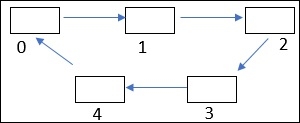
算法
Topological Sort:
Begin
   Declare topo_sort(int *v, int T_S[][5], int i) function
      a = new NodeInfo.
      a->n = i
      a->S_Time = cn.
      Call push_node(a) function to insert data.
      v[i] = 1.
      for (int j = 0; j < 5; j++)
         if (T_S[i][j] == 0 || (T_S[i][j] == 1 && v[j] == 1)) then
            continue.
         else if(T_S[i][j] == 1 && v[j] == 0) then
            cn++.
            Call topo_sort(v,T_S, j) function.
      cn++.
      a = pop().
      a->L_Time = cn.
      Store_Node(a).
End.
示例
#include<iostream>
#include<conio.h>
using namespace std;
struct NodeInfo {
   int n;
   int L_Time, S_Time;
}
*a = NULL;
struct Node {
   NodeInfo *ptr;
   Node *nxt;
}
*t = NULL, *b = NULL, *npt = NULL;
struct Node_Link {
   Node_Link *lk;
   NodeInfo *ptr1;
}
*hd = NULL, *m = NULL, *n = NULL, *npt1 = NULL;
int cn = 0;
bool flag = false;
void push_node(NodeInfo *pt) { //insert data
   npt = new Node;
   npt->ptr = pt;
   npt->nxt = NULL;
   if (t == NULL) {
      t = npt;
   } else {
      npt->nxt = t;
      t = npt;
   }
}
NodeInfo *pop() {
   if (t == NULL) {
      cout<<"underflow\n";
   } else {
      b = t;
      t = t->nxt;
      return(b->ptr);
      delete(b);
   }
}
void Store_Node(NodeInfo *pt1) { //store data
   npt1 = new Node_Link;
   npt1->ptr1 = pt1;
   npt1->lk = NULL;
   if (cn == 0) {
      hd = npt1;
      m = hd;
      m->lk = NULL;
      cn++;
   } else {
      m = hd;
      npt1->lk = m;
      hd = npt1;
   }
}
void delete_node(int x) { //delete node
   m = hd;
   if ((m->ptr1)->n == x) {
      hd = hd->lk;
      delete(m);
   } else {
      while ((m->ptr1)->n != x && m->lk != NULL) {
         n = m;
         m = m->lk;
      }
      if ((m->ptr1)->n == x) {
         n->lk = m->lk;
         delete(m);
      } else if (m->lk == NULL) {
         flag = true;
         cout<<"There is no circle in this graph\n";
      }
   }
}
void topo_sort(int *v, int T_S[][5], int i) { //performing topological sort
   a = new NodeInfo;
   a->n = i;
   a->S_Time = cn;
   push_node(a);
   v[i] = 1;
   for (int j = 0; j < 5; j++) {
      if (T_S[i][j] == 0 || (T_S[i][j] == 1 && v[j] == 1))
         continue;
      else if(T_S[i][j] == 1 && v[j] == 0) {
         cn++;
         topo_sort(v,T_S,j);
      }
   }
   cn++;
   a = pop();
   a->L_Time = cn;
   Store_Node(a);
   return;
}
void topologic_sort(int *v, int T_S[][5], int i) {
   v[i] = 1;
   delete_node(i);
   for (int j = 0; j < 5; j++) {
      if (T_S[i][j] == 0 || (T_S[i][j] == 1 && v[j] == 1)) {
         continue;
      } else if(T_S[i][j] == 1 && v[j] == 0) {
         topologic_sort(v, T_S, j);
      }
   }
   return;
}
void Insert_Edge(int T_S[][5], int source, int destination) { // insert the value of edge.
   T_S[source][destination] = 1;
   return;
}
int main() {
   int v[5], T_S[5][5], T_S_N[5][5], cn = 0, a, b;
   for (int i = 0; i < 5; i++) {
      v[i] = 0;
   }
   for (int i = 0; i < 5; i++) {
      for (int j = 0; j < 5; j++) {
         T_S[i][j] = 0;
      }
   }
   while (cn < 5) {
      cout<<"Enter the source: ";
      cin>>a;
      cout<<"Enter the destination: ";
      cin>>b;
      cout<<endl;
      Insert_Edge(T_S, a, b);
      cn++;
   }
   topo_sort(v, T_S, 0);
   for (int i = 0; i < 5; i++) {
      v[i] = 0;
      for (int j = 0; j < 5; j++) {
         T_S_N[j][i] = T_S[i][j];
      }
   }
   if (hd != NULL) {
      topologic_sort(v, T_S_N, (hd->ptr1)->n);
      if (flag == false) {
         cout<<"There is a cycle in this graph...\n";
      }
   }
   getch();
}
输出
Enter the source: 0
Enter the destination: 1

Enter the source: 1
Enter the destination: 2

Enter the source: 2
Enter the destination: 3

Enter the source: 3
Enter the destination: 4

Enter the source: 4
Enter the destination: 0

There is a cycle in this graph...

更新于: 30-7-2019
326 次浏览

广告