
- 算法设计与分析
- 首页
- 算法基础
- 算法导论 - 算法简介
- 算法导论 - 算法分析
- 算法导论 - 分析方法
- 算法导论 - 渐近符号与先验分析
- 算法导论 - 时间复杂度
- 算法导论 - 主定理
- 算法导论 - 空间复杂度
- 分治法
- 算法导论 - 分治算法
- 算法导论 - 最大最小问题
- 算法导论 - 归并排序算法
- 算法导论 - Strassen矩阵乘法
- 算法导论 - Karatsuba算法
- 算法导论 - 汉诺塔
- 贪心算法
- 算法导论 - 贪心算法
- 算法导论 - 旅行商问题
- 算法导论 - Prim最小生成树算法
- 算法导论 - Kruskal最小生成树算法
- 算法导论 - Dijkstra最短路径算法
- 算法导论 - 地图着色算法
- 算法导论 - 分数背包问题
- 算法导论 - 带截止时间的作业排序
- 算法导论 - 最优合并模式
- 动态规划
- 算法导论 - 动态规划
- 算法导论 - 矩阵链乘法
- 算法导论 - Floyd-Warshall算法
- 算法导论 - 0-1背包问题
- 算法导论 - 最长公共子序列算法
- 算法导论 - 使用动态规划的旅行商问题
- 随机化算法
- 算法导论 - 随机化算法
- 算法导论 - 随机化快速排序算法
- 算法导论 - Karger最小割算法
- 算法导论 - Fisher-Yates洗牌算法
- 近似算法
- 算法导论 - 近似算法
- 算法导论 - 顶点覆盖问题
- 算法导论 - 集合覆盖问题
- 算法导论 - 旅行商问题近似算法
- 排序技术
- 算法导论 - 冒泡排序算法
- 算法导论 - 插入排序算法
- 算法导论 - 选择排序算法
- 算法导论 - 希尔排序算法
- 算法导论 - 堆排序算法
- 算法导论 - 桶排序算法
- 算法导论 - 计数排序算法
- 算法导论 - 基数排序算法
- 算法导论 - 快速排序算法
- 查找技术
- 算法导论 - 查找技术简介
- 算法导论 - 线性查找
- 算法导论 - 二分查找
- 算法导论 - 插值查找
- 算法导论 - 跳跃查找
- 算法导论 - 指数查找
- 算法导论 - 斐波那契查找
- 算法导论 - 子列表查找
- 算法导论 - 散列表
- 图论
- 算法导论 - 最短路径
- 算法导论 - 多阶段图
- 算法导论 - 最优代价二叉搜索树
- 堆算法
- 算法导论 - 二叉堆
- 算法导论 - 插入方法
- 算法导论 - 堆化方法
- 算法导论 - 提取方法
- 复杂性理论
- 算法导论 - 确定性计算与非确定性计算
- 算法导论 - 最大团
- 算法导论 - 顶点覆盖
- 算法导论 - P类和NP类
- 算法导论 - Cook定理
- 算法导论 - NP难和NP完全类
- 算法导论 - 爬山算法
- 算法导论有用资源
- 算法导论 - 快速指南
- 算法导论 - 有用资源
- 算法导论 - 讨论
最大团

在一个无向图中,团是一个给定图的完全子图。完全子图意味着这个子图的所有顶点都连接到这个子图的所有其他顶点。
最大团问题是寻找图的最大团的计算问题。最大团用于许多现实世界的问题。
让我们考虑一个社交网络应用程序,其中顶点代表人们的个人资料,边代表图中的相互认识。在这个图中,团代表一群彼此都认识的人。
为了找到最大团,可以系统地检查所有子集,但是这种蛮力搜索对于包含几十个以上顶点的网络来说过于耗时。
最大团算法
寻找图的最大团的算法相对简单。该过程的步骤如下:
步骤1:将一个图作为算法的输入,该图具有非空的顶点集和边集。
步骤2:创建一个输出集,如果边构成图的团,则将它们添加到输出集中。
步骤3:迭代地重复步骤2,直到检查图的所有顶点,并且列表不再形成团。
步骤4:然后回溯输出集以检查哪个团具有最大边数。
伪代码
Algorithm: Max-Clique (G, n, k)
S := ф
for i = 1 to k do
   t := choice (1…n)
   if t є S then
      return failure
   S := S U t
for all pairs (i, j) such that i є S and j є S and i ≠ j do
   if (i, j) is not a edge of the graph then
      return failure
return success
分析
最大团问题是一个非确定性算法。在这个算法中,我们首先尝试确定一组k个不同的顶点,然后我们尝试测试这些顶点是否构成一个完全图。
没有多项式时间确定性算法可以解决这个问题。这个问题是NP完全的。
示例
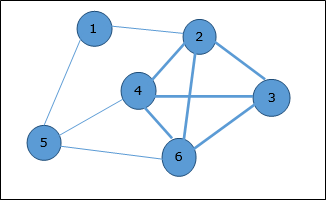
看下面的图。这里,包含顶点2、3、4和6的子图构成一个完全图。因此,这个子图是一个团。由于这是所提供图的最大完全子图,因此它是一个4-团。
实现
以下是上述方法在各种编程语言中的实现:
#include <stdio.h>
#define MAX 100
int store[MAX], n;
int graph[MAX][MAX];
int d[MAX];
int max(int a, int b){
   if(a > b){
      return a;
   }
   else{
      return b;
   }
}
int is_clique(int b)
{
   for (int i = 1; i < b; i++) {
      for (int j = i + 1; j < b; j++) {
         if (graph[store[i]][store[j]] == 0) {
            return 0;
         }
      }
   }
   return 1;
}
int maxCliques(int i, int l)
{
   int max_ = 0;
   for (int j = i + 1; j <= n; j++) {
      store[l] = j;
      if (is_clique(l + 1)) {
         max_ = max(max_, l);
         max_ = max(max_, maxCliques(j, l + 1));
      }
   }
   return max_;
}
int main()
{
   int edges[][2] = { { 1, 4 }, { 4, 6 }, { 1, 6 },
                      { 3, 3 }, { 4, 2 }, { 8, 12 } };
   int size = sizeof(edges) / sizeof(edges[0]);
   n = 6;
   for (int i = 0; i < size; i++) {
      graph[edges[i][0]][edges[i][1]] = 1;
      graph[edges[i][1]][edges[i][0]] = 1;
      d[edges[i][0]]++;
      d[edges[i][1]]++;
   }
   printf("Max clique: %d\n", maxCliques(0, 1));
   return 0;
}
输出
Max clique: 3
using namespace std;
#include<iostream>
const int MAX = 100;
// Storing the vertices
int store[MAX], n;
// Graph
int graph[MAX][MAX];
// Degree of the vertices
int d[MAX];
// Function to check if the given set of vertices in store array is a clique or not
bool is_clique(int b)
{
   // Run a loop for all set of edges
   for (int i = 1; i < b; i++) {
      for (int j = i + 1; j < b; j++)

      // If any edge is missing
      if (graph[store[i]][store[j]] == 0)
         return false;
   }
   return true;
}
// Function to find all the sizes of maximal cliques
int maxCliques(int i, int l)
{
   // Maximal clique size
   int max_ = 0;
   // Check if any vertices from i+1 can be inserted
   for (int j = i + 1; j <= n; j++) {
      // Add the vertex to store
      store[l] = j;
      // If the graph is not a clique of size k then
      // it cannot be a clique by adding another edge
      if (is_clique(l + 1)) {
   	     // Update max
   	     max_ = max(max_, l);
   	     // Check if another edge can be added
   	     max_ = max(max_, maxCliques(j, l + 1));
   	}
   }
   return max_;
}
// Driver code
int main()
{
   int edges[][2] = { { 1, 4 }, { 4, 6 }, { 1, 6 },
   				{ 3, 3 }, { 4, 2 }, { 8, 12 } };
   int size = sizeof(edges) / sizeof(edges[0]);
   n = 6;
   for (int i = 0; i < size; i++) {
      graph[edges[i][0]][edges[i][1]] = 1;
      graph[edges[i][1]][edges[i][0]] = 1;
      d[edges[i][0]]++;
      d[edges[i][1]]++;
   }
   cout <<"Max clique: "<<maxCliques(0, 1);
   return 0;
}
输出
Max clique: 3
import java.util.ArrayList;
import java.util.List;
public class MaxCliques {
   static final int MAX = 100;
   static int[] store = new int[MAX];
   static int[][] graph = new int[MAX][MAX];
   static int[] d = new int[MAX];
   static int n;
   // Function to check if the given set of vertices in store array is a clique or not
   static boolean isClique(int b) {
      for (int i = 1; i < b; i++) {
         for (int j = i + 1; j < b; j++)
            if (graph[store[i]][store[j]] == 0)
               return false;
      }
      return true;
   }
   // Function to find all the sizes of maximal cliques
   static int maxCliques(int i, int l) {
      int max_ = 0;
      for (int j = i + 1; j <= n; j++) {
         store[l] = j;
         if (isClique(l + 1)) {
            max_ = Math.max(max_, l);
            max_ = Math.max(max_, maxCliques(j, l + 1));
         }
      }
      return max_;
   }
   // Driver code
public static void main(String[] args) {
   int[][] edges = { { 1, 4 }, { 4, 6 }, { 1, 6 },
           { 3, 3 }, { 4, 2 }, { 8, 12 } };
   int size = edges.length;
   n = 6;
   for (int i = 0; i < size; i++) {
      graph[edges[i][0]][edges[i][1]] = 1;
      graph[edges[i][1]][edges[i][0]] = 1;
      d[edges[i][0]]++;
      d[edges[i][1]]++;
   }
   System.out.println("Max cliques: " + maxCliques(0, 1));
   }
}
输出
Max cliques: 3
MAX = 100
# Storing the vertices
store = [0] * MAX
n = 0
# Graph
graph = [[0] * MAX for _ in range(MAX)]
# Degree of the vertices
d = [0] * MAX
# Function to check if the given set of vertices in store array is a clique or not
def is_clique(b):
    # Run a loop for all set of edges
    for i in range(1, b):
        for j in range(i + 1, b):
            # If any edge is missing
            if graph[store[i]][store[j]] == 0:
                return False
    return True
# Function to find all the sizes of maximal cliques
def maxCliques(i, l):
    # Maximal clique size
    max_ = 0
    # Check if any vertices from i+1 can be inserted
    for j in range(i + 1, n + 1):
        # Add the vertex to store
        store[l] = j
        # If the graph is not a clique of size k then
        # it cannot be a clique by adding another edge
        if is_clique(l + 1):
            # Update max
            max_ = max(max_, l)
            # Check if another edge can be added
            max_ = max(max_, maxCliques(j, l + 1))
    return max_
# Driver code
def main():
    global n
    edges = [(1, 4), (4, 6), (1, 6),
             (3, 3), (4, 2), (8, 12)]
    size = len(edges)
    n = 6
    for i in range(size):
        graph[edges[i][0]][edges[i][1]] = 1
        graph[edges[i][1]][edges[i][0]] = 1
        d[edges[i][0]] += 1
        d[edges[i][1]] += 1
    print("Max cliques:" ,maxCliques(0, 1))
if __name__ == "__main__":
    main()
输出
Max cliques: 3
广告