- GraphQL 教程
- GraphQL - 首页
- GraphQL - 简介
- GraphQL - 环境搭建
- GraphQL - 架构
- GraphQL - 应用程序组件
- GraphQL - 示例
- GraphQL - 类型系统
- GraphQL - 模式
- GraphQL - 解析器
- GraphQL - 查询
- GraphQL - 变异
- GraphQL - 验证
- GraphQL - JQuery 集成
- GraphQL - React 集成
- GraphQL - Apollo 客户端
- GraphQL - 客户端身份验证
- GraphQL - 缓存
- GraphQL 有用资源
- GraphQL - 快速指南
- GraphQL - 有用资源
- GraphQL - 讨论
GraphQL - Apollo 客户端
我们已经使用 Apollo Server 在服务器端构建了 graphql 规范。它可以快速轻松地构建生产就绪的 GraphQL 服务器。现在让我们了解客户端。
Apollo Client 是使用 GraphQL 构建客户端应用程序的最佳方式。该客户端旨在帮助开发人员快速构建一个使用 GraphQL 获取数据的 UI,并且可以与任何 JavaScript 前端一起使用。
Apollo Client 支持以下平台:
| 序号 | 平台和框架 |
|---|---|
| 1 | Javascript React、Angular、Vue、Meteor、Ember |
| 2 | WebComponents Polymer、lit-apollo |
| 3 | 原生移动 使用 Java 的原生 Android,使用 Swift 的原生 iOS |
缓存是 Apollo Client 的主要功能之一。apollo-boost 是一个便捷的软件包,它包含了许多其他依赖项。
图示
让我们看看如何使用 Apollo Client 通过以下步骤构建客户端应用程序:
设置服务器
我们必须按照以下步骤设置服务器:
步骤 1 - 下载并安装项目所需的依赖项
创建一个文件夹 apollo-server-app。从终端将您的目录更改为 apollo-server-app。然后,按照环境设置章节中解释的步骤 3 到 5 进行操作。
步骤 2 - 创建模式
在项目文件夹 apollo-server-app 中添加 schema.graphql 文件,并添加以下代码:
type Query
{
   students:[Student]
}

type Student {
   id:ID!
   firstName:String
   lastName:String
   college:College
}

type College {
   id:ID!
   name:String
   location:String
   rating:Float
}
步骤 3 - 添加解析器
在项目文件夹中创建一个文件 resolvers.js,并添加以下代码:
const db = require('./db')

const Query = {
   //resolver function for students returns list
   students:() => db.students.list(),
}

const Student = {
   college:(root) => {
      return db.colleges.get(root.collegeId);
   }
}
module.exports = {Query,Student}
步骤 4 - 运行应用程序
创建一个 server.js 文件。参考环境设置章节中的步骤 8。在终端中执行命令 npm start。服务器将在 9000 端口启动并运行。在这里,我们将使用 GraphiQL 作为客户端来测试应用程序。
打开浏览器并输入 URL https://:9000/graphiql。在编辑器中键入以下查询。
{
   students{
      id
      firstName
      college{
         name
      }
   }
}
查询的响应如下所示:
{
   "data": {
      "students": [
         {
            "id": "S1001",
            "firstName": "Mohtashim",
            "college": {
               "name": "CUSAT"
            }
         },

         {
            "id": "S1002",
            "firstName": "Kannan",
            "college": {
               "name": "AMU"
            }
         },

         {
            "id": "S1003",
            "firstName": "Kiran",
            "college": {
               "name": "AMU"
            }
         }
      ]
   }
}
设置客户端
为客户端打开一个新的终端。在执行客户端应用程序之前,应保持服务器终端运行。React 应用程序将在 3000 端口运行,服务器应用程序将在 9000 端口运行。
步骤 1 - 创建 React 应用程序
在客户端终端中,键入以下命令:
npx create-react-app hello-world-client
这将安装典型 React 应用程序所需的一切。npx 实用程序和 create-react-app 工具创建一个名为 hello-world-client 的项目。安装完成后,在 VSCode 中打开项目。
步骤 2 - 启动 hello-world-client
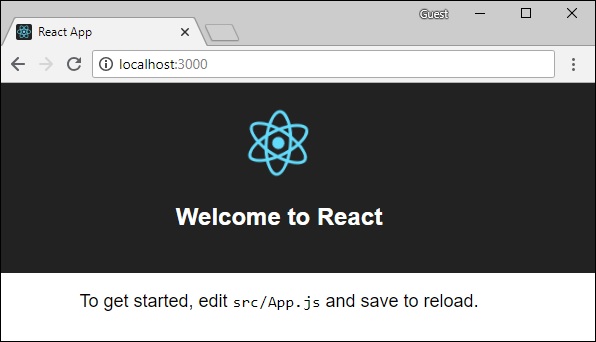
将终端中的当前文件夹路径更改为 hello-world-client。键入 npm start 启动项目。这将在 3000 端口运行开发服务器,并将自动打开浏览器并加载索引页面。
这在下面给出的屏幕截图中显示:
步骤 3 - 安装 Apollo Client 库
要安装 Apollo Client,请打开一个新的终端并位于当前项目文件夹路径中。键入以下命令:
npm install apollo-boost graphql
这将下载客户端的 graphql 库以及 Apollo Boost 包。我们可以通过在 apollo-boost 依赖项中键入 npm view 来交叉检查这一点。这将具有许多依赖项,如下所示:
{
   'apollo-cache': '^1.1.15',
   'apollo-cache-inmemory': '^1.2.8',
   'apollo-client': '^2.4.0',
   'apollo-link': '^1.0.6',
   'apollo-link-error': '^1.0.3',
   'apollo-link-http': '^1.3.1',
   'apollo-link-state': '^0.4.0',
   'graphql-tag': '^2.4.2'
}
我们可以清楚地看到已安装 Apollo-Client 库。
步骤 4 - 修改 index.js 文件中的 App 组件
使用 Apollo Client,我们可以直接调用服务器,而无需使用 fetch API。此外,查询和变异不应嵌入用反引号编写的字符串中。这是因为 gql 函数直接解析查询。这意味着程序员可以在使用 GraphiQL 工具编写查询时以相同的方式直接编写查询。gql 是一个标签函数,它将用反引号编写的模板字符串解析为 graphql 查询对象。Apollo Client 的 query 方法返回一个 Promise。
以下代码片段显示了如何导入 Apollo Client:
import {ApolloClient, HttpLink, InMemoryCache} from 'apollo-boost'

const endPointUrl = 'https://:9000/graphql'
const client = new ApolloClient({
   link: new HttpLink({uri:endPointUrl}),
   cache:new InMemoryCache()
});
在上一章中,我们讨论了如何使用 fetch API 进行 HTTP 请求。以下代码显示了如何使用 gql 函数。loadStudentsAsync 函数使用 graphql 客户端查询服务器。
async function loadStudentsAsync() {
   const query = gql`
   {
      students{
         id
         firstName
         lastName
         college{
            name
         }
      }
   }`
   const {data} = await client.query({query}) ;
   return data.students;
}
您只需要保留 src 文件夹中的 index.js 和 public 文件夹中的 index.html;所有其他自动生成的可以删除。
目录结构如下所示:
hello-world-client /
   -->node_modules
   -->public
         index.html
   -->src
         index.js
   -->package.json
以下是 React 应用程序中的 index.js:
import React, {Component} from 'react';
import ReactDOM from 'react-dom';

// apollo client

import {ApolloClient, HttpLink, InMemoryCache} from 'apollo-boost'
import gql from 'graphql-tag'

const endPointUrl = 'https://:9000/graphql'
const client = new ApolloClient({
   link: new HttpLink({uri:endPointUrl}),
   cache:new InMemoryCache()
});

async function loadStudentsAsync() {
   const query = gql`
   {
      students{
         id
         firstName
         lastName
         college{
            name
         }
      }
   }
   `
   const {data} = await client.query({query}) ;
   return data.students;
}
class  App  extends Component {
   constructor(props) {
      super(props);
      this.state = {
         students:[]
      }
      this.studentTemplate =  [];
   }
   async loadStudents() {
      const studentData =  await loadStudentsAsync();
      this.setState({
         students: studentData
      })
      console.log("loadStudents")
   }
   render() {
      return(
         <div>
            <input type = "button"  value = "loadStudents" onClick = {this.loadStudents.bind(this)}/>
            <div>
               <br/>
               <hr/>
               <table border = "3">
                  <thead>
                     <tr>
                        <td>First Name</td>
                        <td>Last Name</td>
                        <td>college Name</td>
                     </tr>
                  </thead>

                  <tbody>
                     {
                        this.state.students.map(s => {
                           return (
                              <tr key = {s.id}>
                                 <td>
                                    {s.firstName}
                                 </td>
                                 <td>
                                    {s.lastName}
                                 </td>
                                 <td>
                                    {s.college.name}
                                 </td>
                              </tr>
                           )
                        })
                     }
                  </tbody>
               </table>
            </div>
         </div>
      )
   }
}
ReactDOM.render(<App/>, document.getElementById('root'));
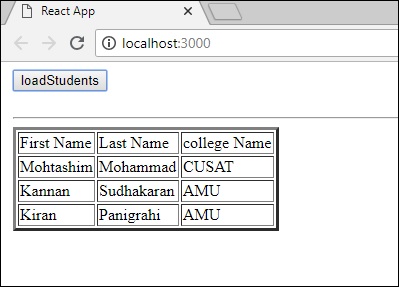
一旦我们单击 loadStudents 按钮,React 应用程序将从 GraphQL 服务器加载学生,如下所示: