
 数据结构
数据结构 网络技术
网络技术 关系型数据库
 操作系统
操作系统 Java
Java MS Excel
 iOS
iOS HTML
HTML CSS
CSS Android
 Python
 C 编程
C 编程 C++
C++ C#
C# MongoDB
 MySQL
MySQL Javascript
 PHP
PHP 物理学
物理学 化学
化学 生物学
生物学 数学
数学 英语
英语 经济学
经济学 心理学
心理学 社会学
社会学 时尚研究
时尚研究 法律研究
法律研究割线法解非线性方程\n
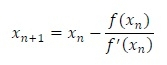
割线法也用于解非线性方程。此方法类似于牛顿拉夫森法,但这里我们不需要求函数 f(x) 的导数。我们仅能使用 f(x) 通过使用牛顿差商公式在数值上求得 f’(x)。根据牛顿拉夫森公式,
我们知道,
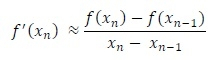
现在,使用差商公式,我们得到,

用新 f’(x) 替换牛顿拉夫森公式中的 f’(x),我们可以找到割线公式来解非线性方程。
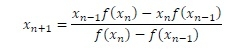
注意:对于此方法,我们需要任何两个初始猜测来开始求非线性方程的根。
输入和输出
Input:
The function f(x) = (x*x) - (4*x) - 10
Output:
The root is: -1.74166
算法
secant(x1, x2)
输入:两个根的初始猜测。
输出:非线性方程 f(x) 的近似根。
Begin
   f1 := f(x1)
   f2 := f(x2)
   x3 := ((f2*x1) – (f1*x2)) / (f2 – f1)
   while relative error of x3 and x2 are > precision, do
      x1 := x2
      f1 := f2
      x2 := x3
      f2 := f(x2)
      x3 := ((f2*x1) – (f1*x2)) / (f2 – f1)
   done
   root := x3
   return root
End
示例
#include<iostream>
#include<cmath>
using namespace std;

double absolute(double value) {             //to find magnitude of value
   if(value < 0)
      return (-value);
   return value;
}

double f(double x) {              //the given function x^2-4x-10
   return ((x*x)-(4*x)-10);
}

double secant(double x1, double x2) {
   double x3, root;
   double f1, f2;
   f1 = f(x1);
   f2 = f(x2);
   x3 = (f2*x1-f1*x2)/(f2-f1);

   while(absolute((x3-x2)/x3) > 0.00001) {         //test accuracy of x3
      x1 = x2;           //shift x values
      f1 = f2;
      x2 = x3;
      f2 = f(x2);                 //find new x2
      x3 = (f2*x1-f1*x2)/(f2-f1);          //calculate x3
   }

   root = x3;
   return root;              //root of the equation
}

main() {
   double a, b, res;
   a = 0.5;
   b = 0.75;
   res = secant(a, b);
   cout << "The root is: " << res;
}
输出
The root is: -1.74166

更新于: 2020 年 6 月 17 日
1K+ 查看

广告