
 数据结构
数据结构 网络
网络 关系型数据库管理系统
 操作系统
操作系统 Java
Java MS Excel
 iOS
iOS HTML
HTML CSS
CSS Android
 Python
 C语言编程
C语言编程 C++
C++ C#
C# MongoDB
 MySQL
MySQL Javascript
 PHP
PHP 物理学
物理学 化学
化学 生物学
生物学 数学
数学 英语
英语 经济学
经济学 心理学
心理学 社会学
社会学 时尚研究
时尚研究 法律研究
法律研究并联RLC电路:分析和示例问题
考虑图中所示的并联RLC电路,其中电阻R、电感L和电容C并联连接,I(RMS)为总电源电流。在并联电路中,三个元件上的电压V(RMS)保持相同。因此,为方便起见,电压可以作为参考相量。
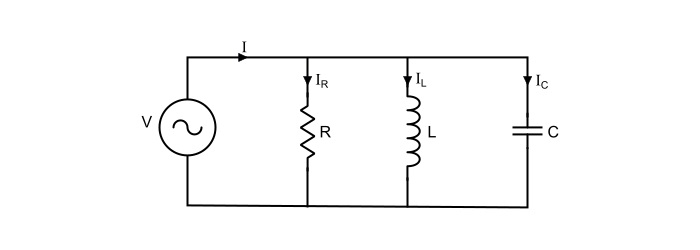
这里,
$$\mathrm{\mathit{V}=\mathit{IZ}=\frac{\mathit{I}}{\mathit{Y}}}$$
其中,
- Z= 并联电路的总阻抗,
- Y=1/Z= 并联电路的导纳。
并联电路的导纳由下式给出:
$$\mathrm{\mathit{Y}=\frac{1}{\mathit{R}}+\frac{1}{\mathit{j\omega L}}+\mathit{j\omega C}=\frac{1}{\mathit{R}}+ {\mathit{j}}(\mathit{\omega C}-\frac{1}{\mathit{\omega L}})=\mathit{G}+\mathit{jB}}$$
其中,
- G=1/R= 电路的电导,
- B=1/X= 电路的电纳,
$$\mathrm{导纳幅值,|\mathit{Y}|=\sqrt{(\frac{1}{\mathit{R}})^{2}+(\mathit{\omega C}-\frac{1}{\mathit{\omega L}})^{2}}}$$
$$\mathrm{导纳相角,\:\varphi=\tan^{-1}(\frac{\mathit{\omega C}-\frac{1}{\mathit{\omega L}}}{\frac{1}{\mathit{R}}})=\tan^{-1}(\mathit{R}(\mathit{\omega C}-\frac{1}{\mathit{\omega L}}))}$$
因此,
$$\mathrm{\mathit{I}=\mathit{VY}=\mathit{V}×\sqrt{(\frac{1}{\mathit{R}})^{2}+(\mathit{\omega C}-\frac{1}{\mathit{\omega L}})^{2}}\angle\tan^{-1}(\mathit{R}(\mathit{\omega C}-\frac{1}{\mathit{\omega L}}))}$$
因此,
$$\mathrm{电源电流幅值,| \mathit{I}|=\mathit{V}×\sqrt{(\frac{1}{\mathit{R}})^{2}+(\mathit{\omega C}-\frac{1}{\mathit{\omega L}})^{2}}}$$
$$\mathrm{导纳相角,\:\varphi=\tan^{-1}(\mathit{R}(\mathit{\omega C}-\frac{1}{\mathit{\omega L}}))}$$
因此,支路电流为
$$\mathrm{电阻电流,\mathit{I}_{\mathit{R}}=\frac{\mathit{V}}{\mathit{R}}=\frac{|\mathit{V}|\angle0^{\circ}}{\mathit{R}}=|\mathit{I}_{\mathit{R}}|\angle0^{\circ}}$$
$$\mathrm{电感电流,\mathit{I}_{L}=\frac{\mathit{V}}{\mathit{X}_{L}}=\frac{|\mathit{V}|\angle0^{\circ}}{\mathit{j\omega L}}=\frac{|\mathit{V}|}{\mathit{\omega L}}\angle(0^{\circ}-90^{\circ})=|\mathit{I}_{L}|\angle(-90^{\circ})}$$
$$\mathrm{电容电流,\mathit{I}_{c}==\frac{\mathit{V}}{\mathit{X}_{c}}=|\mathit{V}|\angle0^{\circ}(\mathit{j\omega C})=|\mathit{V}| \mathit{\omega C}\angle(+90^{\circ})=|\mathit{I}_{L}|\angle(+90^{\circ})}$$
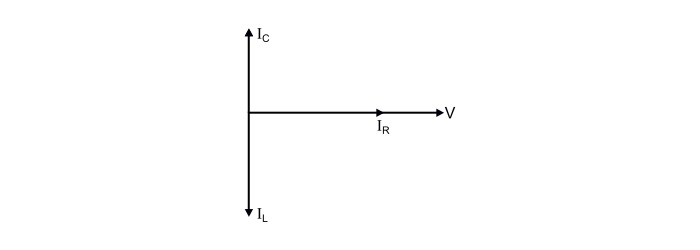
因此,很明显
电阻电流IR与电源电压同相。
电感电流IL滞后于外加电压90°。
电容电流IC超前于外加电压90°。
并联RLC电路中的总电源电流是上述三个电流的相量和(粗体字母),而不是算术和,即
$$\mathrm{\mathit{I}=\mathit{I}_{\mathit{R}}+\mathit{I}_{\mathit{L}}+\mathit{I}_{\mathit{C}}}$$
$$\mathrm{电源幅值,|\mathit{I}|=\sqrt{(\mathit{I}_{\mathit{R}})^2+(\mathit{I}_{\mathit{C}}-\mathit{I}_{\mathit{L}})^2}}$$
电源电流I的相角取决于IC和IL的大小。
并联RLC电路的三种情况
情况1 – 当,|IL|>|Ic| 或 XL<XC
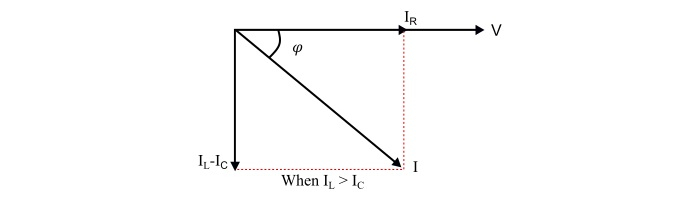
这里,
电源电流滞后于电源电压φ°。
电路的功率因数滞后。
并联RLC电路表现为感性电路。
情况2 – 当,|IL|<|Ic| 或 XL>𝐶XC
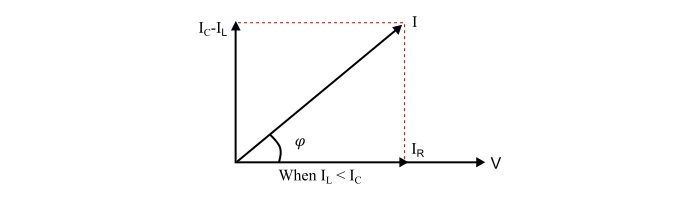
这里,
电源电流超前于电源电压φ°。
电路的功率因数超前。
并联RLC电路表现为容性电路。
情况3 – 当,|IL| = |Ic| 或 XL = XC

这里,
电源电流与电源电压同相,即角度φ = 0°。
电源电流等于电阻电流,即I = IR。
电路的功率因数为1。
并联RLC电路表现为纯电阻电路。
在这种情况下,并联RLC电路称为并联谐振电路。
并联谐振
当导纳的虚部为零时,并联RLC电路中发生谐振现象。然而,导纳为
$$\mathrm{\mathit{Y}=\mathit{G}+\mathit{jB}=\frac{1}{\mathit{R}}+\mathit{j}(\mathit{\omega C}-\frac{1}{\mathit{\omega L}})}$$
在谐振时,
$$\mathrm{\mathit{\omega C}-\frac{1}{\mathit{\omega L}}=0}$$
因此,
$$\mathrm{\mathit{Y}=\frac{1}{\mathit{R}}}$$
发生谐振的频率为
$$\mathrm{\mathit{\omega_{0} C}-\frac{1}{\mathit{\omega_{0} L}}=0}$$
$$\mathrm{\Rightarrow\:\mathit{\omega_{0}}=\frac{1}{\sqrt{\mathit{LC}}}}$$
谐振时的电源电流(I)为
$$\mathrm{\mathit{I}=\mathit{VY}=\frac{\mathit{V}}{\mathit{R}}=\mathit{I}_{\mathit{R}}}$$
$$\mathrm{\Rightarrow\:\mathit{V}=\mathit{IR}=\mathit{I}_{\mathit{R}}\mathit{R}}$$
电感电流幅值(IL)为
$$\mathrm{|\mathit{I}_{L}|=\frac{\mathit{V}}{\mathit{\omega L}}=\frac{\mathit{IR}}{\mathit{\omega L}}=\mathit{IQ}_{0}}$$
$$\mathrm{其中,\mathit{Q}_{0}=\frac{\mathit{R}}{\mathit{\omega L}}=品质因数}$$
谐振时电容电流幅值(IC)为
$$\mathrm{|\mathit{I}_{c}|=\mathit{V}(\mathit{\omega C})=\mathit{I}(\mathit{\omega R C})=\mathit{IQ}_{0}}$$
并联谐振结论 -
XL=XC 或 IL = IC,因此谐振频率,ω0=$1/\sqrt{LC}$。
Y=1/R,即导纳值最小。
Z=R,即阻抗最大。
IR=V/R= 电源电流(I)
| IL |=| IC |=IQ0
并联谐振电路的功率因数为1。
导纳-频率曲线
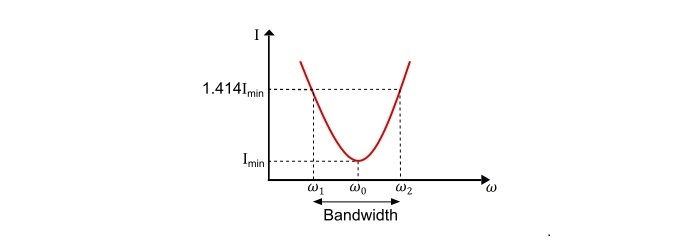
$$\mathrm{\mathit{Y}=\frac{1}{\mathit{R}}+\mathit{j}(\mathit{\omega C}-\frac{1}{\mathit{\omega L}})}$$
这里,
在低于谐振频率的频率下,XL < XC 或 IL > IC ,因此电路表现为感性电路,功率因数滞后。
在高于谐振频率的频率下,XL > XC 或 IL < IC ,因此电路表现为容性电路,功率因数超前。
在谐振频率下,XL = XC 或 IL = IC ,因此电路表现为纯电阻电路,功率因数为1。
电流-频率曲线
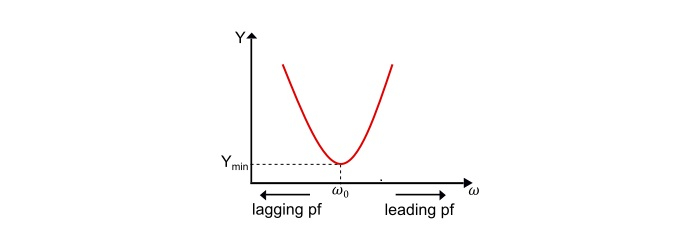
$$\mathrm{\mathit{I}=\mathit{VY}\:或\:\mathit{I}\:\alpha\:\mathit{Y}}$$
因此,并联RLC电路的电流与频率曲线与导纳与频率曲线相同。
参考电流-频率曲线,
$$\mathrm{下截止频率,\mathit{\omega}_{1}=-\frac{1}{2\mathit{RC}}+\sqrt{(\frac{1}{2\mathit{RC}})^2+\frac{1}{\mathit{LC}}}}$$
$$\mathrm{上截止频率,\omega_{2}=+\frac{1}{2\mathit{RC}}+\sqrt{(\frac{1}{2\mathit{RC}})^2+\frac{1}{\mathit{LC}}}}$$
电路的带宽为
$$\mathrm{BW=\mathit{\omega}_{2}-\mathit{\omega}_{1}=\frac{1}{\mathit{RC}}=\frac{\mathit{\omega}_{0}}{\mathit{\omega}_{0}\mathit{RC}}=\frac{\mathit{\omega}_{0}}{Q_{0}}}$$
另外,
$$\mathrm{\mathit{\omega}_{1}\:\mathit{\omega}_{2}=\frac{1}{\mathit{LC}}=\mathit{\omega}_{0}^2}$$
$$\mathrm{\Rightarrow\:\mathit{\omega}_{0}=\sqrt{(\mathit{\omega}_{1}\:\mathit{\omega}_{2})}}$$
因此,谐振频率是半功率频率的几何平均值。
并联RLC电路的品质因数
$$\mathrm{∵\mathit{Q}\:−因数=\frac{无功功率}{有功功率}=\frac{\mathit{R}}{\mathit{\omega L}}=\mathit{\omega RC}}$$
在谐振时,
$$\mathrm{\mathit{Q}_{0}-因数=\frac{\mathit{R}}{\omega_{0}\mathit{L}}=\omega_{0}\mathit{RC}}$$
由于谐振频率为
$$\mathrm{\omega_{0}=\frac{1}{\sqrt{\mathit{LC}}}}$$
因此,并联谐振电路的品质因数为
$$\mathrm{\mathit{Q}_{0}-因数=\frac{\mathit{R}}{\omega_{0}\mathit{L}}=\mathit{R}\frac{\sqrt{\mathit{LC}}}{\mathit{L}}=\mathit{R}\sqrt{\frac{\mathit{C}}{\mathit{L}}}}$$
数值示例
并联RLC电路中的外加电压由下式给出:
$$\mathrm{
u=100sin(314t+\frac{\pi}{4})V}$$
如果R、L和C的值分别为30 Ω、1.3 mH和30 μF,求电源提供的总电流。另外,求谐振频率(Hz)和相应的品质因数。
解决方案
外加电压的RMS值为
$$\mathrm{\mathit{V}=\frac{100\angle45^{\circ}}{\sqrt{2}}=70.72\angle45° V}$$
$$\mathrm{角频率,\omega=314 rad/sec}$$
这里,
$$\mathrm{导纳,\mathit{Y}=\frac{1}{\mathit{R}}+j(\omega \mathit{C}-\frac{1}{\omega \mathit{L}})}$$
$$\mathrm{∵(\omega C-\frac{1}{\omega L})=((314×30×10^{−6})-(\frac{1}{314×1.3×10^{−3}}))=-2.439S}$$
$$\mathrm{∴\mathit{Y}=\frac{1}{30}+j(-2.439)=(0.033−j2.439)}$$
$$\mathrm{|\mathit{Y}|=\sqrt{(0.033)^2+(-2.439)^2}=2.439 S}$$
$$\mathrm{\varphi=\tan^{-1}(-\frac{2.439}{0.033})=-89.22^{\circ}}$$
因此,电源提供的电流为
$$\mathrm{\mathit{I}=\mathit{VY}=70.72\angle45°×2.439\angle-89.22°=172.486\angle-44.22°A}$$
谐振频率由下式给出:
$$\mathrm{\mathit{f}_{0}=\frac{1}{2\pi\sqrt(\mathit{LC})}=\frac{1}{2\pi\sqrt{1.3×10^{−3}×30×10^{−6}}}=806.32 Hz}$$
对应于谐振频率的品质因数为
$$\mathrm{\mathit{Q}_{0}-因数=\mathit{R}\sqrt{\frac{\mathit{C}}{\mathit{L}}}=30×\sqrt{\frac{30×10^{−6}}{1.3×10^{−3}}}=4.557}$$

18K+ 次查看
