
- TensorFlow 教程
- TensorFlow - 主页
- TensorFlow - 简介
- TensorFlow - 安装
- 了解人工智能
- 数学基础
- 机器学习与深度学习
- TensorFlow - 基础知识
- 卷积神经网络
- 循环神经网络
- TensorBoard 可视化
- TensorFlow - 词嵌入
- 单层感知器
- TensorFlow - 线性回归
- 关于 TFLearn 及其安装
- CNN 与 RNN 之间的差异
- TensorFlow - Keras
- TensorFlow - 分布式计算
- TensorFlow - 导出
- 多层感知器学习
- 感知器的隐藏层
- TensorFlow - 优化器
- TensorFlow - XOR 实现
- 梯度下降优化
- TensorFlow - 形成图
- 使用 TensorFlow 进行图像识别
- 神经网络训练建议
- TensorFlow 的有用资源
- TensorFlow - 快速指南
- TensorFlow - 有用资源
- TensorFlow - 讨论
TensorFlow - 梯度下降优化
梯度下降优化被认为是数据科学中一个重要的概念。
考虑以下所示步骤来了解梯度下降优化 −
步骤 1
通过我们用来定义梯度下降优化的变量 X 和 Y 包含必要模块和声明。
import tensorflow as tf

x = tf.Variable(2, name = 'x', dtype = tf.float32)
log_x = tf.log(x)
log_x_squared = tf.square(log_x)

optimizer = tf.train.GradientDescentOptimizer(0.5)
train = optimizer.minimize(log_x_squared)
步骤 2
初始化必要变量,并调用优化器用相应函数进行定义和调用。
init = tf.initialize_all_variables()

def optimize():
   with tf.Session() as session:
      session.run(init)
      print("starting at", "x:", session.run(x), "log(x)^2:", session.run(log_x_squared))

      for step in range(10):
         session.run(train)
         print("step", step, "x:", session.run(x), "log(x)^2:", session.run(log_x_squared))
optimize()
上面这行代码生成的结果如以下屏幕截图所示 −
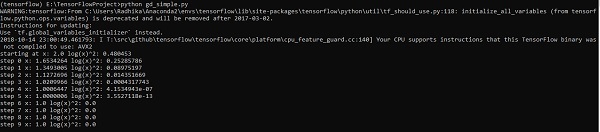
我们可以看到,必要时段和迭代次数按输出所示计算出来。
广告