
- 数据结构与算法
- DSA - 首页
- DSA - 概述
- DSA - 环境搭建
- DSA - 算法基础
- DSA - 渐进分析
- 数据结构
- DSA - 数据结构基础
- DSA - 数据结构和类型
- DSA - 数组数据结构
- 链表
- DSA - 链表数据结构
- DSA - 双向链表数据结构
- DSA - 循环链表数据结构
- 栈和队列
- DSA - 栈数据结构
- DSA - 表达式解析
- DSA - 队列数据结构
- 搜索算法
- DSA - 搜索算法
- DSA - 线性搜索算法
- DSA - 二分搜索算法
- DSA - 插值搜索
- DSA - 跳跃搜索算法
- DSA - 指数搜索
- DSA - 斐波那契搜索
- DSA - 子列表搜索
- DSA - 哈希表
- 排序算法
- DSA - 排序算法
- DSA - 冒泡排序算法
- DSA - 插入排序算法
- DSA - 选择排序算法
- DSA - 归并排序算法
- DSA - 希尔排序算法
- DSA - 堆排序
- DSA - 桶排序算法
- DSA - 计数排序算法
- DSA - 基数排序算法
- DSA - 快速排序算法
- 图数据结构
- DSA - 图数据结构
- DSA - 深度优先遍历
- DSA - 广度优先遍历
- DSA - 生成树
- 树数据结构
- DSA - 树数据结构
- DSA - 树的遍历
- DSA - 二叉搜索树
- DSA - AVL树
- DSA - 红黑树
- DSA - B树
- DSA - B+树
- DSA - 伸展树
- DSA - 字典树
- DSA - 堆数据结构
- 递归
- DSA - 递归算法
- DSA - 使用递归实现汉诺塔
- DSA - 使用递归实现斐波那契数列
- 分治法
- DSA - 分治法
- DSA - 最大最小问题
- DSA - Strassen矩阵乘法
- DSA - Karatsuba算法
- 贪心算法
- DSA - 贪心算法
- DSA - 旅行商问题(贪心算法)
- DSA - Prim最小生成树
- DSA - Kruskal最小生成树
- DSA - Dijkstra最短路径算法
- DSA - 地图着色算法
- DSA - 分数背包问题
- DSA - 带截止日期的作业调度
- DSA - 最佳合并模式算法
- 动态规划
- DSA - 动态规划
- DSA - 矩阵链乘法
- DSA - Floyd-Warshall算法
- DSA - 0-1背包问题
- DSA - 最长公共子序列算法
- DSA - 旅行商问题(动态规划)
- 近似算法
- DSA - 近似算法
- DSA - 顶点覆盖算法
- DSA - 集合覆盖问题
- DSA - 旅行商问题(近似算法)
- 随机化算法
- DSA - 随机化算法
- DSA - 随机化快速排序算法
- DSA - Karger最小割算法
- DSA - Fisher-Yates洗牌算法
- DSA 有用资源
- DSA - 问答
- DSA - 快速指南
- DSA - 有用资源
- DSA - 讨论
C语言中的深度优先遍历
我们将不会看到C编程语言中深度优先遍历(或深度优先搜索)的实现。为了参考,我们将遵循我们的示例并将其作为我们的图模型:
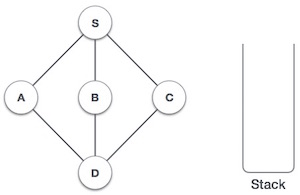
C语言实现
#include <stdio.h>
#include <stdlib.h>
#include <stdbool.h>

#define MAX 5

struct Vertex {
   char label;
   bool visited;
};

//stack variables

int stack[MAX];
int top = -1;

//graph variables

//array of vertices
struct Vertex* lstVertices[MAX];

//adjacency matrix
int adjMatrix[MAX][MAX];

//vertex count
int vertexCount = 0;

//stack functions

void push(int item) {
   stack[++top] = item;
}

int pop() {
   return stack[top--];
}

int peek() {
   return stack[top];
}

bool isStackEmpty() {
   return top == -1;
}

//graph functions

//add vertex to the vertex list
void addVertex(char label) {
   struct Vertex* vertex = (struct Vertex*) malloc(sizeof(struct Vertex));
   vertex->label = label;
   vertex->visited = false;
   lstVertices[vertexCount++] = vertex;
}

//add edge to edge array
void addEdge(int start,int end) {
   adjMatrix[start][end] = 1;
   adjMatrix[end][start] = 1;
}

//display the vertex
void displayVertex(int vertexIndex) {
   printf("%c ",lstVertices[vertexIndex]->label);
}

//get the adjacent unvisited vertex
int getAdjUnvisitedVertex(int vertexIndex) {
   int i;

   for(i = 0; i < vertexCount; i++) {
      if(adjMatrix[vertexIndex][i] == 1 && lstVertices[i]->visited == false) {
         return i;
      }
   }

   return -1;
}

void depthFirstSearch() {
   int i;

   //mark first node as visited
   lstVertices[0]->visited = true;

   //display the vertex
   displayVertex(0);

   //push vertex index in stack
   push(0);

   while(!isStackEmpty()) {
      //get the unvisited vertex of vertex which is at top of the stack
      int unvisitedVertex = getAdjUnvisitedVertex(peek());

      //no adjacent vertex found
      if(unvisitedVertex == -1) {
         pop();
      } else {
         lstVertices[unvisitedVertex]->visited = true;
         displayVertex(unvisitedVertex);
         push(unvisitedVertex);
      }
   }

   //stack is empty, search is complete, reset the visited flag
   for(i = 0;i < vertexCount;i++) {
      lstVertices[i]->visited = false;
   }
}

int main() {
   int i, j;

   for(i = 0; i < MAX; i++) {   // set adjacency
      for(j = 0; j < MAX; j++) // matrix to 0
         adjMatrix[i][j] = 0;
   }

   addVertex('S');   // 0
   addVertex('A');   // 1
   addVertex('B');   // 2
   addVertex('C');   // 3
   addVertex('D');   // 4

   addEdge(0, 1);    // S - A
   addEdge(0, 2);    // S - B
   addEdge(0, 3);    // S - C
   addEdge(1, 4);    // A - D
   addEdge(2, 4);    // B - D
   addEdge(3, 4);    // C - D

   printf("Depth First Search: ");
   depthFirstSearch();

   return 0;
}
如果我们编译并运行上述程序,它将产生以下结果:
输出
Depth First Search: S A D B C
depth_first_traversal.htm
广告